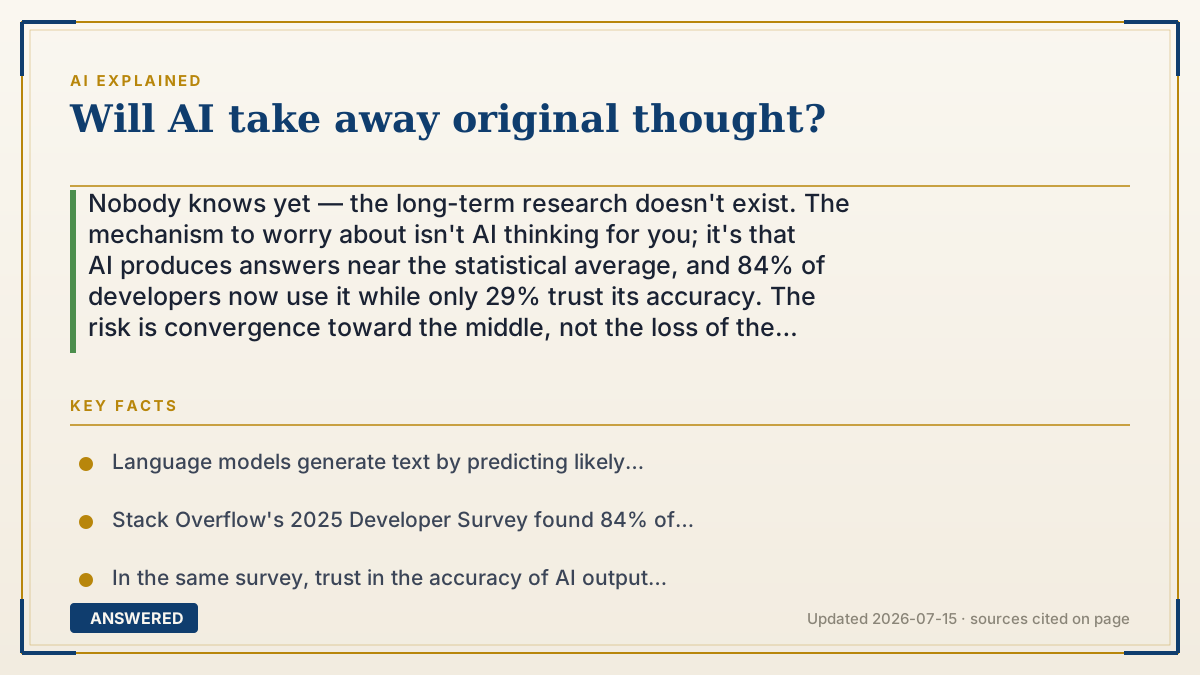
Will AI take away original thought?
Nobody knows yet — the long-term research doesn't exist. The mechanism to worry about isn't AI thinking for you; it's that AI produces answers near the statistical average, and 84% of developers now use it while only 29% trust its accuracy. The risk is convergence toward the middle, not the loss of the ability to think.
Why — the first-principles explanation
This question deserves an honest "we don't know," because the studies that would answer it need years of longitudinal data on tools that are three years old. Anyone telling you AI definitely will or won't damage original thinking is expressing a temperament. But the mechanism is worth understanding, because it's specific and it isn't what most people fear.
A language model generates text by predicting likely continuations. "Likely" means near the statistical center of everything it read. So its default output is, almost by construction, the consensus view expressed in the consensus way. Ask a hundred people to brainstorm with the same model and you don't get a hundred perspectives converging on truth — you get a hundred people receiving a similar draft of the middle. The danger isn't that any individual answer is bad. Most are fine. It's variance collapse: the outliers, the weird framings, the bad ideas that turn out to be good, get quietly filtered before anyone sees them. Originality lives in the tails, and the tails are exactly what a plausibility-maximizer trims.
The second mechanism is effort substitution. Thinking is largely the experience of struggling — sitting with a problem long enough that your assumptions crack. If a competent draft appears in two seconds, the struggle never happens. There's a real analogy to navigation: turn-by-turn directions get you there, and you never learn the city. But be careful with that analogy, because it cuts both ways. Nobody laments losing the ability to do long division, and calculators didn't kill mathematics. Some cognitive offloading is pure gain. We don't yet know which category writing falls into, and that's a genuine open question rather than a rhetorical one.
There's a hopeful signal, though, in how practitioners actually behave. Stack Overflow's 2025 survey found 84% of developers use or plan to use AI tools while trust in its accuracy fell to 29%, and 66% named their top frustration as answers that are "almost right, but not quite." That is not a picture of people outsourcing their judgment. That's a picture of people using a fast, unreliable assistant and staying skeptical. Heavy use plus falling trust is roughly what healthy tool use looks like.
The practical read: AI won't take your original thought. It will offer, constantly and convincingly, to save you from the discomfort where original thought happens. Whether that matters depends entirely on when you accept the offer.
An example that makes it click
Imagine a town where everyone gets their dinner recipes from one very good cook. The food is genuinely good — better than what most people were making. Nobody's poisoned. Nobody's unhappy.
But ten years on, the town has one cuisine. Not because the cook banned anything, and not because anyone forgot how to cook. Because every night, at 6pm, there was a good-enough answer already on the counter, and improvising cost effort that suddenly had no reward. The grandmother's weird soup with the burnt lemon? Nobody made it. It wasn't outlawed. It was just slower than the alternative.
How to do it
- Think first, prompt second. Write your own rough take before you ask — 90 seconds of your own thinking is the whole intervention.
- Use AI to attack your idea, not to generate it. 'Here's my argument, find the three weakest points' preserves your thinking and borrows its breadth.
- Ask for the distribution, not the answer: 'give me five approaches including two most people would reject.' This deliberately fights variance collapse.
- Notice when the first draft is good enough and you stopped. That moment is exactly where the cost is paid.
- Keep at least one domain deliberately unassisted — the thing you want to actually be good at. Struggle is the mechanism, not a side effect.
- Treat 'almost right' as the default assumption. 66% of developers name it as their top frustration; skepticism is the professional posture, not paranoia.
Key facts
- Language models generate text by predicting likely continuations, which places default output near the statistical center of their training data rather than at the extremes where novelty lives.
- Stack Overflow's 2025 Developer Survey found 84% of developers use or plan to use AI tools, up from 76% the prior year, and 51% of professional developers use them daily.
- In the same survey, trust in the accuracy of AI output fell to 29%, down from 40% — heavy adoption coexisting with rising skepticism.
- 66% of developers cited 'AI solutions that are almost right, but not quite' as their biggest frustration; 45% said debugging AI-generated code takes more time.
- As of 2026-07, no long-term longitudinal study establishes whether generative AI use degrades original thinking; widely-used tools are only about three years old.
- The GEO study demonstrates that generative engines reward and reproduce content that is statistically citable, illustrating the mechanism by which AI systems favor consensus material.
▶ The 60-second explainer (script)
Will AI take away original thought? Honest answer: nobody knows. The studies that would tell us need years of data on tools that are three years old. Anyone who's certain either way is describing their mood. But the mechanism is real, and it's not what you think. It's not that AI thinks for you. It's that a language model predicts likely continuations — and "likely" means near the statistical center of everything it read. So its default answer is the consensus view, phrased the consensus way. Ask a hundred people to brainstorm with the same model, and you don't get a hundred perspectives. You get a hundred people handed a similar draft of the middle. The risk isn't that any one answer is bad. Most are fine. It's variance collapse. Originality lives in the tails — and the tails are exactly what a plausibility machine trims. Picture a town where everyone gets recipes from one very good cook. The food's genuinely good. Nobody's unhappy. Ten years later the town has one cuisine — not because anything was banned, but because every night at six there was a good-enough answer already on the counter, and the grandmother's weird burnt-lemon soup was just slower than the alternative. But here's the hopeful part. Developers use AI at eighty-four percent — while trust in its accuracy fell to twenty-nine. That's not outsourced judgment. That's people using a fast, unreliable assistant and staying skeptical. So: AI won't take your original thought. It'll offer, constantly, to save you from the discomfort where original thought happens. The question is when you say yes.
What authoritative sources say
People also ask
Is there evidence AI makes people less creative?
No settled evidence either way. The tools are roughly three years old and the relevant longitudinal studies don't exist yet. Treat confident claims in both directions as speculation.
Isn't this just like calculators and math?
Maybe. Calculators offloaded a mechanical step and mathematics thrived. But arithmetic isn't where mathematical insight lived, and it's genuinely unclear whether drafting is where writing's insight lives. That's the open question.
Why would AI push everyone toward the same ideas?
Because it predicts likely continuations, and likely means near the average of its training data. It's not censoring outliers — it's just never the first to suggest them, and most people stop at the first suggestion.
How do I use AI without flattening my thinking?
Form your own take before prompting, then use AI to attack it rather than generate it. Ask explicitly for approaches most people would reject — that fights the pull toward the middle.
Are people actually outsourcing their judgment to AI?
The data suggests not yet. Developers use AI at 84% while trust in its accuracy sits at 29%. Heavy use combined with falling trust looks like skeptical tool use, not surrender.