Will AI take my job?
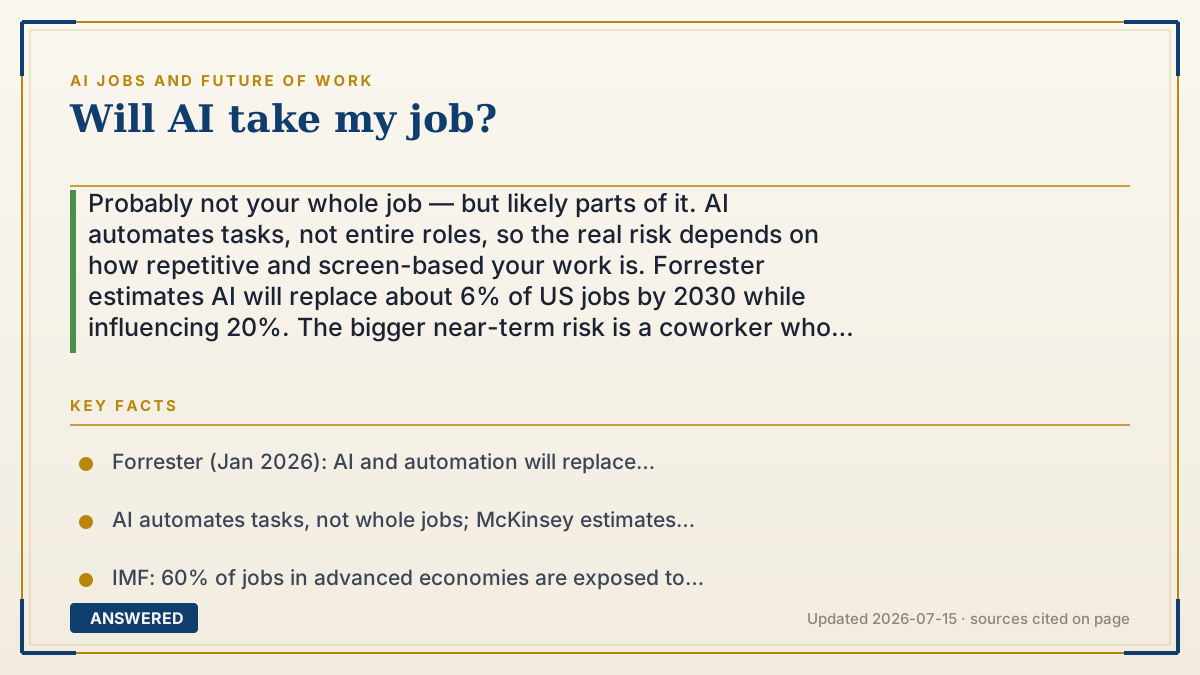
Probably not your whole job — but likely parts of it. AI automates tasks, not entire roles, so the real risk depends on how repetitive and screen-based your work is. Forrester estimates AI will replace about 6% of US jobs by 2030 while influencing 20%. The bigger near-term risk is a coworker who uses AI outpacing you.
Why — the first-principles explanation
The honest way to answer "will AI take my job" is to stop thinking about your job title and start thinking about your tasks. AI doesn't decide to fire a "marketing manager"; it gets good at specific tasks — writing copy, sorting data, making slides. Whether you're at risk depends on what fraction of your day is made of tasks AI can now do well, and whether the rest is enough to justify your role.
AI is strongest on work that is repetitive, rule-based, and done through a screen, and weakest on work that needs physical presence, human judgment, relationships, or accountability. So a job that's 80% routine document processing is far more exposed than one that's 80% negotiating with people or fixing physical things. Forrester's 2026 forecast captures this split: it expects AI to replace about 6% of US jobs by 2030 but influence about 20% — meaning for most people the change is a reshaped job, not a pink slip.
There's a second, closer risk most people miss. In the next few years, you're less likely to be replaced by AI directly than by a colleague who uses AI well. If AI lets one skilled person do the work of three, two roles may vanish — and the survivor is the one who mastered the tools. That flips the takeaway: the question isn't just "can AI do my tasks" but "am I the person using AI to do more."
An example that makes it click
Picture a graphic designer worried about AI image tools. AI can now generate a decent logo draft in seconds — that's a real chunk of the old job gone. But AI can't sit with a client to understand their brand, judge which of fifty drafts actually fits the culture, or take responsibility when the final choice ships.
So the designer who only cranked out simple graphics is exposed. The designer who uses AI to produce fifty drafts in an hour, then applies taste and client relationships to pick the right one, just got faster and more valuable. Same job title, opposite outcomes — decided entirely by whether they command the tool or compete with it.
How to do it
- List your weekly tasks and estimate what percent are repetitive and screen-based versus judgment, physical, or relationship-driven.
- If most tasks are routine and digital, treat that as a signal to reshape your role toward the human-heavy parts.
- Start using the leading AI tools in your field so you're the one directing them, not being outpaced by those who do.
- Deepen the parts AI can't copy: client trust, complex decisions, hands-on skill, leadership.
- Keep learning — the WEF says 39% of skills will shift by 2030, so ongoing reskilling is the real job security.
Key facts
- Forrester (Jan 2026): AI and automation will replace about 6.1% of US jobs by 2030 — roughly 10.4 million — while influencing about 20%.
- AI automates tasks, not whole jobs; McKinsey estimates up to 30% of US work hours are automatable, mostly reshaping roles.
- IMF: 60% of jobs in advanced economies are exposed to AI, but about half could be enhanced rather than replaced.
- WEF: 39% of workers' skills are expected to change between 2025 and 2030.
- The nearer-term risk for many workers is being outcompeted by colleagues who use AI, not replaced by AI directly.
▶ The 60-second explainer (script)
Will AI take my job? Here's the honest answer: probably not your whole job — but likely parts of it. Stop thinking about your job title and think about your tasks. AI doesn't fire a marketing manager; it gets good at specific tasks like writing copy or making slides. So your risk depends on how much of your day is repetitive and screen-based versus how much needs judgment, hands, or human trust. Forrester's 2026 forecast expects AI to replace about six percent of US jobs by 2030, but influence about twenty percent — so for most people it's a reshaped job, not a layoff. And here's the risk people miss: in the next few years, you're more likely to be replaced by a coworker who uses AI well than by AI itself. If AI lets one person do the work of three, the survivor is the one who mastered the tools. So audit your tasks, lean into the human parts, and start commanding AI — that's how you make sure the answer stays no.
What authoritative sources say
People also ask
How do I know if my job is at risk from AI?
Estimate what share of your tasks are repetitive and screen-based. The higher that share, the more exposed you are. Judgment, physical, and relationship work is far safer.
Is AI more likely to replace or reshape my job?
Reshape. Forrester expects AI to influence about 20% of US jobs but replace only about 6% by 2030, so most people will see their role change, not disappear.
What's the fastest way to protect my job?
Learn the AI tools used in your field so you're the one directing them. The near-term risk is being outpaced by colleagues who use AI, not AI itself.
Which jobs are most likely to be taken by AI?
Routine, digital roles — data entry, basic bookkeeping, clerical support, and simple content production — face the highest automation risk through 2030.