Are AI detectors accurate in 2026?
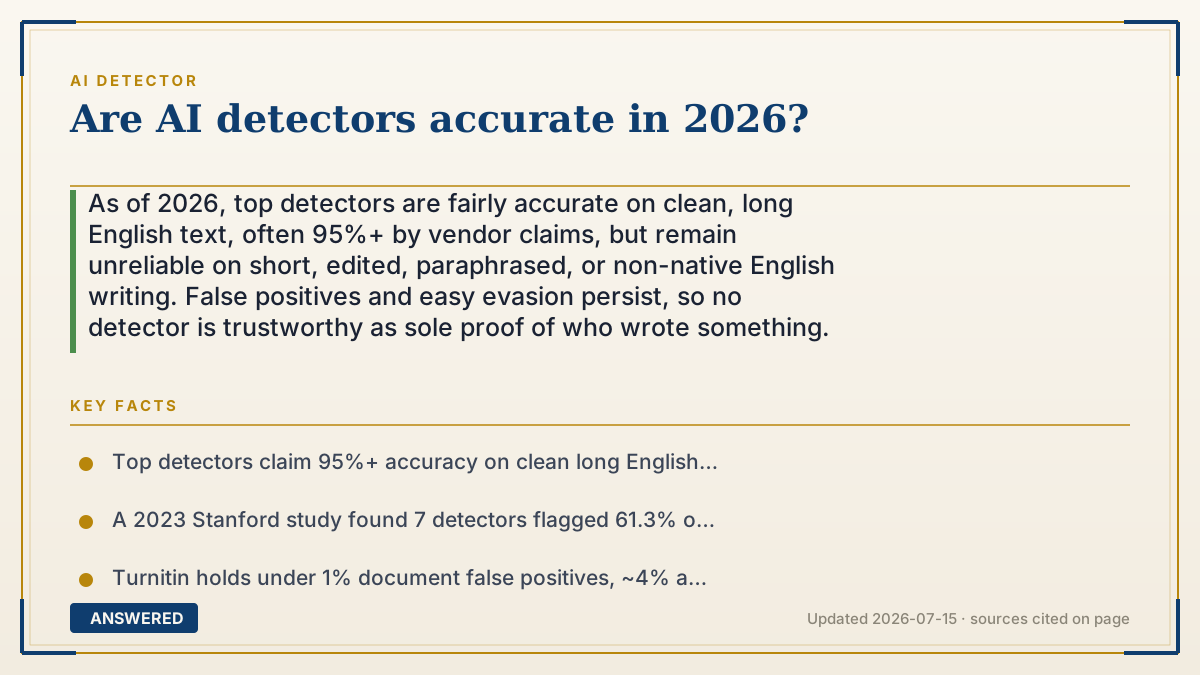
As of 2026, top detectors are fairly accurate on clean, long English text, often 95%+ by vendor claims, but remain unreliable on short, edited, paraphrased, or non-native English writing. False positives and easy evasion persist, so no detector is trustworthy as sole proof of who wrote something.
Why — the first-principles explanation
Detection accuracy in 2026 is a moving target because it's the product of an arms race. Every time language models get more fluent and human-like, the statistical gap that detectors rely on, low perplexity, uniform rhythm, narrows. Detector makers respond by retraining on the newest AI output, so accuracy on last year's models improves while accuracy on the very latest models temporarily dips. There is no stable "accuracy number" that holds across all inputs and model versions.
What has stayed constant is the shape of the errors. Detectors still work by measuring predictability rather than authorship, so they still generate false positives on plain, formulaic, or non-native English writing and still get fooled by paraphrasing and humanizer tools. The 2023 Stanford finding, that seven detectors flagged 61% of non-native essays as AI, reflects a structural bias that better models reduce but don't eliminate. Turnitin's conservative tuning (under 1% document false positives, ~4% at the sentence level, missing ~15% of AI text) illustrates that even a mature tool trades accuracy against fairness.
So the accurate summary for 2026 is: detectors are a useful signal on long-form English essays and a poor proof in every context. Vendors publish high accuracy on their own clean test sets, but independent testing and the fact that OpenAI abandoned its own detector show the real-world number is lower and highly input-dependent. Best practice hasn't changed, use detectors to raise questions, never to settle them.
An example that makes it click
Think of weather forecasting. In 2026 it's genuinely good for tomorrow in a stable climate, but still shaky for two weeks out or during a freak storm. Nobody cancels a wedding on a single 60% chance of rain.
AI detectors are like that forecast. On a plain, long English essay they're reasonably good. On short text, edited text, or a non-native writer, they're the two-week forecast, still just a probability. You use them to prepare and ask questions, not to make an irreversible decision from one reading.
Key facts
- Top detectors claim 95%+ accuracy on clean long English text, but real-world accuracy is lower and input-dependent.
- A 2023 Stanford study found 7 detectors flagged 61.3% of non-native English essays as AI; the bias persists in 2026.
- Turnitin holds under 1% document false positives, ~4% at sentence level, while missing ~15% of AI text.
- Detectors are retrained continuously as new AI models appear, so accuracy shifts over time.
- OpenAI's own detector caught only 26% of AI text before shutting down in 2023, illustrating the difficulty.
▶ The 60-second explainer (script)
Are AI detectors accurate in 2026? On clean, long English essays, the top tools are fairly good, vendors claim over ninety-five percent. But that number is a best case, and it falls apart on hard inputs: short passages, edited or paraphrased text, and writing by non-native English speakers. The reason accuracy keeps shifting is that this is an arms race. Every time AI models sound more human, the gap detectors rely on shrinks, so makers retrain, and accuracy on the newest models temporarily dips. What hasn't changed is the type of error. Detectors still measure predictability, not authorship, so they still produce false positives on plain writing and still get fooled by paraphrasing. A 2023 Stanford study found detectors wrongly flagged sixty-one percent of non-native essays, and that bias is still with us. So in 2026, treat detectors as a useful signal on long English text, but never as proof of who wrote something.
What authoritative sources say
People also ask
Have detectors gotten better by 2026?
Yes on older AI models, but the newest, more human-like models are harder to catch, so accuracy is a moving target rather than a fixed number.
Can I trust a detector in 2026 to prove cheating?
No. False positives and easy evasion persist, and vendors and universities still warn against using a score as sole proof.
Which inputs are detectors least accurate on?
Short passages, heavily edited or paraphrased text, and writing by non-native English speakers, where false positives spike.
Do all detectors agree in 2026?
No. They use different models and thresholds, so the same text can get very different scores across tools.