Can professors detect ChatGPT?
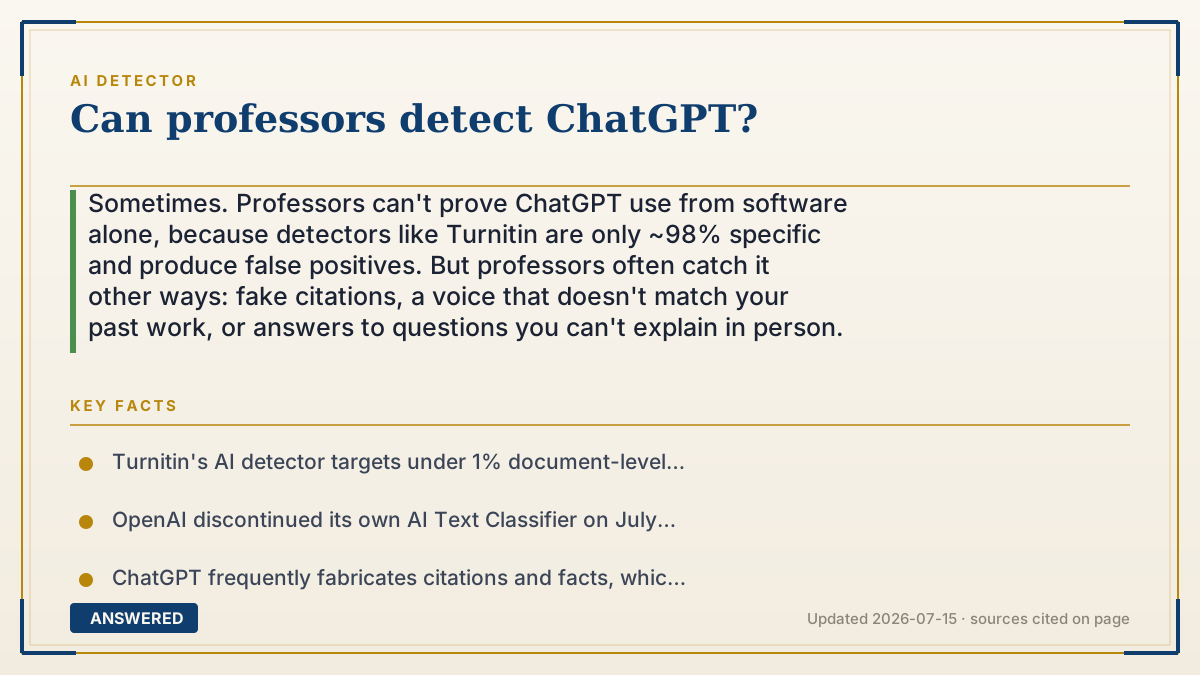
Sometimes. Professors can't prove ChatGPT use from software alone, because detectors like Turnitin are only ~98% specific and produce false positives. But professors often catch it other ways: fake citations, a voice that doesn't match your past work, or answers to questions you can't explain in person.
Why — the first-principles explanation
There are two separate questions hiding inside "can professors detect ChatGPT": can a tool detect it, and can a person detect it. They have very different answers.
Tools are unreliable. AI detectors measure statistical smoothness (perplexity) and rhythm (burstiness), not authorship. They output a probability, and vendors openly warn that probability isn't proof. Turnitin keeps false positives under 1% at the document level but still misses about 15% of real AI text, and its sentence-level error rate is around 4%. So a professor who relies only on a detector score is standing on shaky ground, and many universities, including Vanderbilt, have disabled these tools entirely.
Humans catch different signals. ChatGPT loves to invent citations that don't exist, state confident facts that are wrong, and write in a generic, evenly-polished voice. A professor who has read your earlier essays notices when your style suddenly changes. The strongest "detector" of all is a conversation: if you can't explain your own argument, define your own terms, or reproduce your reasoning on the spot, that tells a professor far more than any percentage score. This is why oral defenses, in-class writing, and "explain your draft" meetings are becoming common.
An example that makes it click
Think of a substitute art teacher grading a painting. A gadget that scans brushstroke smoothness might guess "this looks machine-made," but it's often wrong. What really gives a student away is when the teacher asks, "Why did you use blue here?" and the kid has no idea, or when the painting is suddenly ten times better than last week's with no explanation.
Professors work the same way. The software is the weak clue. The strong clue is a made-up source, a fact that's flat wrong, or a student who can't talk about their own paper.
Key facts
- Turnitin's AI detector targets under 1% document-level false positives but misses about 15% of AI-generated text (false negatives).
- OpenAI discontinued its own AI Text Classifier on July 20, 2023 because it caught only 26% of AI text.
- ChatGPT frequently fabricates citations and facts, which professors can verify directly, unlike detector scores.
- Many institutions, including Vanderbilt University (Aug 2023), have disabled Turnitin's AI detector over reliability concerns.
- A 2023 Stanford study found detectors flag non-native English writers as AI at far higher rates, undermining tool-based accusations.
▶ The 60-second explainer (script)
Can professors detect ChatGPT? Sometimes, but probably not the way you'd guess. Detection software like Turnitin is unreliable. It measures how predictable your writing is, not who actually wrote it, and it produces false positives, so most professors can't prove AI use from a score alone. Here's what actually gives students away. ChatGPT loves inventing citations for books and studies that don't exist. It states facts confidently that turn out wrong. And it writes in a generic, evenly-polished voice that suddenly doesn't match your earlier work. The single most powerful detector is a conversation. If a professor asks you to explain your own argument and you can't, that's more convincing than any percentage. So the real answer: the tool is weak, but a professor who reads your past work and asks you questions is surprisingly strong.
What authoritative sources say
People also ask
Can professors tell if I used ChatGPT?
Not with certainty from software. They can suspect it from detector scores, fabricated citations, wrong facts, or a voice that doesn't match your prior work, then ask you to explain your draft.
Does ChatGPT get flagged by Turnitin?
Often, but not always. Turnitin misses about 15% of AI text, and lightly edited or paraphrased AI writing is harder for it to catch.
Can I be failed based only on a detector score?
Policies vary, but many universities forbid using detector scores as sole proof because of false positives. Ask for the specific evidence.
What's the biggest giveaway of ChatGPT use?
Invented sources and facts. Professors can check whether a cited study actually exists, which no detector score can match for reliability.