Can AI detectors be wrong?
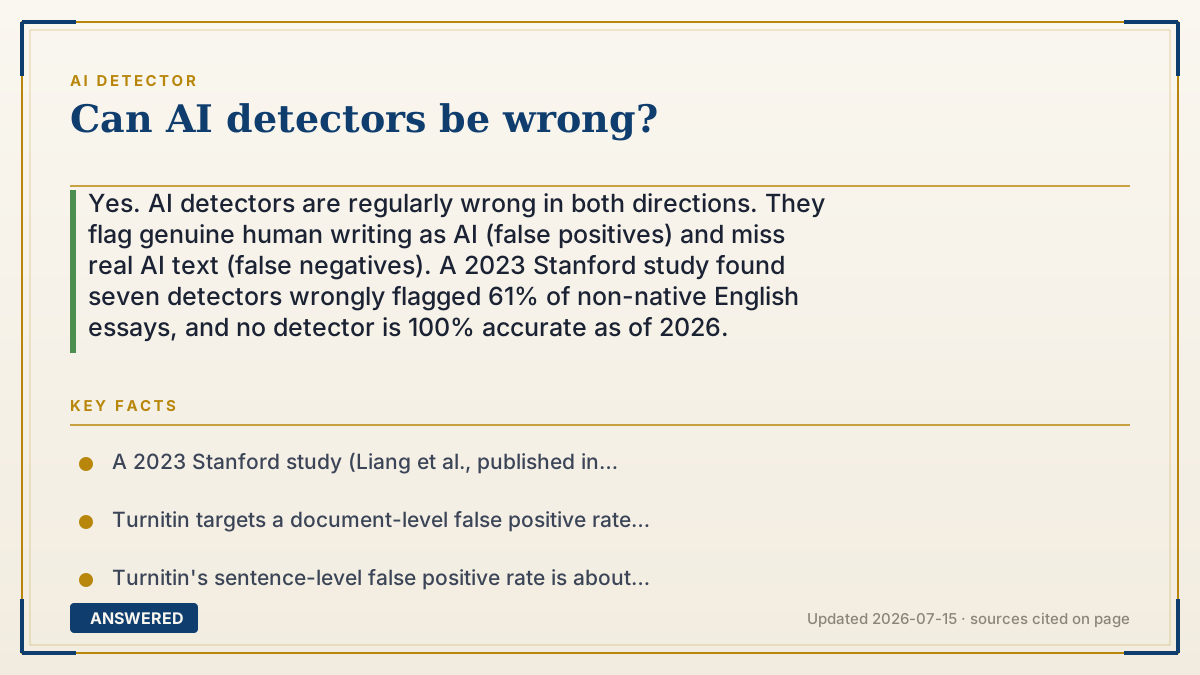
Yes. AI detectors are regularly wrong in both directions. They flag genuine human writing as AI (false positives) and miss real AI text (false negatives). A 2023 Stanford study found seven detectors wrongly flagged 61% of non-native English essays, and no detector is 100% accurate as of 2026.
Why — the first-principles explanation
AI detectors do not "know" who wrote something. They are statistical models that guess. Most work by measuring two things: perplexity (how predictable each word is) and burstiness (how much sentence length and rhythm vary). AI language models are trained to pick the most likely next word, so their output tends to be smooth and predictable. Detectors treat that smoothness as a fingerprint of machine writing.
The problem is that plenty of humans write smoothly too. A student who writes clear, simple, grammatically clean prose produces low-perplexity text that looks exactly like what a detector expects from AI. There is no hard line between "predictable because a machine wrote it" and "predictable because a careful person wrote it," so the detector has to draw a threshold and accept that some honest writers will land on the wrong side.
Because of this, every detector faces a trade-off. Turn sensitivity up and you catch more AI but falsely accuse more humans. Turn it down and you protect humans but miss more AI. Turnitin tunes its tool to keep document-level false positives under 1%, which means it deliberately misses roughly 15% of AI text. Even a 1% error rate means real people get flagged: Vanderbilt University noted that at 75,000 papers a year, a 1% rate could wrongly flag about 750 papers.
An example that makes it click
Imagine a smoke alarm that beeps when the air looks "too clean and still," because it assumes real cooking makes messy, uneven smoke. Most of the time it's right. But a person who cooks very neatly with no smoke sets off no alarm, while a still, quiet kitchen with steam from a kettle triggers it by mistake.
That's an AI detector. It listens for "too smooth" writing. A careful human who writes plainly can trip the alarm, and a clever cheater who roughs up their AI text can slip past it silently. The beep is a guess, not proof.
Key facts
- A 2023 Stanford study (Liang et al., published in Patterns) found 7 GPT detectors flagged 61.3% of non-native English TOEFL essays as AI-written, versus about 5.1% for native writers.
- Turnitin targets a document-level false positive rate under 1%, verified against 700,000 pre-ChatGPT papers.
- Turnitin's sentence-level false positive rate is about 4%, higher than the document rate.
- OpenAI's own AI Text Classifier correctly flagged only 26% of AI text and wrongly flagged 9% of human text before being shut down on July 20, 2023.
- No AI detector on the market as of 2026 claims 100% accuracy; all publish or acknowledge error rates.
▶ The 60-second explainer (script)
Yes, AI detectors can absolutely be wrong, and they're wrong more often than most people think. Here's why. A detector doesn't actually know who wrote your text. It measures how predictable your word choices are and how much your sentence rhythm varies. AI writing tends to be smooth and predictable, so detectors treat smoothness as guilt. The catch? Lots of humans write smoothly too. In one Stanford study, seven detectors wrongly flagged sixty-one percent of essays by non-native English speakers as AI. Even Turnitin, which keeps false positives under one percent, admits it misses about fifteen percent of real AI text to stay that careful. And OpenAI shut down its own detector because it caught only twenty-six percent of AI writing. So a detector score is a probability, not proof. If you're ever flagged, treat it as a starting question, never a verdict.
What authoritative sources say
People also ask
How often are AI detectors wrong?
It varies by tool and text. Document-level false positives are often 1-4%, but studies show error rates jump sharply for non-native English writers and short passages, sometimes above 50%.
Can a detector be 100% sure?
No. Every detector outputs a probability or percentage, not proof. Vendors themselves warn scores should not be used as sole evidence of cheating.
Which is more common, false positives or false negatives?
It depends on how the tool is tuned. Turnitin is tuned to minimize false positives, so it produces more false negatives, missing about 15% of AI text.
Does a high AI score mean I cheated?
No. It means the text statistically resembles AI writing. Clean, simple, or formulaic human writing can score high without any AI use.