Are AI detectors biased against non-native english speakers?
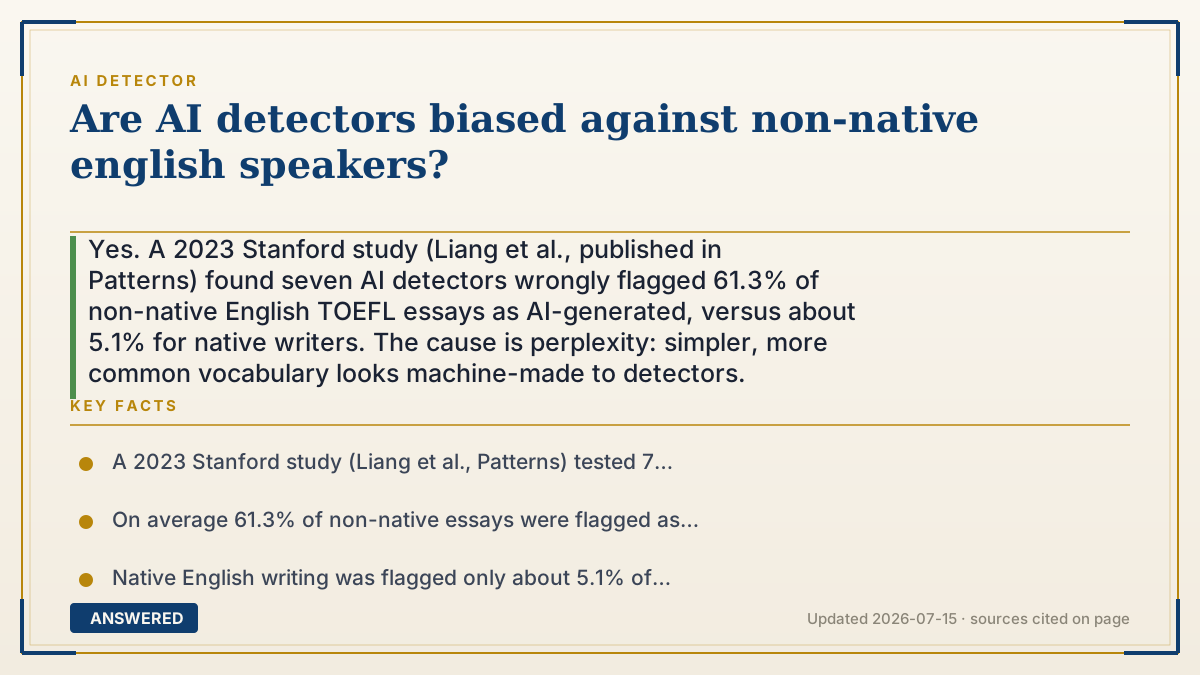
Yes. A 2023 Stanford study (Liang et al., published in Patterns) found seven AI detectors wrongly flagged 61.3% of non-native English TOEFL essays as AI-generated, versus about 5.1% for native writers. The cause is perplexity: simpler, more common vocabulary looks machine-made to detectors.
Why — the first-principles explanation
The bias is a direct, almost mechanical result of how detectors judge text. They score writing by perplexity, how surprising or predictable each word is. Text full of common, expected words gets low perplexity, and detectors read low perplexity as a sign of AI. This rule has nothing to do with who actually wrote the words; it only cares about statistical predictability.
Non-native English writers, by the nature of learning a second language, tend to draw from a smaller, more common vocabulary and use more standard sentence constructions. That's not a flaw in their writing, it's a feature of fluency-in-progress, but it produces exactly the low-perplexity signature the detector distrusts. So the detector systematically mistakes "limited vocabulary range" for "written by a machine." The Stanford team confirmed this: across seven detectors, 61.3% of TOEFL essays by non-native speakers were flagged, one detector flagged nearly 98%, while native-speaker essays were flagged only about 5% of the time.
The study also showed the bias is fixable in a revealing way: asking a model to rewrite the non-native essays with richer vocabulary dropped the false-positive rate sharply. That proves the detectors were keying on language sophistication, not authorship. The same mechanism penalizes neurodivergent writers and anyone using plain, formulaic English. This is why universities and researchers warn that detector scores can discriminate and should never be used as standalone evidence of misconduct.
An example that makes it click
Imagine a bouncer who decides who's 'a local' based only on how fancy their slang is. A tourist who speaks careful, textbook English gets turned away as 'fake,' while a local who mumbles casually gets waved in, even though the tourist is a perfectly real person.
AI detectors judge like that bouncer. They treat plain, careful English, exactly what many second-language writers produce, as 'fake' (AI). The writing is completely genuine; it just uses simpler words, and the detector wrongly reads simplicity as machine-made.
Key facts
- A 2023 Stanford study (Liang et al., Patterns) tested 7 detectors on 91 non-native TOEFL essays.
- On average 61.3% of non-native essays were flagged as AI; one detector flagged nearly 98%.
- Native English writing was flagged only about 5.1% of the time by the same detectors.
- The cause is perplexity: simpler, more common vocabulary produces the low-perplexity signal detectors treat as AI.
- Rewriting the essays with richer vocabulary sharply reduced false positives, confirming the bias is language-based.
▶ The 60-second explainer (script)
Are AI detectors biased against non-native English speakers? Yes, and there's hard evidence. A 2023 Stanford study published in the journal Patterns ran essays by non-native English speakers through seven different detectors. On average, sixty-one percent were wrongly flagged as AI-generated. One detector flagged almost ninety-eight percent. Meanwhile, essays by native speakers were flagged only about five percent of the time. Why? Detectors score writing by perplexity, how predictable the words are. Common, simple vocabulary gets a low score, and detectors read low perplexity as a sign of a machine. Non-native writers naturally use a smaller, more common vocabulary, so they trip the alarm, not because they cheated, but because their English is plainer. The researchers even proved it: rewriting those essays with fancier words made the false positives drop. So the tools are really detecting language sophistication, not authorship, which is why they should never be used as sole proof.
What authoritative sources say
People also ask
Why are non-native writers flagged more often?
They tend to use simpler, more common vocabulary, which produces low perplexity, the exact signal detectors treat as AI-generated.
How big is the bias?
In the Stanford study, 61.3% of non-native essays were flagged versus about 5.1% of native essays, more than a tenfold gap.
Does the bias affect other groups too?
Yes. Neurodivergent writers and anyone using plain, formulaic English can be over-flagged for the same low-perplexity reason.
Can non-native writers protect themselves?
Keep drafts and version history as proof of authorship, and if flagged, cite the documented bias when requesting human review.
The same question, asked other ways
- Why do AI detectors flag non-native english writing?
- Do AI detectors falsely flag non-native english writing?
- Do AI detectors flag non-native English speakers?