Will AI replace lawyers?
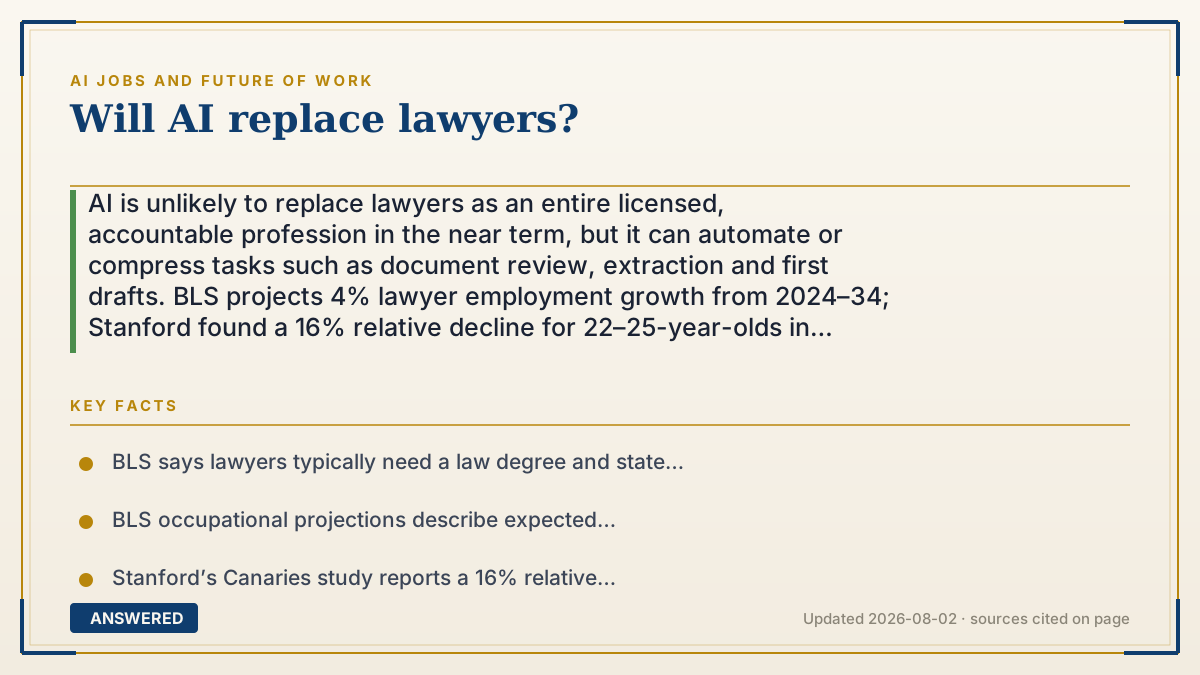
AI is unlikely to replace lawyers as an entire licensed, accountable profession in the near term, but it can automate or compress tasks such as document review, extraction and first drafts. BLS projects 4% lawyer employment growth from 2024–34; Stanford found a 16% relative decline for 22–25-year-olds in the most AI-exposed occupations, while Yale found no discernible economy-wide disruption after 33 months. None of those findings is a lawyer-specific replacement forecast.
Why — the first-principles explanation
“Lawyer” is an occupation made of tasks, responsibilities and a regulated relationship, not one text-generation task. A tool can search documents, extract clauses, compare versions, summarize a record or propose a draft without becoming the person who decides a client’s objectives, interprets uncertain facts, negotiates, advocates, signs a filing or owes professional duties. Analyze task exposure plus adoption and supervision, not a headline about an entire profession. In the United States, lawyers generally need a state license, and ABA Formal Opinion 512 says duties concerning competence, confidentiality, client communication and reasonable fees continue to apply when lawyers use generative AI. That is guidance tied to ABA Model Rules, not identical law in every jurisdiction; state bars and courts can impose more rules. The labor evidence answers different questions. BLS projects 4% growth for lawyers from 2024 to 2034, but that is an occupational projection, not proof AI caused or will prevent growth. Stanford reports a 16% relative employment decline for workers aged 22–25 in the most AI-exposed occupations after controlling for firm-level shocks; it is broad evidence about early-career workers, not a lawyer estimate. Yale’s Budget Lab found no discernible economy-wide labor-market disruption in the first 33 months after ChatGPT’s release and cautioned that exposure measures are theoretical and data is limited. These findings can coexist: entry-level pathways may tighten in selected tasks while the profession remains employed overall. High-volume, structured and checkable legal tasks—document classification, discovery triage, clause extraction, chronology, first-pass research, standard-form comparison and draft generation—are easier to automate or augment. Issue spotting, negotiation preparation and client-intake organization can be augmented, but a reviewer must verify authority, facts, privilege, deadlines, jurisdiction and strategic fit. Court advocacy, accountability, trust, negotiation and deciding what risk a client should accept are not interchangeable with fluent text. For a student, lawyer or firm buyer, measure accuracy on real documents, citation support, confidentiality, review time, error severity, client communication and total cost. Keep a human owner, approved data path, escalation rule and rollback plan. Do not infer career advice from one percentage, and do not treat this page as legal, employment or education advice for a particular person or jurisdiction.
An example that makes it click
A firm tests an AI tool on a contract-review queue. It correctly extracts renewal dates and missing indemnity clauses, cutting first-pass time. It also misses a definition that changes the governing law and cites a clause from the wrong version. The tool has automated a task, not replaced the lawyer. A licensed reviewer must verify source, privilege, jurisdiction, client objective and final advice; the firm must also assess vendor data handling and fees. The useful metric is verified risk-adjusted work completed, not raw draft volume.
How to do it
- Separate the question into tasks: intake, research, discovery, drafting, negotiation, advocacy, client advice, billing, supervision and compliance.
- Classify each task by repetition, data structure, need for judgment, consequence of error, jurisdictional variation and whether a human can reliably check the output.
- Keep BLS projections, Stanford early-career findings and Yale macro evidence in their original populations and dates; do not turn a broad statistic into a lawyer-specific forecast.
- Review the applicable bar, court, client, confidentiality, privilege, security, disclosure and fee rules before selecting a tool.
- Test the tool on representative matter files, including missing facts, conflicting authorities, unanswerable questions, long documents, adversarial instructions and wrong document versions.
- Require source-linked research and verify every citation, quotation, statute, case, date, calculation and jurisdiction. A polished draft is not a legal conclusion.
- Keep confidential or privileged information out of an unapproved service. Document retention, training, access, deletion, security and contracts and obtain any required informed consent.
- Set human review and escalation thresholds. Court filings, client advice, settlement positions, deadlines and high-impact decisions require a responsible lawyer.
- Measure quality, review time, error severity, rework, client outcome, privacy incidents and total cost against a baseline workflow.
- Update training and career plans around fact investigation, judgment, communication, negotiation, domain expertise, tool evaluation and supervision, and revisit them when models or rules change.
Key facts
- BLS says lawyers typically need a law degree and state license and projects 4% employment growth from 2024 to 2034, about as fast as average.
- BLS occupational projections describe expected employment, not a causal estimate of what AI will do to lawyers.
- Stanford’s Canaries study reports a 16% relative employment decline for workers aged 22–25 in the most AI-exposed occupations; it is not a lawyer-specific estimate.
- Stanford distinguishes occupations where AI automates work from those where it augments work, a distinction that matters for entry-level legal tasks.
- Yale’s Budget Lab found no discernible economy-wide labor-market disruption in the first 33 months after ChatGPT’s release and says exposure measures are theoretical and data is limited.
- The ABA says lawyers using generative AI must consider competence, confidentiality, client communication and reasonable fees; ABA Model Rules guidance is not identical to every jurisdiction’s law.
- High-volume, structured and checkable tasks are easier to automate or augment than client judgment, advocacy, negotiation and accountability.
- A model can produce an incorrect citation or misread a controlling authority, so research output requires source-level verification and jurisdiction checks.
- A firm’s AI decision includes confidentiality, privilege, vendor security, retention, client consent, supervision, disclosure and fee questions, not just model accuracy.
- A profession-level forecast cannot tell an individual whether to attend law school or change jobs; use current local labor, education and professional guidance.
Evaluate legal AI by task, risk and accountability
Compare tools and career paths using verified sources, jurisdiction, confidentiality, supervision, review cost and client outcomes—not a single replacement headline.
▶ The 60-second explainer (script)
Will AI replace lawyers? The evidence does not support treating an entire licensed profession as one automatable task. AI can compress document review, extraction, discovery triage, first-pass research and standard drafts. Lawyers still owe duties of competence, confidentiality, communication and independent judgment. BLS projects 4% lawyer employment growth from 2024 to 2034; Stanford found a 16% relative decline for 22-to-25-year-olds in the most AI-exposed occupations, not lawyers specifically; Yale found no discernible economy-wide disruption after 33 months and warns exposure measures are theoretical. Test tools on real matter types, verify citations and jurisdiction, protect privileged data, keep a responsible lawyer in the loop and measure error severity and rework. The likely near-term change is task mix and entry-level training, not a simple replacement event.
What authoritative sources say
People also ask
Will AI replace lawyers completely?
There is no reliable evidence that it will eliminate the entire profession on a defined timetable. AI can automate or augment particular tasks, while licensing, client representation, judgment, advocacy, negotiation, confidentiality and accountability remain human responsibilities in current practice.
Which legal tasks are most exposed to AI?
Document classification, discovery triage, clause extraction, chronology, first-pass research, standard-form comparison and draft generation are relatively structured and checkable. Exposure varies by matter, data quality, jurisdiction and supervision.
Does BLS’s 4% projection prove AI is safe for lawyers?
No. It is an occupational projection for 2024–34, not a causal test of AI. Compare it with task-level adoption, firm hiring, specialization and local conditions.
Does Stanford’s 16% finding mean 16% of lawyers will lose jobs?
No. Stanford studied workers aged 22–25 in the most AI-exposed occupations broadly. It did not estimate a 16% decline for lawyers, and the result should not be transferred to a particular occupation.
Why do Yale and Stanford appear to disagree?
They measure different populations and outcomes. Stanford examines early-career employment in highly exposed occupations; Yale examines broader labor-market disruption over 33 months and emphasizes pre-trends, theoretical exposure measures and limited data.
Can I use ChatGPT instead of hiring a lawyer?
It can help explain concepts or prepare questions, but it does not provide a licensed lawyer’s representation, jurisdiction-specific judgment or accountability. For a material legal matter, consult a qualified lawyer and verify every source.
Can a law firm use generative AI?
Law firms can use tools subject to applicable professional, court, client, confidentiality, security, privilege, supervision, disclosure and fee obligations. ABA Formal Opinion 512 emphasizes competence, confidentiality, communication and reasonable fees; state rules can differ.
Must lawyers disclose AI use to clients or courts?
The answer depends on the jurisdiction, court rule, engagement, matter and how the tool is used. Review current local guidance and the client’s expectations; do not assume disclosure or secrecy is universally required.
Will AI eliminate entry-level legal jobs?
It may reduce or reshape entry-level tasks that once trained junior lawyers, especially when firms automate rather than augment work. Stanford’s broad early-career result is a warning signal, not a lawyer-specific prediction.
What skills will lawyers need as AI improves?
Fact investigation, legal judgment, client communication, negotiation, advocacy, domain expertise, source verification, privacy and security literacy, tool evaluation and supervision become more valuable when routine drafting is faster.
Can AI hallucinations make legal work unsafe?
Yes. A fabricated case, statute, quotation or deadline can harm a client or court filing. Use approved sources, verify controlling authority, test unanswerable cases and require a responsible lawyer to review material output.
Should I go to law school if I am worried about AI?
Do not decide from a headline or this page alone. Compare local bar and education costs, practice areas, experiential training, technology policy, demand and the skills you want; obtain current career advice for your jurisdiction.
The same question, asked other ways
- Will lawyers be replaced by AI?