Can Claude write code?
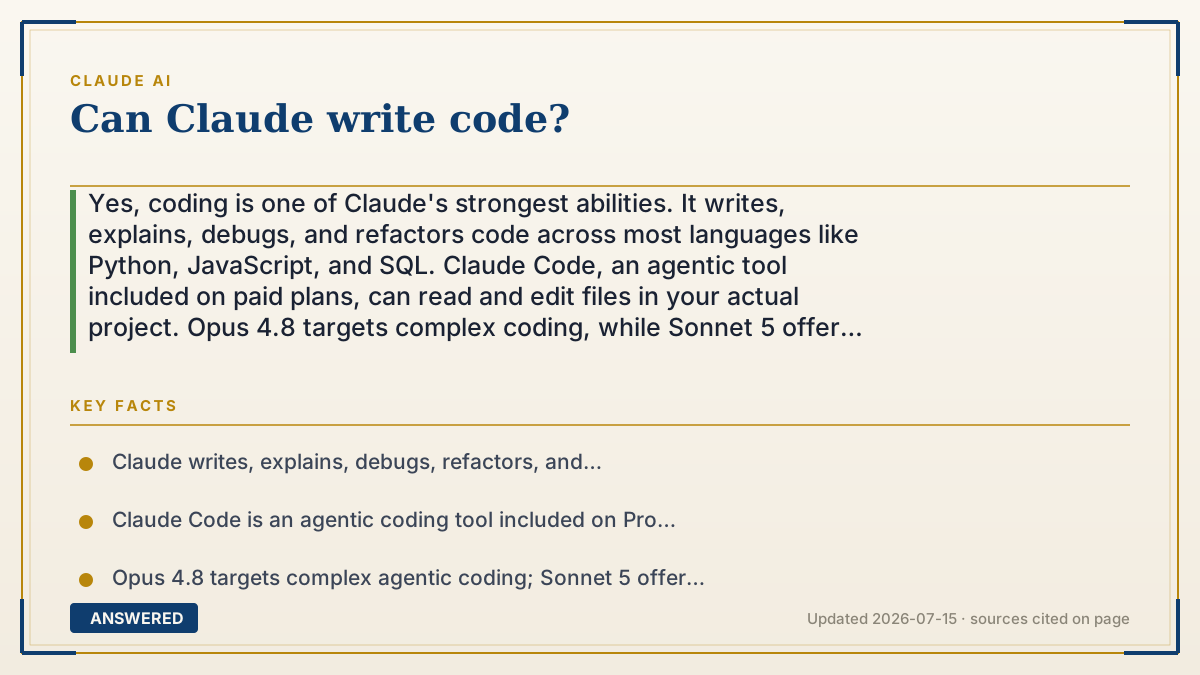
Yes, coding is one of Claude's strongest abilities. It writes, explains, debugs, and refactors code across most languages like Python, JavaScript, and SQL. Claude Code, an agentic tool included on paid plans, can read and edit files in your actual project. Opus 4.8 targets complex coding, while Sonnet 5 offers nearly the same quality faster and cheaper.
Why — the first-principles explanation
Code is just highly structured text with strict rules, which turns out to be an ideal match for a language model. Claude was trained on enormous amounts of source code and technical writing, so it learned the patterns of many languages, common bugs, and how working solutions are shaped. Predicting the next token in code is like predicting the next word in a sentence, only the grammar is stricter and mistakes are easy to catch by running it.
That's why Claude can do the full loop: write new functions, explain unfamiliar code, debug errors from a stack trace, translate between languages, and refactor for clarity or speed. Because top models hold up to a 1M-token context window, you can paste in a large file, or a whole small codebase, and it can reason across all of it at once instead of losing track.
The leap beyond a chat box is Claude Code, an agentic coding tool that runs in your terminal and can actually read, write, and run files in your project, then check its own work. It's included on Pro and Max plans. As with any AI, generated code should be reviewed and tested, models can produce a subtle bug or use an outdated API, but Claude is widely regarded as one of the best coding assistants available, with Opus 4.8 aimed at the hardest agentic work and Sonnet 5 delivering close quality at lower cost and higher speed.
An example that makes it click
Think of Claude as a very fast pair-programming partner who has seen millions of code examples. You say, 'Write a function that emails me when a website goes down,' and it drafts it in seconds. Paste an error message, and it points to the likely bug and suggests a fix. With Claude Code, it's like that partner can also reach over, open your files, make the edit, and run the tests, while you review each change. You still check the work, just like reviewing a teammate's pull request.
How to do it
- Describe your goal plainly, e.g., 'Write a Python script that renames all files in a folder by date.'
- Paste any existing code or error messages so Claude has full context.
- Ask it to explain, debug, or optimize, and request tests alongside the code.
- For project-wide work, use Claude Code (Pro/Max) so it can read and edit files directly.
- Always review and run the generated code before using it in production.
Key facts
- Claude writes, explains, debugs, refactors, and translates code across most major languages.
- Claude Code is an agentic coding tool included on Pro and Max plans that edits and runs files in your project.
- Opus 4.8 targets complex agentic coding; Sonnet 5 offers close quality at lower cost and higher speed.
- Top models' 1M-token context lets Claude reason over large files or small codebases at once.
- Generated code should always be reviewed and tested, since models can introduce subtle bugs.
Try Claude's $0 Free plan first, then compare current usage limits and billing before upgrading.
Choose a coding workflow, not just a model
Compare Claude's coding surfaces with other repository-aware tools using the same tasks, permissions and tests.
▶ The 60-second explainer (script)
Can Claude write code? Yes, and it's one of the best at it. Code is really just structured text with strict rules, which is a perfect fit for a language model trained on tons of source code. So Claude can write new functions, explain code you don't understand, debug errors from a stack trace, translate between languages, and refactor for clarity or speed. Paste in a big file, or even a small whole codebase, and thanks to a million-token context window it can reason across all of it. The real power move is Claude Code, an agentic tool on the Pro and Max plans that runs in your terminal and can actually read, edit, and run files in your project, then check its own work. Opus 4.8 handles the hardest coding, while Sonnet 5 is nearly as good but faster and cheaper. Just remember to review and test what it writes.
What authoritative sources say
People also ask
Which languages can Claude code in?
Most major languages, including Python, JavaScript/TypeScript, Java, C++, Go, SQL, and more, plus config and markup formats.
What is Claude Code?
An agentic coding tool included on Pro and Max plans that runs in your terminal and can read, write, and run files in your actual project.
Which model is best for coding?
Opus 4.8 for the most complex agentic coding, or Sonnet 5 for near-equal quality at lower cost and faster speed.
Can I trust Claude's code without checking it?
No. Always review and test generated code, since models can produce subtle bugs or use outdated APIs.