Can teachers detect AI writing?
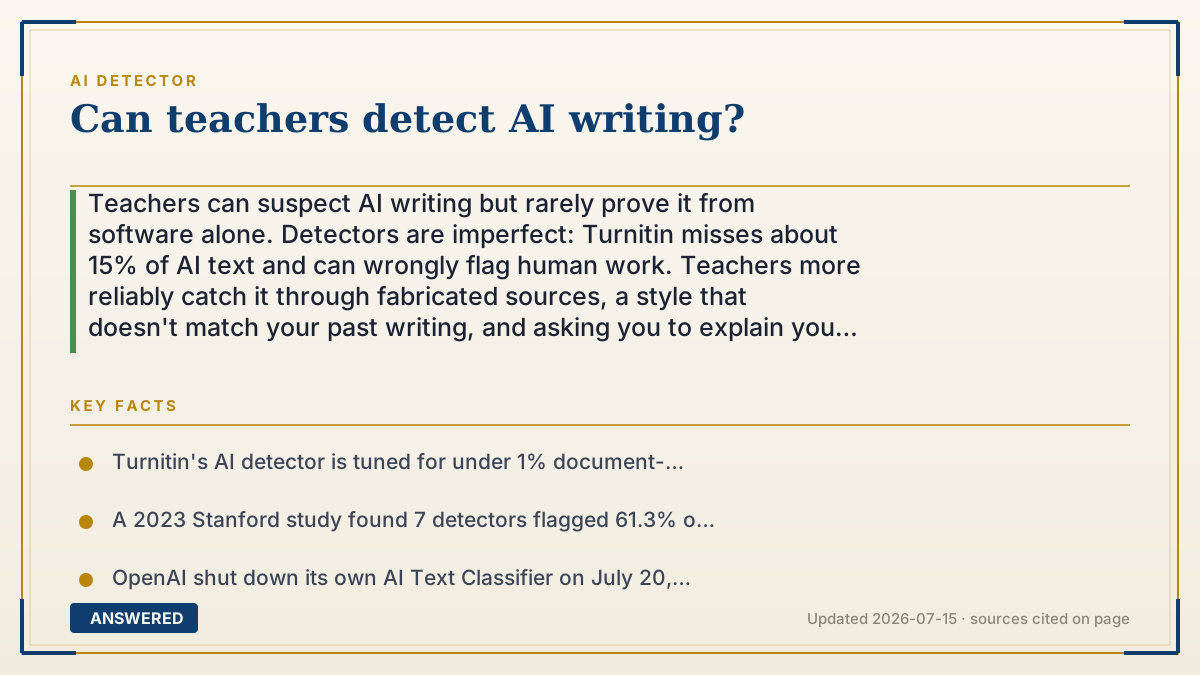
Teachers can suspect AI writing but rarely prove it from software alone. Detectors are imperfect: Turnitin misses about 15% of AI text and can wrongly flag human work. Teachers more reliably catch it through fabricated sources, a style that doesn't match your past writing, and asking you to explain your work.
Why — the first-principles explanation
"Detecting AI writing" splits into machine detection and human judgment, and they behave very differently. Machine detectors read text for perplexity (predictability) and burstiness (variation in sentence length). AI models are built to choose the most probable next word, so their prose is smooth and low-perplexity, and detectors treat that as a signature. But careful human writers also produce smooth prose, so the signal is noisy. That's why detectors publish error rates and warn against using scores as proof.
Teachers, though, have context a machine lacks. They've read your earlier assignments, so a sudden jump in vocabulary or a personality change in your voice stands out. They also know their subject: AI routinely invents quotes, cites studies that don't exist, and gets specific facts wrong with total confidence. Those are checkable, unlike a probability score.
The most reliable method isn't detection software at all. It's process and conversation. Teachers increasingly require drafts, outlines, in-class writing, and short oral explanations. If a student turns in a polished essay but can't summarize their own thesis or explain a word they "used," that gap is more convincing than any detector. Because AI detectors are known to be biased and unreliable, many schools now lean on these human methods rather than software verdicts.
An example that makes it click
Picture a swim coach who has watched you swim all season. A stopwatch app might guess you "look too fast to be real," but that's a weak, error-prone hunch. What actually tips off the coach is when you suddenly swim a perfect race with a stroke you've never used, and then can't repeat it or explain how you did it.
AI writing works the same way. The software is the shaky stopwatch. The real catch is a student whose work jumps in quality overnight and who can't retrace how they got there.
Key facts
- Turnitin's AI detector is tuned for under 1% document-level false positives and consequently misses about 15% of AI text.
- A 2023 Stanford study found 7 detectors flagged 61.3% of non-native English essays as AI, showing tool bias.
- OpenAI shut down its own AI Text Classifier on July 20, 2023 after it detected only 26% of AI writing.
- AI models frequently fabricate citations and facts, which teachers can verify directly.
- Turnitin requires at least 300 words of long-form prose before it will score a document.
▶ The 60-second explainer (script)
Can teachers detect AI writing? They can suspect it, but proving it from software alone is hard. Detectors like Turnitin measure how predictable your writing is, not who wrote it, so they miss about fifteen percent of real AI text and sometimes flag honest students by mistake. What teachers catch more reliably has nothing to do with software. AI tools invent quotes and cite studies that don't exist, and a teacher can just check whether that source is real. Teachers who've read your past essays also notice when your voice suddenly changes. And the strongest test is simply asking you to explain your own paper out loud. If you can't summarize your thesis or explain a word you supposedly used, that gap says more than any score. So yes, teachers can often tell, just usually not by the tool you're worried about.
What authoritative sources say
People also ask
How do teachers detect AI writing without software?
They check citations and facts, compare your voice to earlier work, and ask you to explain your draft in person. Those signals are more reliable than detector scores.
Are AI detectors accurate enough for teachers to trust?
Not fully. They produce false positives and negatives, and several universities have disabled them. Most guidance says never use a score as sole proof.
Can lightly edited AI writing avoid detection?
It can lower the odds, because paraphrasing raises perplexity. But it also risks introducing fake facts or citations that a teacher can catch.
Do teachers get told which sentences look AI?
Turnitin highlights suspected passages, but its sentence-level error rate is around 4%, so highlighted sentences can still be human-written.
The same question, asked other ways
- Can a teacher detect if students are using artificial intelligence?
- How do professors detect AI writing?