Can you copyright AI art?
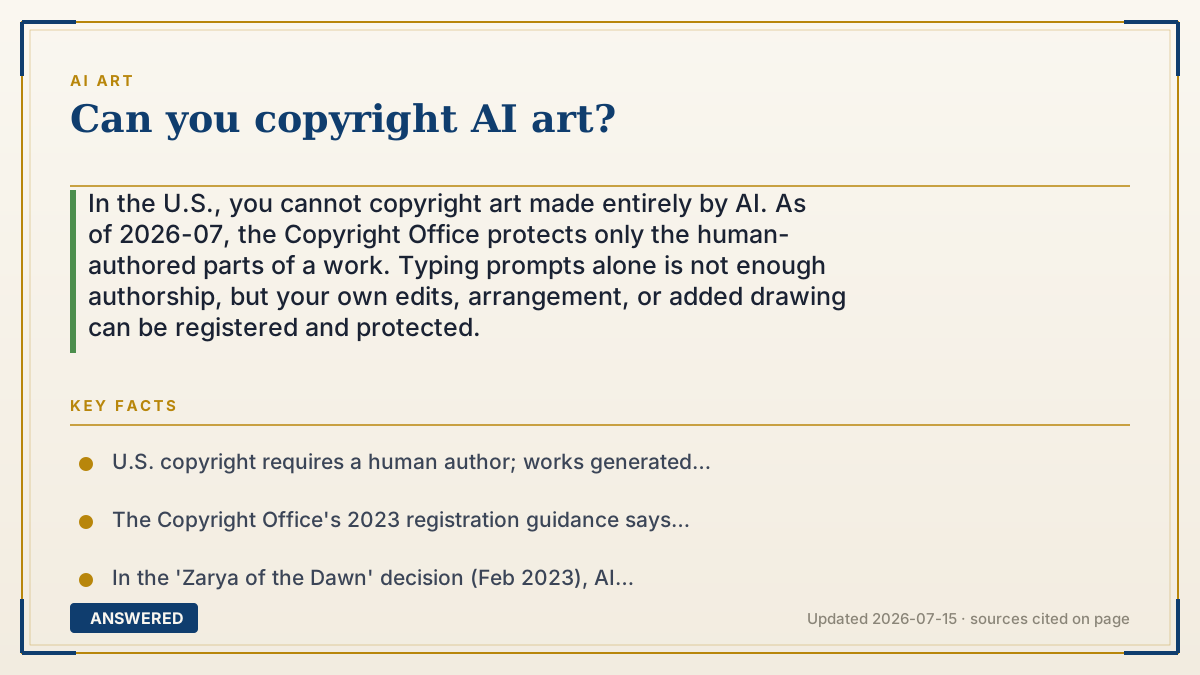
In the U.S., you cannot copyright art made entirely by AI. As of 2026-07, the Copyright Office protects only the human-authored parts of a work. Typing prompts alone is not enough authorship, but your own edits, arrangement, or added drawing can be registered and protected.
Why — the first-principles explanation
Copyright exists to reward and protect human creativity. U.S. law only grants a copyright to an "author," and the Copyright Office and the courts have consistently held that an author must be a human being. A machine, no matter how advanced, cannot legally be an author. This is why a picture generated purely from a text prompt sits in a gray zone: no human hand made the specific pixels.
The deeper reason is control. To be an author, you have to control how your idea becomes the final expression. The Copyright Office concluded in 2025 that when you type a prompt, the AI decides thousands of details you did not specify, so you do not truly control the output. You steer it, but you don't execute it, the way a director gives notes but does not personally paint every frame.
That does not mean AI art is worthless legally. Copyright can still cover the human contributions layered on top: the selection and arrangement of images, meaningful edits you make by hand, text you write, or original elements you combine with AI pieces. In the "Zarya of the Dawn" comic, the AI images were rejected but the human-written story and the arrangement were protected.
So the practical rule is: the more real human creative work you add, the more of the final piece you can own.
An example that makes it click
Think of a snack vending machine. You press "B4" and it drops a candy bar. You chose the button, but you didn't invent or make the candy, so you can't claim you "created" it. That's a pure AI prompt.
Now imagine you buy five candy bars, melt them, and sculpt them into a little castle, then arrange them on a painted board. The castle and the arrangement are yours, even though the raw candy wasn't. That's AI art with real human editing on top, and that human part is what copyright can protect.
How to do it
- Decide honestly how much of the work is human-made versus AI-generated.
- Add genuine human authorship: hand-edit the image, combine pieces, or arrange them in an original way.
- Go to the U.S. Copyright Office registration portal at copyright.gov and start an application.
- In the application, disclaim the AI-generated portions and describe what you personally created.
- Submit, pay the fee, and keep records (prompts, edit files, timestamps) proving your human contribution.
Key facts
- U.S. copyright requires a human author; works generated entirely by AI cannot be registered (Copyright Office, 2025).
- The Copyright Office's 2023 registration guidance says applicants must disclaim AI-generated content in their filing.
- In the 'Zarya of the Dawn' decision (Feb 2023), AI images were denied but the human text and arrangement were protected.
- In Thaler v. Perlmutter, the D.C. Circuit affirmed in March 2025 that an AI cannot be the author of a copyrighted work.
- Human edits, selection, arrangement, or added original elements can still qualify for copyright protection.
Choosing a tool for your creative workflow?
The answer above explains the concept; this next step helps you choose by job, limits and current terms.
▶ The 60-second explainer (script)
Can you copyright AI art? Short answer: not the AI-only part. In the United States, copyright only protects work made by a human, and as of 2026, the Copyright Office says typing a prompt isn't enough, because the AI, not you, decides most of the final details. But here's the useful part: anything you personally add is fair game. If you edit the image by hand, combine several pieces, write text, or arrange everything in an original layout, those human contributions can be registered and protected. When you file, you just have to be honest and disclaim the AI-generated portions. So the more real creative work you put in, the more of the final piece you actually own. Pure prompt in, pure prompt out? That belongs to no one.
What authoritative sources say
People also ask
Can I copyright a Midjourney image I generated?
Not the raw output by itself. But if you meaningfully edit or combine it with your own work, those human contributions can be protected.
Do I have to tell the Copyright Office I used AI?
Yes. Since 2023 the Office requires you to disclaim AI-generated portions in your application.
Is this the same in every country?
No. Rules differ. The U.K. and some countries have provisions for computer-generated works, while the U.S. currently requires human authorship.
What if I write a very long, detailed prompt?
As of 2026 the Copyright Office still says prompts alone, however detailed, do not make you the author of the output.
The same question, asked other ways
- What does the US copyright office say about AI art?