How can I tell if I'm talking to a human or an AI?
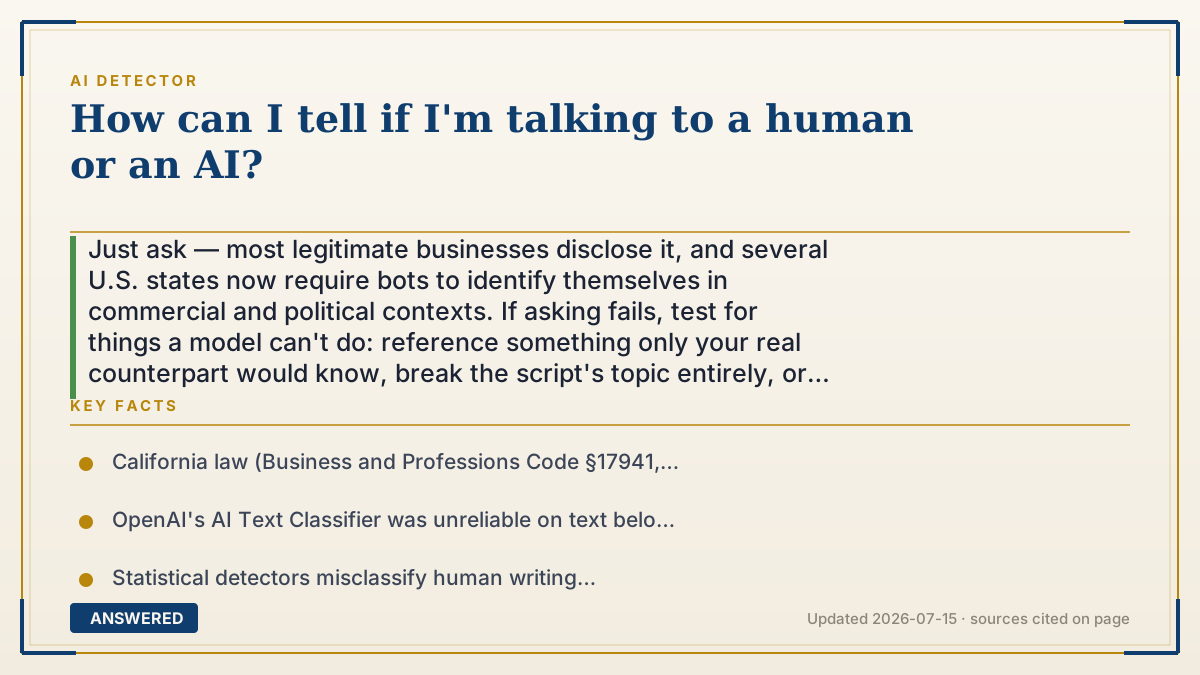
Just ask — most legitimate businesses disclose it, and several U.S. states now require bots to identify themselves in commercial and political contexts. If asking fails, test for things a model can't do: reference something only your real counterpart would know, break the script's topic entirely, or ask them to do something in the physical world on a timeline.
Why — the first-principles explanation
Start with the cheap move everyone skips: ask directly. Reputable companies label their bots, because a customer who feels tricked is expensive. And some jurisdictions require it — California's bot disclosure law (SB 1001, in force since 2019) makes it unlawful to use an undisclosed bot to incentivize a purchase or influence a vote. Deception isn't free, so most legitimate operators don't bother.
When asking fails, the useful tests come from what a language model structurally lacks, not from writing style. Style is a dead end — modern models write conversationally, use slang, make typos on request, and a scripted human agent reading from a call center macro sounds more robotic than GPT does.
Test one: shared history. A model has no memory of your specific life. "What did you say you'd send me last Tuesday?" is unanswerable for an impostor and trivial for the real person. This is why the strongest check for a suspicious message from a friend or family member is a fact from your shared past — not their phrasing, which is exactly what a model reproduces well.
Test two: break the frame. A bot deployed for customer service has a purpose and a scope. Ask it something absurdly off-topic, or ask it to disobey its own instructions, and you often see either a graceful deflection back to the script or an unnaturally cheerful compliance no human would offer at 2 a.m.
Test three: physical world with a clock. "Take a photo of your left hand holding three fingers up next to today's newspaper" is hard to fake in real time — though far from impossible now, so treat it as strong evidence rather than proof.
The honest caveat: you will get this wrong, in both directions. Studies of statistical AI detection show tools flag careful human writing constantly — about 61% of non-native-English essays across seven detectors — and humans reading text do worse than tools. And the reason it matters is almost never curiosity. It's a scam. So the higher-value question is usually not "is this a bot" but "is this person asking me for money, credentials, or urgency?" — because that's true whether a human or a machine is typing.
An example that makes it click
Someone messages you claiming to be your cousin, needing money fast. You could analyze their grammar. Useless — a model writes like your cousin better than your cousin does.
Instead: "Hey, what did we eat at Grandma's last Thanksgiving?" A real cousin answers instantly and probably corrects you about the pie. An impostor produces something confident, plausible, and wrong — because it's generating what a Thanksgiving sounds like rather than remembering one. Ten seconds, no software, and it works whether you're talking to a bot or a human running the same scam. That's the whole trick: don't test the writing, test the memory only the real person has.
How to do it
- Ask directly whether you're speaking with a bot. Most legitimate businesses disclose, and in California, undisclosed bots used to incentivize a purchase or influence a vote are unlawful under SB 1001.
- Test shared history — reference a specific fact only your real counterpart would know. This defeats impersonation regardless of whether a human or a model is typing.
- Break the frame: ask something wildly off-topic, or ask the agent to ignore its own instructions. Scripted deflection or unnatural compliance is informative.
- Ask for a real-world action on a clock: a photo of a specific gesture, a callback to a number you supply, a detail visible only right now. Strong evidence, not proof.
- Ignore writing style entirely. Models write casually and make typos on request; human agents reading macros sound robotic. Style tells you almost nothing.
- Reframe to the question that matters: is this conversation steering me toward money, credentials, or urgency? If yes, verify through a channel you chose — a number you looked up yourself — regardless of who's typing.
- Don't rely on AI detector tools for chat. They're unreliable on short text — OpenAI's own classifier was unreliable below 1,000 characters before it was withdrawn.
Key facts
- California law (Business and Professions Code §17941, operative July 1, 2019) makes it unlawful to use a bot to communicate with a person in California with intent to mislead about its artificial identity in order to influence a commercial transaction or a vote — and states a person is not liable if they disclose that it is a bot; the disclosure must be 'clear, conspicuous, and reasonably designed to inform.'
- OpenAI's AI Text Classifier was unreliable on text below 1,000 characters — shorter than most chat messages — and was withdrawn on July 20, 2023 after identifying only 26% of AI-written text.
- Statistical detectors misclassify human writing systematically: about 61% of non-native-English TOEFL essays were flagged as AI across seven detectors versus roughly 5% for native writers (Liang et al., Patterns, July 10, 2023).
- Peer-reviewed testing of 14 detection systems (December 2023) found them neither accurate nor reliable — they are not a solution for identifying a chat partner.
- Google DeepMind's SynthID watermarks text generated in the Gemini app and images, audio, and video from Google models, but does not cover conversations from other providers.
- C2PA Content Credentials can establish the origin of media a chat partner sends — signed manifests naming the creating tool, time, and edits (spec v2.3 as of 2026-07).
▶ The 60-second explainer (script)
How can you tell if you're talking to a human or an AI? Start with the move everyone skips: ask. Most legitimate businesses label their bots, and in California it's actually illegal to use an undisclosed bot to push you toward a purchase or sway your vote. Deception has a cost, so most real operators don't bother. If asking doesn't settle it, test what a model structurally can't do — and that is not writing style. Style is a dead end. Modern models write casually, use slang, add typos on request. Meanwhile a human agent reading a call center script sounds more robotic than any chatbot. Test one: shared history. A model has no memory of your life. 'What did you say you'd send me last Tuesday?' is trivial for the real person and impossible for an impostor. Test two: break the frame. Ask a customer service bot something wildly off-topic, or ask it to ignore its own instructions. You'll get graceful deflection or unnatural cheerfulness no human offers at 2am. Test three: the physical world on a clock. A photo of your left hand, three fingers up, right now. Strong evidence — not proof anymore. And don't paste chat into an AI detector. OpenAI's own tool was unreliable under a thousand characters, and most messages are shorter than that. But here's the thing. You're almost never asking out of curiosity. You're asking because something feels like a scam. So ask the better question: is this conversation pushing me toward money, credentials, or urgency? Because that's a problem whether the typist is a human or a machine.
What authoritative sources say
People also ask
Do bots have to tell me they're bots?
Sometimes. California's SB 1001 prohibits undisclosed bots used to incentivize a purchase or influence a vote. Rules vary by state and context, and a scammer breaking the law is not deterred by it — so asking is a useful test, not a guarantee.
Will an AI admit it's an AI if I ask?
Most mainstream assistants will, because they're instructed to. One deployed to deceive won't. That's why the honest answer relies on shared memory and real-world checks rather than on the answer to the question.
Can I paste the chat into an AI detector?
Not usefully. Detectors need length — OpenAI's own classifier was unreliable below 1,000 characters, and chat messages are far shorter. You'd be adding noise to a decision that matters.
What about voice calls and video?
Voice cloning and real-time video are good enough that neither settles it. Fall back on the same principle: verify through a channel you initiated, using a number you looked up yourself, and test a fact only the real person knows.