How accurate is Turnitin AI detection?
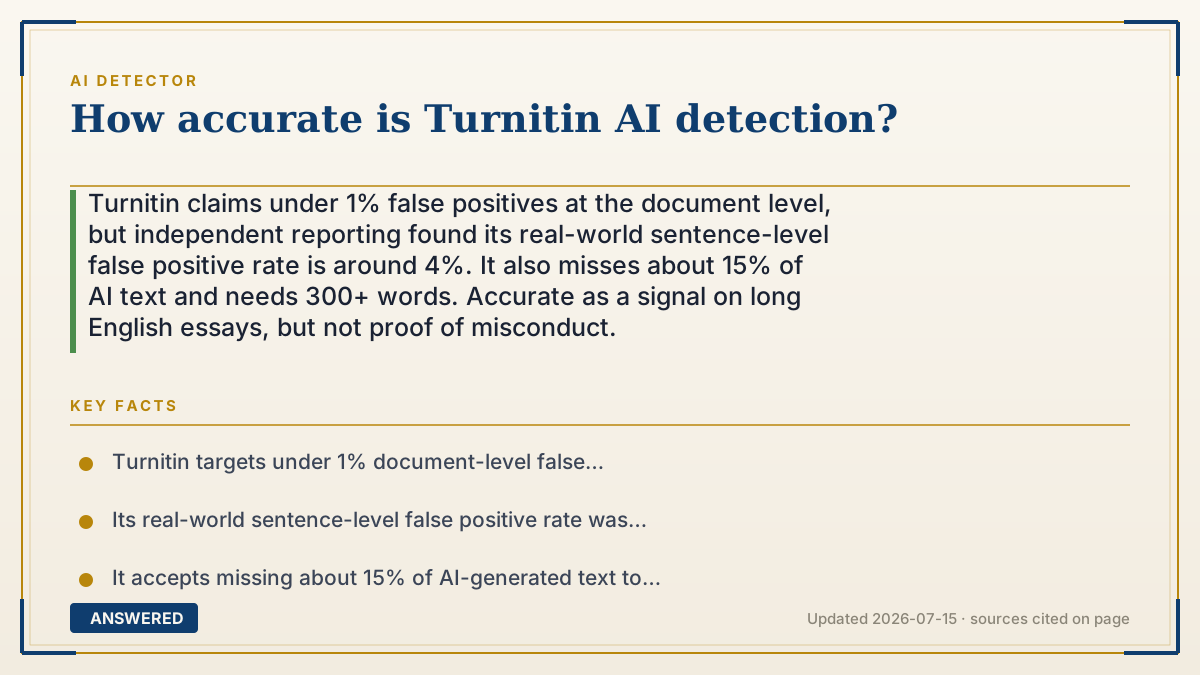
Turnitin claims under 1% false positives at the document level, but independent reporting found its real-world sentence-level false positive rate is around 4%. It also misses about 15% of AI text and needs 300+ words. Accurate as a signal on long English essays, but not proof of misconduct.
Why — the first-principles explanation
Turnitin publishes its accuracy as a false-positive target rather than a single "accuracy percent," and that framing matters. The company tunes its model to wrongly flag fully human documents less than 1% of the time, and it validated that claim against 700,000 papers written before ChatGPT existed. To hit such a low false-positive rate, it deliberately trades away sensitivity, accepting that it will miss roughly 15% of genuinely AI-written text.
The headline 1% figure is measured at the whole-document level and only applies confidently above a 20% AI score, which is why lower scores carry a caution asterisk. At the sentence level, accuracy is worse: Inside Higher Ed reported a real-world false-positive rate near 4%, and Turnitin acknowledged higher-than-expected false positives, especially where AI and human sentences sit next to each other. Because false positives compound across a class, Vanderbilt calculated that even 1% applied to its 75,000 annual papers could wrongly flag about 750 of them.
Accuracy also degrades on the inputs students actually produce: text under 300 words isn't scored at all, paraphrasers and "humanizer" tools raise perplexity and slip through, and non-native English writing is over-flagged. Turnitin's own guidance is that the score is not a determination of misconduct. So "how accurate" has a two-part answer: strong on long, unedited English prose; unreliable enough that it should never stand alone as evidence.
An example that makes it click
Picture a bouncer who's told to almost never wrongly turn away a real guest. To keep that promise, he waves through some gate-crashers rather than risk stopping the wrong person. He's 'accurate' in the sense that he rarely blocks a real guest, but plenty of crashers still get in.
That's Turnitin. It's built to rarely accuse an innocent essay, so it lets about fifteen percent of AI writing walk past. Rare mistakes on honest work, but not a tight net, and never a courtroom-proof verdict.
Key facts
- Turnitin targets under 1% document-level false positives, validated on 700,000 pre-ChatGPT papers.
- Its real-world sentence-level false positive rate was reported near 4% (Inside Higher Ed, 2023).
- It accepts missing about 15% of AI-generated text to keep false positives low.
- Scores under 20% AI carry a caution asterisk because false positives rise at low percentages.
- It requires 300+ words and performs worse on paraphrased text and non-native English writing.
▶ The 60-second explainer (script)
How accurate is Turnitin's AI detection? Turnitin claims it wrongly flags fully human documents less than one percent of the time, and it tested that against seven hundred thousand papers written before ChatGPT. But there are catches. That one percent is measured for the whole document. At the sentence level, independent reporting found a false positive rate closer to four percent. To stay that cautious, Turnitin also misses about fifteen percent of real AI text. It won't score anything under three hundred words, it struggles with paraphrased writing, and it over-flags non-native English speakers. And remember, even one percent adds up: Vanderbilt estimated seven hundred fifty of its papers could be wrongly flagged in a year. Turnitin itself says the score is not proof of cheating. So it's a useful signal on long English essays, but never the final word.
What authoritative sources say
People also ask
What is Turnitin's false positive rate?
Under 1% at the document level per Turnitin, but independent reporting found around 4% at the sentence level, especially near AI-written passages.
Does Turnitin catch all AI writing?
No. It accepts missing about 15% of AI text, and paraphrased or humanized AI writing is harder for it to detect.
Why do low AI scores have an asterisk?
Turnitin flags scores under 20% AI as less reliable because false positives are more likely at low percentages.
Should schools rely on the Turnitin AI score alone?
No. Turnitin says it is not a determination of misconduct, and several universities disabled it over accuracy and bias concerns.
The same question, asked other ways
- How accurate is Turnitin's AI detection?