How does turnitin detect AI writing?
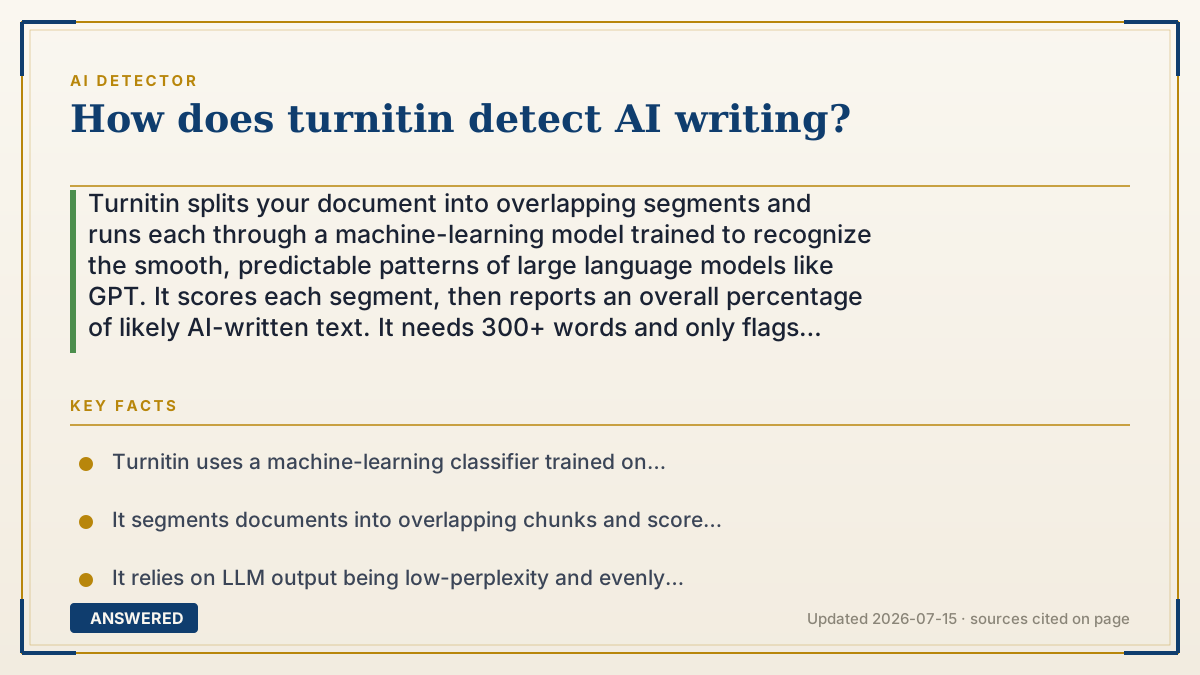
Turnitin splits your document into overlapping segments and runs each through a machine-learning model trained to recognize the smooth, predictable patterns of large language models like GPT. It scores each segment, then reports an overall percentage of likely AI-written text. It needs 300+ words and only flags long-form prose.
Why — the first-principles explanation
Turnitin's AI detector is a trained classifier, not a plagiarism-style database match. Regular Turnitin plagiarism checking compares your text against a huge library of existing documents to find copied passages. AI detection is different: there's no source document to match, because the AI wrote something new. So Turnitin instead learns what machine writing looks like.
The process works in segments. Turnitin breaks the submission into overlapping chunks of a few hundred words each, then feeds each chunk to a model trained on large amounts of human-written and AI-written text. The model has learned that LLM output is low-perplexity (each word is highly predictable) and evenly structured, so it assigns each segment a probability of being AI-generated. Turnitin then aggregates those segment scores into a single percentage estimate for the whole document and can highlight which passages drove the score.
Two design choices shape the result. First, it only scores long-form prose of at least 300 words, because short or list-like text is too noisy to judge. Second, it's tuned for a low false-positive rate (under 1% at the document level), which means it misses about 15% of AI text on purpose. Because it recognizes patterns rather than proof, paraphrasing tools, heavy editing, and AI "humanizers" that raise perplexity can reduce the score, and Turnitin states the result is not a determination of misconduct.
An example that makes it click
Think about spotting a factory-made sweater versus a hand-knitted one, without a label. A factory sweater has perfectly even stitches; a handmade one has little irregularities. You don't compare it to a catalog, you just recognize the 'too even' texture.
Turnitin does that with paragraphs. It doesn't look up your essay in a library. It runs each chunk past a model that has seen thousands of 'factory' AI paragraphs and 'handmade' human ones, and asks, 'Does this stitch pattern look machine-even?' Then it adds up the chunks into one percentage.
Key facts
- Turnitin uses a machine-learning classifier trained on human and AI text, not a plagiarism database match.
- It segments documents into overlapping chunks and scores each for AI-likelihood, then aggregates a percentage.
- It relies on LLM output being low-perplexity and evenly structured.
- It requires 300+ words of long-form prose and does not score short or list-style text.
- It is tuned to under 1% document-level false positives, missing about 15% of AI text as a result.
▶ The 60-second explainer (script)
How does Turnitin detect AI writing? It's not the same as plagiarism checking. Plagiarism detection compares your text to a library of existing documents. But AI writes something brand new, so there's nothing to match. Instead, Turnitin uses a trained model. It breaks your paper into overlapping chunks of a few hundred words, then runs each chunk through a machine-learning model that has studied huge amounts of human and AI text. That model has learned that AI writing is smooth and predictable, so it scores each chunk for how machine-like it looks, then combines those into one overall percentage. Two things to know: it only works on long-form prose of at least three hundred words, and it's tuned to rarely accuse innocent writing, which means it misses about fifteen percent of real AI text. And because it recognizes patterns, not proof, paraphrasing can lower the score.
What authoritative sources say
People also ask
Does Turnitin compare my essay to a database to detect AI?
No. Plagiarism checking uses a database, but AI detection uses a trained model that recognizes machine-writing patterns in your text itself.
What patterns does Turnitin look for?
Mainly low perplexity (predictable word choices) and even, uniform sentence structure, which are typical of large language model output.
Why won't Turnitin score my short answer?
It requires at least 300 words. Shorter text lacks enough statistical signal for a reliable AI score.
Can paraphrasing beat Turnitin's AI detection?
Sometimes. Paraphrasing raises perplexity and can lower the AI score, but it may introduce errors or fake facts a human reviewer can catch.