How does voice cloning work in AI music?
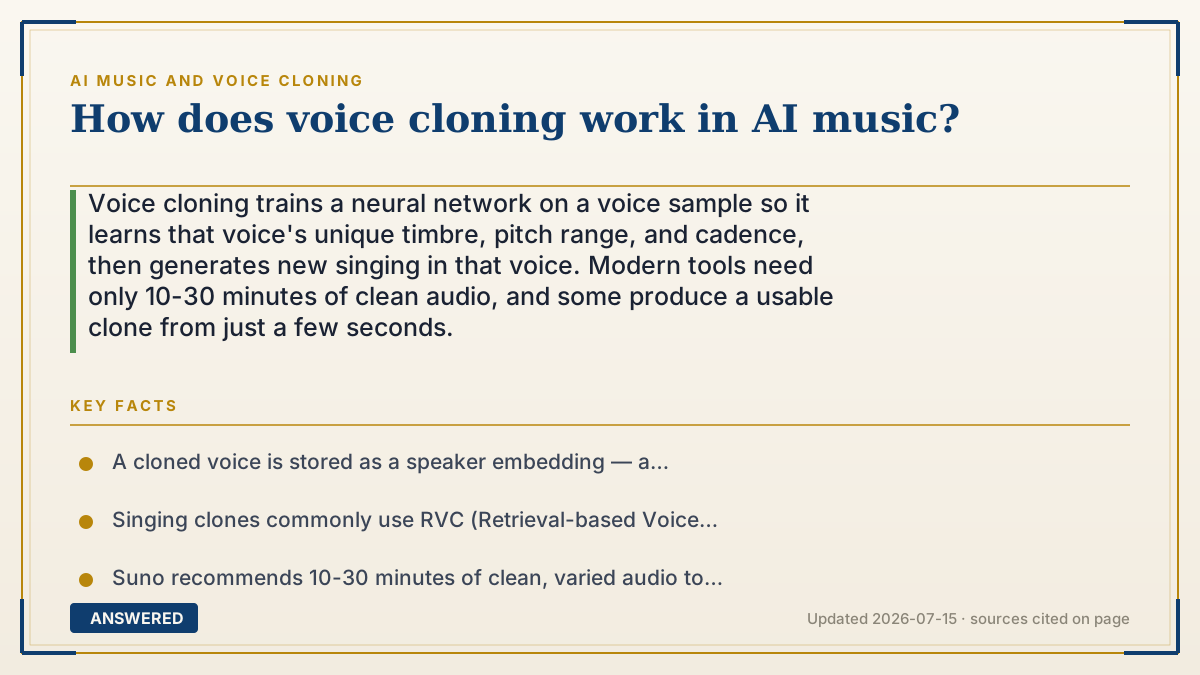
Voice cloning trains a neural network on a voice sample so it learns that voice's unique timbre, pitch range, and cadence, then generates new singing in that voice. Modern tools need only 10-30 minutes of clean audio, and some produce a usable clone from just a few seconds.
Why — the first-principles explanation
Every human voice has a physical fingerprint. The size of your vocal cords, the shape of your throat and mouth, and your speaking habits create a timbre that is as unique as a face. A voice-cloning model listens to a recording and compresses all of that into a short list of numbers called a speaker embedding — essentially a mathematical portrait of what makes you sound like you.
For singing specifically, most tools use a technique called RVC (Retrieval-based Voice Conversion). You feed it an existing vocal track — say, a real singer performing a melody. The model keeps the pitch, timing, and words exactly as sung, but swaps the timbre for the cloned voice's embedding. That is why an AI cover follows the original melody perfectly: the AI is not composing, it is repainting an existing performance in a new voice.
The final step is a vocoder, a neural network that turns the model's internal representation back into an audible waveform. Better training data (clean, varied, 10-30 minutes) produces a more convincing clone because the model hears the voice across many pitches and vowel sounds. This is why Suno's newer models ask you to read a verification phrase and sing in different registers — more coverage means fewer robotic artifacts.
An example that makes it click
Imagine your friend Sam can imitate voices at parties. After listening to 20 minutes of your voicemails, Sam learns exactly how you say your vowels, how high and low you go, and your little verbal habits. Now Sam can say sentences you never said, in your voice. A voice-cloning AI is a super-fast Sam that writes your 'voiceprint' down as a card of numbers.
When you want an AI cover, you hand the AI a karaoke performance and the voiceprint card. The AI keeps the tune note-for-note but sings it using your card, so the melody is the original singer's and the voice is yours.
Key facts
- A cloned voice is stored as a speaker embedding — a compact set of numbers describing timbre, not a copy of the audio.
- Singing clones commonly use RVC (Retrieval-based Voice Conversion), which keeps the source pitch and lyrics and only changes the voice.
- Suno recommends 10-30 minutes of clean, varied audio to build a high-quality voice; some tools clone from seconds.
- A vocoder neural network converts the model's output back into an audible waveform.
- Suno's v5.5 model is marketed as capturing tone, cadence, pitch range, and emotional detail.
- More varied training audio (different registers and vowels) reduces robotic artifacts in the clone.
Choosing a tool for your creative workflow?
The answer above explains the concept; this next step helps you choose by job, limits and current terms.
▶ The 60-second explainer (script)
Here's how voice cloning works in AI music. First, the AI listens to a voice sample and measures its unique timbre — the sound created by your vocal cords and throat shape. It writes that down as a set of numbers called a speaker embedding, basically a voiceprint. To make a cover, the AI takes an existing sung performance and keeps the exact melody and words, but swaps in your voiceprint so the tune is sung in a different voice. This trick is called retrieval-based voice conversion. A final network called a vocoder turns the result back into real audio you can hear. The more clean, varied audio you provide — usually ten to thirty minutes — the more natural the clone sounds. That's why quality samples across high and low notes matter so much.
What authoritative sources say
People also ask
How much audio do I need to clone a voice?
For a strong singing clone, tools like Suno suggest 10-30 minutes of clean, varied audio. Some speech tools can clone from a few seconds, but quality is lower.
Does the AI compose the melody?
For covers, no. It keeps the original melody and lyrics and only replaces the voice's timbre. For fully generated songs, the model does create new melodies.
Why do some clones sound robotic?
Usually because the training audio was short, noisy, or lacked variety. More registers and cleaner recordings reduce artifacts.
Is a cloned voice an audio recording of me?
No. It is stored as a mathematical speaker embedding, a set of numbers describing your timbre, not a saved clip.
The same question, asked other ways
- How is voice cloning used in AI song generators?