How to detect AI generated art?
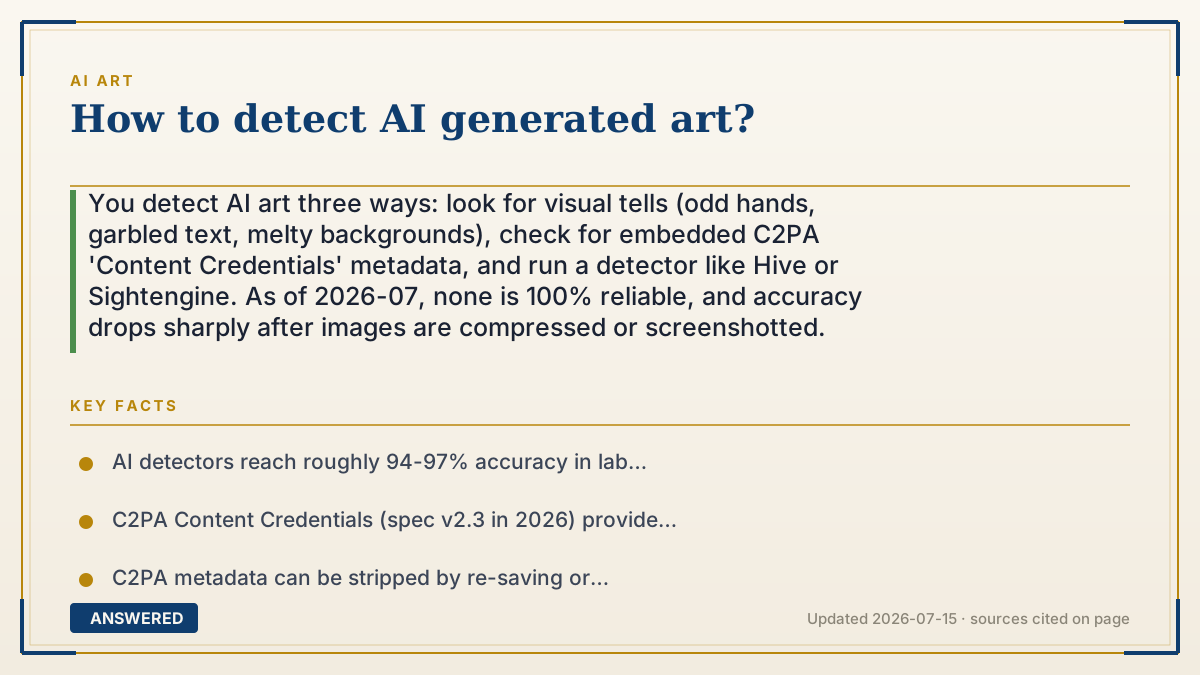
You detect AI art three ways: look for visual tells (odd hands, garbled text, melty backgrounds), check for embedded C2PA 'Content Credentials' metadata, and run a detector like Hive or Sightengine. As of 2026-07, none is 100% reliable, and accuracy drops sharply after images are compressed or screenshotted.
Why — the first-principles explanation
There are three fundamentally different signals you can chase. The first is visual artifacts. Diffusion models are great at overall vibe but weaker on strict rules: five fingers, readable text, symmetric jewelry, consistent reflections. Errors here are shrinking fast in 2026, so this is the least reliable method now.
The second is provenance metadata. Many big generators embed C2PA 'Content Credentials,' a tamper-evident label acting like a nutrition label for the file, recording that it was AI-made. If it's present, you have strong proof. The weakness: many tools don't embed it, and re-saving or screenshotting can strip it, so absence proves nothing.
The third is statistical detectors. Tools like Hive and Sightengine were trained to spot the subtle fingerprints AI generation leaves in the pixels. In clean lab conditions they hit roughly 94-97%, but on real-world images that were compressed, cropped, or passed through social media, accuracy can fall below 50%, and they sometimes flag real photos as fake.
Because each signal has blind spots, the honest approach is to combine them and treat any single result as a clue, not a verdict.
An example that makes it click
It's like figuring out if a $20 bill is fake. You can eyeball it for weird printing (visual tells), hold it to the light for the watermark strip (C2PA credentials), or run it through a counter-detector pen (an AI detector). Each catches different fakes and each misses some.
A smart cashier uses all three and stays humble, because a good counterfeit can pass one test. Detecting AI art works the same way: no single check is proof, so you stack them.
How to do it
- Zoom in on hands, teeth, text, jewelry, and backgrounds for melty or impossible details.
- Check the file's metadata for C2PA 'Content Credentials' (e.g., via the Content Credentials verify tool).
- Run the image through a detector such as Hive Moderation or Sightengine.
- Reverse-image-search to see if it matches a known artist or a generator's gallery.
- Combine the signals; treat a single tool's result as a clue, not proof.
Key facts
- AI detectors reach roughly 94-97% accuracy in lab conditions but can drop below 50% on compressed or social-media images.
- C2PA Content Credentials (spec v2.3 in 2026) provide tamper-evident provenance when a generator embeds them.
- C2PA metadata can be stripped by re-saving or screenshotting, so its absence doesn't prove human authorship.
- Detectors like Hive and Sightengine can produce false positives on genuine photos.
- Visual tells (hands, text, symmetry) are becoming less reliable as 2026 models improve.
▶ The 60-second explainer (script)
How do you detect AI-generated art? There are three main ways, and you should use all of them. First, look for visual tells: strange hands, garbled text, melting backgrounds, mismatched earrings. But be careful, 2026 models are getting really good, so this alone isn't proof. Second, check the file's metadata for C2PA Content Credentials, a built-in label that says an image was AI-made. If it's there, that's strong evidence, but many tools don't add it, and saving a screenshot can wipe it. Third, run the image through a detector like Hive or Sightengine. These hit around 95% in the lab, but on compressed or social-media images they can fall below 50% and even flag real photos. So stack all three signals, and treat any single answer as a clue, not a verdict.
What authoritative sources say
People also ask
What's the most reliable single method?
Intact C2PA Content Credentials are the strongest signal, but only if the generator embedded them and they weren't stripped.
Can detectors be wrong?
Yes. They can miss AI images and flag real photos, especially after compression or editing.
Do all AI tools add metadata?
No. Many closed tools do, but open-source and older tools often don't, so missing metadata isn't proof.
Are the 'weird hands' tells still valid?
Less so in 2026. Newer models fix hands and text well, so rely on tells only as a weak hint.