How to make an AI?
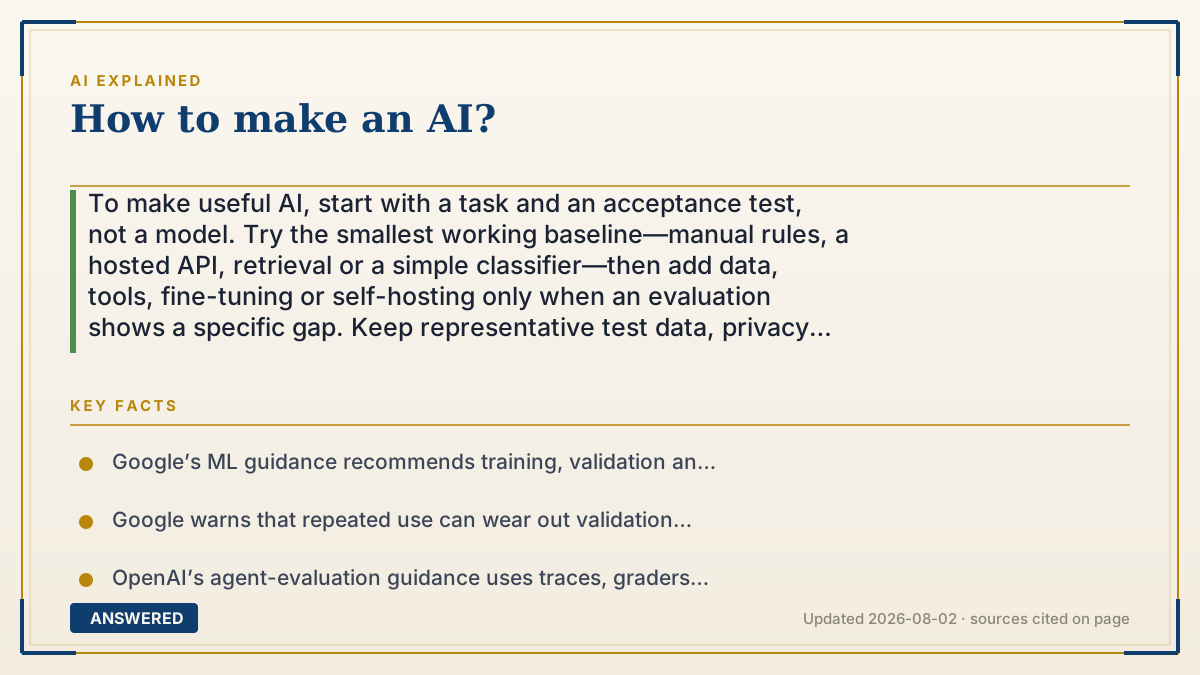
To make useful AI, start with a task and an acceptance test, not a model. Try the smallest working baseline—manual rules, a hosted API, retrieval or a simple classifier—then add data, tools, fine-tuning or self-hosting only when an evaluation shows a specific gap. Keep representative test data, privacy controls, human review, monitoring and a rollback path. Training a foundation model from scratch is a different industrial-scale project.
Why — the first-principles explanation
“Make an AI” can mean four very different projects: prompt an existing model, wrap a model with retrieval and tools, train a narrow model for a task, or pretrain a foundation model. The first three can be sensible product work; the last one needs a research, data, compute, safety and operations program. Define the outcome before choosing the category.
Start with a task contract: who uses the system, what input it receives, what output it must produce, what a good result means, what it must never do, and who owns the decision. A support-ticket router, a document question-answering tool and an autonomous purchasing agent are not the same build. Their data, permissions, evaluation and human checkpoints differ.
Build a baseline before building infrastructure. A rule, spreadsheet, manual process, retrieval prompt or API call gives you a reference point. If the baseline already meets the acceptance test, a custom model may add cost and maintenance without adding value. If it fails, name the failure precisely: missing context, formatting, retrieval, latency, domain knowledge, privacy, tool use or reliability.
Evaluation is the hinge. Google’s machine-learning guidance recommends separate training, validation and test sets; the test set should be representative of real inputs, statistically useful and free of duplicates from training. OpenAI’s current evaluation guidance moves from traces to graders and then to repeatable datasets and eval runs. A high score on examples the system has already influenced is not proof of generalization.
Add complexity in measured steps. Retrieval can supply current private context; structured outputs can constrain a schema; a tool can perform an action; an agent loop can choose multiple steps. Anthropic’s engineering guidance says to start with simple prompts and add multi-step orchestration only when evaluation shows a real improvement. More autonomy also means more permissions, latency, cost and ways for errors to compound.
Fine-tuning is an optimization, not a rite of passage. OpenAI’s current guide places evals and prompt engineering before fine-tuning, recommends representative real-world test data, and notes that the fine-tuning platform and model timelines can change. Fine-tune only when the gap is repeatable, the data is authorized and labeled, the lifecycle is supported, and the expected gain exceeds migration and maintenance cost.
Production is part of the model. NIST’s AI Risk Management Framework asks teams to govern, map, measure and manage risks across the lifecycle. Minimize sensitive data, restrict tool permissions, log inputs and outputs, add abuse and privacy controls, keep a human approval path for consequential actions, and define a rollback threshold. A model that scores well but cannot be monitored or safely stopped is not a finished product.
The buy-versus-build answer is a total-cost calculation: vendor/API fees, data preparation, evaluation, security review, latency, inference, observability, human review, on-call work, upgrades, deprecations and lock-in. Compare a small pilot with an existing vendor to a narrowly scoped internal baseline. Do not use a fixed “hundreds of dollars,” “one weekend” or universal vendor-success percentage; the task, data and operating requirements decide the budget.
An example that makes it click
Suppose a team wants to route support emails into six queues. First write the contract: acceptable error rate, escalation rules, languages, privacy boundary and who can correct a route. Baseline with rules or a hosted model. Build a representative dataset, remove duplicates and split it before tuning. Measure precision, recall, false routing and human correction time on untouched test cases. If the model lacks current policy context, add retrieval; if the format is unstable, constrain the output; if a repeatable domain gap remains, evaluate fine-tuning. Launch with a low-risk queue, log every correction and stop or roll back when the agreed threshold is missed. That is making an AI system; selecting a bigger model is only one implementation choice.
How to do it
- Write the task contract: user, input, output, success metric, unacceptable behavior, owner, risk level and human decision point.
- Decide whether to buy, configure or build. Test an existing vendor/API and a simple internal baseline before committing to custom training.
- Create a data contract: permitted sources, retention, labels, sensitive fields, licenses, representative populations and who can change the dataset.
- Split data into training, validation and test sets before tuning. Remove duplicates and keep the test set untouched and representative of production.
- Measure the baseline on the acceptance test: correctness, coverage, latency, cost, subgroup performance, human edit time and failure severity.
- Add only the component that addresses the measured gap: retrieval for missing context, structured output for schema errors, a tool for an external action or an agent loop for genuinely open-ended steps.
- Consider fine-tuning only after prompt and retrieval experiments, with authorized examples, a supported model lifecycle and a repeatable eval improvement.
- Deploy with least-privilege tools, privacy controls, logs, rate limits, human approval, incident handling and a tested rollback or shutdown path.
- Recalculate total cost and re-run evals after model, data, vendor, policy or user-population changes. Keep a decision log so buy/build is revisable.
Key facts
- Google’s ML guidance recommends training, validation and test sets; the test set should be representative of real-world inputs, statistically useful and free of duplicates from training.
- Google warns that repeated use can wear out validation and test sets; fresh data may be needed to keep evaluation trustworthy.
- OpenAI’s agent-evaluation guidance uses traces, graders, datasets and eval runs to find workflow failures and compare changes over time.
- OpenAI’s fine-tuning guide places evals and prompt engineering before fine-tuning and says test data should represent real-world inputs; it also notes that platform timelines can change.
- Anthropic’s building-agents guidance recommends starting with simple prompts and adding complexity only when it demonstrably improves outcomes; agent autonomy raises cost and compounding-error risk.
- NIST’s AI Risk Management Framework treats governance, mapping, measurement and management as lifecycle activities, not a final checklist after launch.
- An AI application can combine a model with retrieval, tools, memory, permissions, monitoring and human review. The model alone is not the whole product.
- Training a foundation model from scratch, fine-tuning an existing model and calling an API have different data, compute, staffing, safety and maintenance requirements; no single cost or timeline applies to all three.
- A benchmark or demo is evidence for a task, version and date. It does not prove privacy, security, fairness, uptime or safe behavior in your production workflow.
- Vendor pricing, model access, retention, deprecation and regional availability change; record the exact plan, model and terms used in the pilot.
Build the smallest system that passes the test
Compare buy, configure and build options using real inputs, privacy rules, evaluation evidence and total cost before committing.
▶ The 60-second explainer (script)
How do you make an AI? First decide what make means. Prompt an existing model, wrap one with retrieval and tools, train a narrow model, and pretrain a foundation model are four different projects. Start with a task contract: input, output, success metric, unacceptable behavior and human owner. Try a baseline—rules, retrieval, a hosted API or a simple classifier—before buying infrastructure. Split representative data into training, validation and untouched test sets, remove duplicates and measure real failure costs. Add only what fixes a measured gap: retrieval for missing context, structured output for format errors, a tool for an action, or an agent loop for genuinely open-ended steps. OpenAI’s current guidance puts evals and prompt engineering before fine-tuning, while Anthropic recommends adding agent complexity only when it improves measured outcomes. In production, minimize sensitive data, restrict permissions, log behavior, keep human approval and test rollback. Decide buy versus build with total cost, maintenance and migration—not a fixed weekend budget.
What authoritative sources say
People also ask
What is the easiest way to make an AI?
Start with an existing model or API and a narrow task. Write an acceptance test, build a baseline and evaluate it before adding retrieval, tools or training. Most useful products do not start by pretraining a foundation model.
Do I need to train an AI from scratch?
Usually no. Prompting, retrieval, structured outputs, a small classifier or a supported fine-tune may solve the task. Training a foundation model from scratch is a separate research and infrastructure program.
Should I buy an AI tool or build one?
Run a small buy-versus-build pilot. Compare reviewed outcome quality, data controls, integrations, latency, reliability, security work, human review, maintenance, vendor changes and migration—not just the API price.
How much data do I need?
There is no universal number. Define the task and collect authorized, representative examples. Start with an evaluation set, check label agreement and use untouched test data; more noisy examples can make a decision less trustworthy.
Do I need a GPU?
Not for an API or hosted baseline. Hardware becomes a decision when you need local inference, special latency, privacy, scale or open-weight customization. Compare total operations and maintenance, not only purchase price.
When should I fine-tune a model?
Only after a repeatable eval shows prompting and relevant context are insufficient, and you have authorized examples and a supported lifecycle. Fine-tuning can improve consistency or a narrow task, but it adds data, testing, monitoring and migration work.
How do I know if my AI works?
Use representative test inputs that were not used to tune the system. Score correctness, coverage, latency, cost, subgroup disparities, human correction and failure severity, then repeat the eval after meaningful changes.
How do I make an AI agent?
Start with a fixed workflow. Add a model, explicit tools, permissions, state, stopping conditions and human approval only when the task cannot be reliably hard-coded. Test in a sandbox and monitor tool calls before granting production access.
How much does it cost to make an AI?
It depends on the task and operating boundary. Budget for data, evaluation, model/API use, retrieval, tools, security, observability, human review, support, upgrades and failures. A fixed “weekend” or “hundreds of dollars” claim is not portable.
The same question, asked other ways
- How to create an AI?
- How to make AI?
- How to create AI?
- How to make your own AI?
- How to create your own AI?
- How do you create AI?