How to rank in AI overviews?
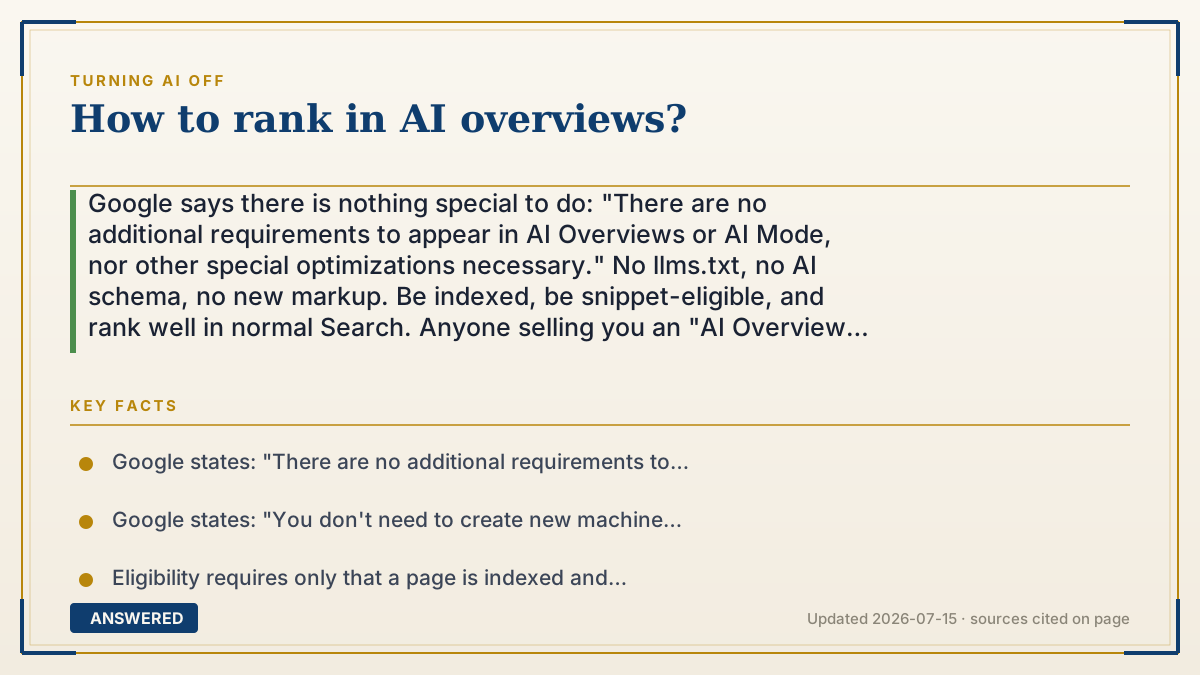
Google says there is nothing special to do: "There are no additional requirements to appear in AI Overviews or AI Mode, nor other special optimizations necessary." No llms.txt, no AI schema, no new markup. Be indexed, be snippet-eligible, and rank well in normal Search. Anyone selling you an "AI Overview optimization" service is selling standard SEO.
Why — the first-principles explanation
The entire "GEO" and "AI Overview optimization" industry rests on an assumption Google has explicitly denied: that AI Overviews run a separate ranking system you can target with separate tactics. Google's own developer documentation states there are no additional requirements and no special optimizations necessary, and adds that "You don't need to create new machine readable files, AI text files, or markup to appear in these features."
This makes sense once you understand how the feature is built. AI Overviews don't crawl the web on their own — they're assembled from Google's existing Search index, using the same retrieval and snippet systems that produce regular results. The model writes a summary from pages Search already surfaced and already considers relevant. So there is no second index to get into and no second ranking to climb. Getting cited in an AI Overview is downstream of ranking in Search, not parallel to it. The eligibility bar Google states is minimal: the page must be indexed and eligible for snippets.
The controls Google gives you all point the same direction — they're subtractive, not additive. `nosnippet`, `data-nosnippet`, and `max-snippet` limit what can be shown from your page. `noindex` removes it. `robots.txt` blocks crawling. `Google-Extended` limits use in other Google AI systems. Notice there is no opposite: no tag that says "please feature me." A system with opt-outs and no opt-ins is telling you plainly that inclusion isn't something you configure.
So the honest strategy is uncomfortable for the SEO industry but simple: rank well, stay snippet-eligible, and write content that answers the question cleanly enough to be worth quoting. That's it. The measurement story confirms it too — Search Console reports AI feature performance inside the ordinary "Web" search type, with no separate AI report. Google isn't tracking it as a separate channel because, on their side, it isn't one.
An example that makes it click
A newspaper columnist writes a weekly roundup quoting local experts. You want to be quoted. So you ask: is there a special form? A quote-submission portal? A "please cite me" tag?
No. She reads the same sources everyone reads, and she quotes whoever said the clearest, most useful thing about this week's topic. There's no side door. You get quoted by being genuinely worth quoting on the beat she already covers. You can tell her never to quote you — that's a real request she'll honor. But there's no matching form for the opposite, and the absence of that form is the whole answer.
How to do it
- Confirm the page is indexed: check it in Google Search Console's URL Inspection tool.
- Confirm it's snippet-eligible: make sure you have not set nosnippet, a restrictive max-snippet, or data-nosnippet on the content you want quoted.
- Rank in normal Search for the query — AI Overviews draw on pages Search already surfaces, so ordinary ranking work is the prerequisite.
- Answer the question directly and early on the page, in plain language, so a clean passage exists to quote.
- Skip the fake work: do not build llms.txt, AI-specific schema, or special markup — Google states none of it is needed to appear in AI features.
- Measure in Search Console under the "Web" search type; there is no separate AI Overviews report.
- If you want out instead: use nosnippet or data-nosnippet to limit what can be shown, noindex to remove the page, or Google-Extended to limit use in other Google AI systems.
Key facts
- Google states: "There are no additional requirements to appear in AI Overviews or AI Mode, nor other special optimizations necessary."
- Google states: "You don't need to create new machine readable files, AI text files, or markup to appear in these features."
- Eligibility requires only that a page is indexed and eligible for snippets — the same bar as standard Search results.
- Available controls are all subtractive: nosnippet, data-nosnippet, max-snippet, noindex, robots.txt, and Google-Extended. No opt-in markup exists.
- Search Console reports AI feature performance under the "Web" search type, with no separate AI-features report.
▶ The 60-second explainer (script)
Google's answer to this is one sentence, and it puts a whole industry out of business. Quote: there are no additional requirements to appear in AI Overviews or AI Mode, nor other special optimizations necessary. That's Google's developer documentation. They go further: you don't need to create new machine readable files, AI text files, or markup to appear in these features. No llms dot txt. No AI schema. Nothing. Here's why that has to be true, mechanically. AI Overviews don't crawl the web themselves. They're built from Google's existing Search index, using the same retrieval and snippet systems that make your normal blue links. The model writes a summary out of pages Search already found and already ranked. So there's no second index to get into. There's no second ranking to climb. Getting cited in an AI Overview is downstream of ranking in Search — not parallel to it. Want proof from the design itself? Look at the controls Google gives you. Nosnippet. Data-nosnippet. Max-snippet. Noindex. Robots dot txt. Google-Extended. Every single one is subtractive — they all limit or remove you. There is no tag that says please feature me. A system with opt-outs and no opt-ins is telling you flat out that inclusion isn't something you configure. So the real playbook is boring. Be indexed. Stay snippet-eligible. Rank for the query. Answer the question early and cleanly so there's a passage worth quoting. That's the whole list. And if someone's selling you AI Overview optimization? They're selling you SEO with a new name on the invoice.
What authoritative sources say
People also ask
Do I need an llms.txt file?
No. Google explicitly states you don't need to create new machine readable files, AI text files, or markup to appear in AI Overviews or AI Mode.
Is there special schema markup for AI Overviews?
No. Google says no special structured data is required. Standard schema still helps with regular rich results, but it isn't an AI Overview lever.
How do I track AI Overview traffic?
In Search Console, under the "Web" search type. Google does not provide a separate AI features report, so AI-driven clicks are blended into your normal Web data.
Can I stop my site appearing in AI Overviews?
Partly. nosnippet and data-nosnippet limit what can be shown, max-snippet caps its length, and noindex removes the page from Search entirely — but there's no AI-Overview-only opt-out that keeps you in normal results.