How to talk to AI?
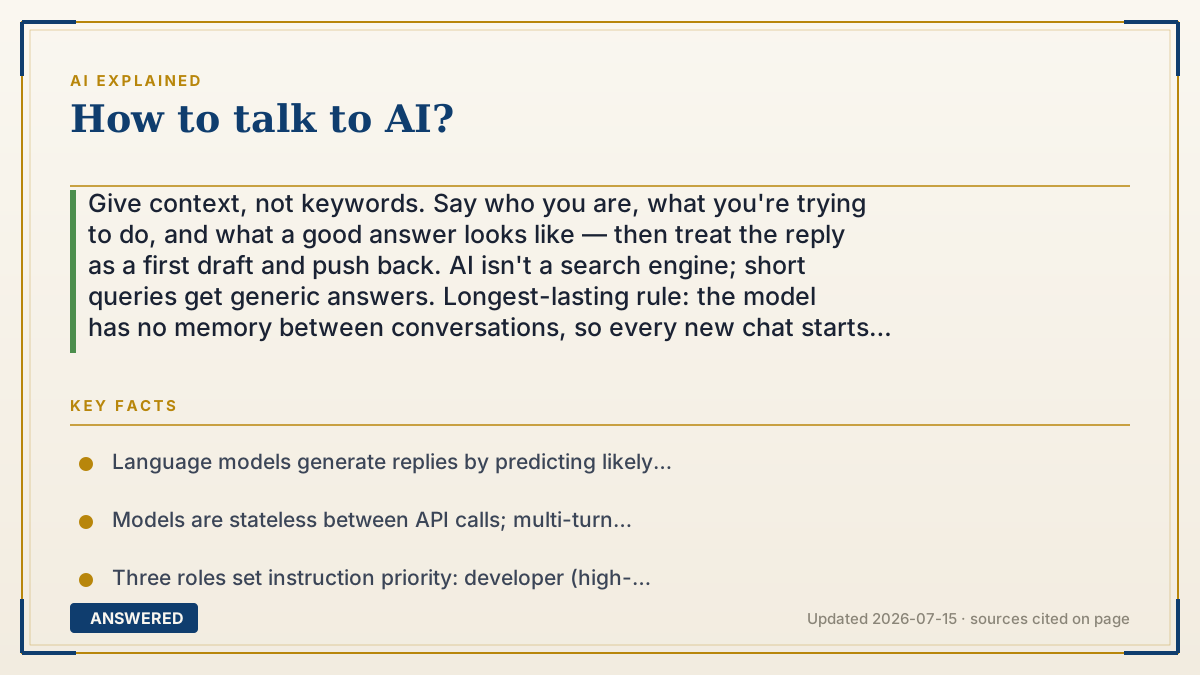
Give context, not keywords. Say who you are, what you're trying to do, and what a good answer looks like — then treat the reply as a first draft and push back. AI isn't a search engine; short queries get generic answers. Longest-lasting rule: the model has no memory between conversations, so every new chat starts from zero.
Why — the first-principles explanation
The habit ruining most people's results is search-engine muscle memory. Google trained us for fifteen years to strip our thoughts down to keywords — "best laptop 2026" — because search matched strings. A language model does the opposite: it predicts the most likely continuation of whatever you wrote. Feed it three vague words and the most likely continuation is a generic listicle, because that's what follows those words across the internet. Feed it a paragraph about your actual situation and the likely continuation becomes specific advice for your situation. More context isn't politeness. It's the mechanism.
The second thing to internalize is that models are stateless. Each conversation starts blank — the model has no memory of yesterday. Within a chat, the app resends the whole transcript with every message, which is why it seems to remember. Open a new chat and you're a stranger again. This is why repeating your context isn't redundant, and why the best users keep a reusable paragraph describing themselves to paste at the top of new chats.
Third: you can set the rules, and the rules outrank the conversation. APIs make this explicit with roles — developer instructions carry higher priority than user messages, which is how a bot stays in character. Consumer apps expose the same thing through custom instructions or system prompts. If you keep fighting the model's default register ("stop being so hedgy," "stop writing essays"), you're fixing it in the wrong place. Put the rule where it persists.
Fourth, and this is where good users separate from frustrated ones: the first answer is a draft, not a verdict. The model optimized for a plausible response to your prompt, not the best possible response to your need. Saying "too generic — I already know the basics, go deeper on the second point" costs three seconds and typically improves the answer more than any amount of prompt engineering. Conversation is the interface. One-shot querying wastes it.
One caution that follows from the same machinery: fluency is not accuracy. The model predicts likely words, so it produces confident sentences whether or not it knows the answer. Its tone carries zero information about its reliability. Ask for sources, paste in the source text yourself, and verify anything that matters.
An example that makes it click
Imagine hiring a brilliant freelancer who starts every job with total amnesia. You could say "write a thing about dogs" and get something bland and shrug. Or you could say: "I run a small grooming shop in Tucson. My clients are older, mostly with small breeds, and they're nervous about handing over their dog. Write a page for my website — plain language, about 200 words, warm but not cutesy, and never say 'furbaby.'"
Same freelancer. Utterly different result. You didn't give better instructions because you were being nice; you gave the only information that made a good answer possible.
And when she hands you the draft, don't sigh and rewrite it yourself. Say "the middle paragraph is too salesy, cut it and add something about how you handle anxious dogs." She'll fix it in seconds. She just can't read your mind — and tomorrow, she won't remember any of this.
How to do it
- Front-load context: who you are, what you're doing, and why. Three or four sentences of setup outperforms any clever phrasing trick.
- State the output you want explicitly — format, length, tone, audience, and what to avoid. 'A 200-word plain-language paragraph for nervous first-time customers' beats 'write something good.'
- Paste in the actual material rather than describing it or asking the model to recall it. Grounding it in real text is the single biggest reduction in made-up answers.
- Ask for the reasoning, not just the conclusion — 'walk me through how you got there' — so you can spot where it went wrong.
- Push back on the first answer. 'Too generic, I know the basics, go deeper on point two' takes three seconds and beats rewriting your prompt from scratch.
- Set persistent rules where they persist: use custom instructions or a system prompt for preferences you have every time. Developer-level instructions outrank in-conversation requests.
- Give an example of what good looks like. One sample of the style you want teaches more than a paragraph of adjectives.
- Start a fresh chat when you switch topics. Old context bleeds into new answers, and models are stateless across conversations anyway.
- Verify anything consequential. Fluent phrasing carries no information about accuracy — ask which sentence in the source supports the claim, and read it yourself.
Key facts
- Language models generate replies by predicting likely continuations of the input, so short keyword-style prompts produce generic output while detailed context produces specific output.
- Models are stateless between API calls; multi-turn conversation works only because the application resends history or chains turns via previous_response_id.
- Three roles set instruction priority: developer (high-priority app instructions), user (lower-priority input), and assistant (model output) — which is why persistent rules belong in system/custom instructions, not in chat messages.
- The instructions parameter applies only to the current request and does not automatically carry forward across chained turns.
- Images can be sent alongside text as URLs, base64 data URLs, or file IDs in PNG, JPEG, WEBP, or non-animated GIF — so 'talking' to AI includes showing it things.
- Fluency is independent of accuracy: because the model optimizes for plausible next words, confident phrasing carries no signal about whether the content is correct.
▶ The 60-second explainer (script)
Talking to AI badly is a habit you learned from Google. Fifteen years of search trained you to strip your thoughts down to keywords — best laptop 2026. But a language model isn't matching strings. It predicts the most likely continuation of what you wrote. Give it three vague words and the likely continuation is a generic listicle, because that's what follows those words across the internet. Give it a paragraph about your actual situation and the likely continuation becomes advice for your situation. More context isn't politeness. It's the whole mechanism. So front-load it: who you are, what you're trying to do, what a good answer looks like. Format, length, tone, what to avoid. And give an example of the style you want — one sample teaches more than a paragraph of adjectives. Second thing: it has no memory. None. Between conversations, you're a stranger every time. Within a chat it only seems to remember because the app resends the whole transcript with every message. So if you have preferences you want every time, put them in custom instructions, not in the chat — those carry higher priority and actually persist. Third, and this is the big one: the first answer is a draft. Say 'too generic, go deeper on point two.' Three seconds. Better than any prompt engineering. And remember — it sounds equally confident whether it knows or not. Fluency tells you nothing about accuracy.
What authoritative sources say
People also ask
Why do I get generic answers?
Your prompt is too short. The model predicts the most likely continuation, and generic input has generic continuations. Add who you are, what you're actually trying to do, and what a good answer looks like.
Does the AI remember me between conversations?
No. Models are stateless — every new chat starts blank. It only appears to remember within a conversation because the app resends the whole transcript each turn. Keep a reusable context paragraph to paste into new chats.
How do I stop it from writing in that annoying AI style every time?
Put the rule in custom instructions or a system prompt rather than asking in the chat. Developer-level instructions carry higher priority than user messages and persist, so you stop re-fighting the same battle.
Should I be polite to AI?
Politeness doesn't matter mechanically, but specificity does — and polite requests are often more specific, which is probably why people notice a difference. Spend your words on context, not courtesy.
Can I trust the answer?
Not on tone. The model optimizes for plausible wording, so it sounds identical whether it's right or inventing. Paste in the source material, ask which sentence supports each claim, and verify anything consequential yourself.