How to track brand mentions in AI search?
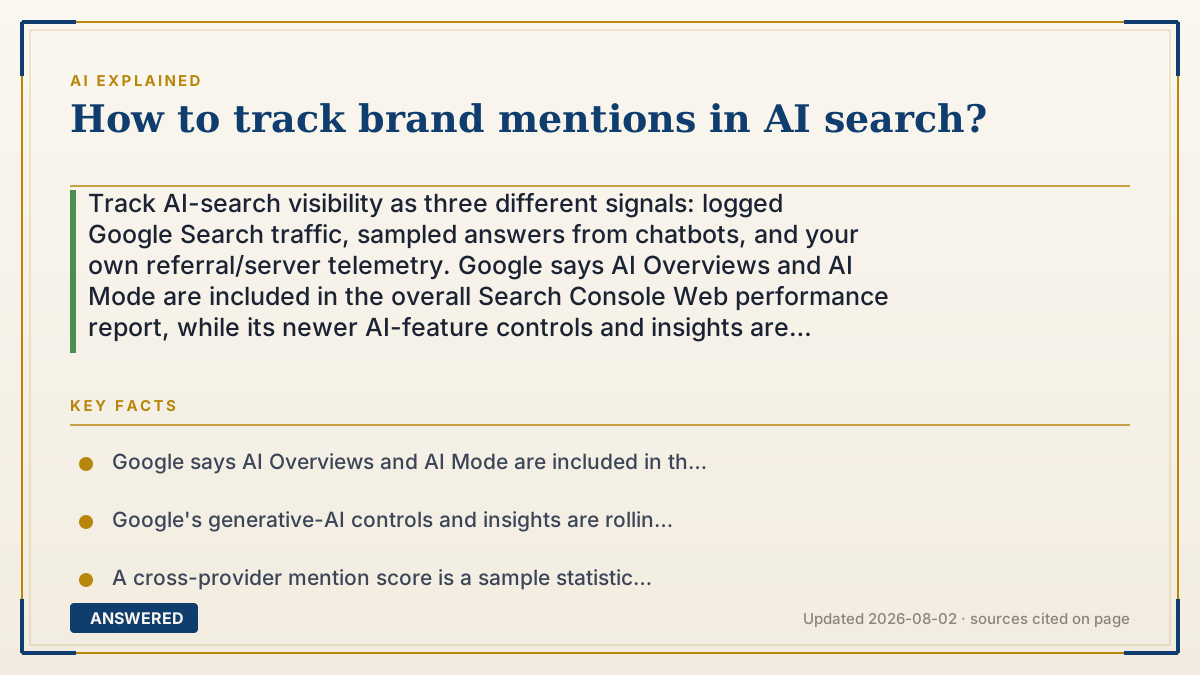
Track AI-search visibility as three different signals: logged Google Search traffic, sampled answers from chatbots, and your own referral/server telemetry. Google says AI Overviews and AI Mode are included in the overall Search Console Web performance report, while its newer AI-feature controls and insights are rolling out. Cross-provider “mention share” is therefore an estimate from a defined prompt set—not a census of every private conversation.
Why — the first-principles explanation
There is no single number called “AI visibility.” Separate the measurement surfaces before building a dashboard.
Logged search behavior is the closest thing to ground truth. Google says pages shown in AI features such as AI Overviews and AI Mode are included in the overall Search Console Performance report under Web search. Google has also announced new controls and insights for generative AI Search features, but those capabilities are rolling out gradually and may not be available to every property or country.
Sampled assistant behavior is different. A tracker can run a fixed set of buyer questions through selected models and record whether your brand appears, how it is described, which position it occupies, and which sources are cited. That is useful observational sampling, not a market-wide count. Results change with model version, location, personalization, session state, prompt wording and randomness. A dashboard's “37% visibility” means “37% of our recorded runs under this method,” not “37% of buyers saw you.”
First-party telemetry closes the loop. Search Console and analytics show real visits; server logs show requests from known crawlers when user agents identify themselves; referral logs may reveal visits from an AI service. None of these proves how often a private answer mentioned a brand. The credible report keeps the denominators separate and connects every claim to the collection method.
An example that makes it click
Suppose a software company wants to know whether AI assistants recommend it for payroll teams. It first records Search Console clicks and impressions for the relevant query group. It then creates a prompt set from sales questions and support tickets, runs the same prompts across selected models and locations, and stores the date, model, answer, cited URLs and brand position. A third table joins AI-referral sessions and conversions. The result can say “our sample mentioned us in 28% of runs and those cited pages drove 14 qualified visits,” but it cannot honestly say “28% of all AI answers mention us.”
How to do it
- Name the surface and denominator. Label each metric as Google Search traffic, sampled assistant output, crawler telemetry or referral traffic; never merge them into one unexplained score.
- Baseline Google Search Console. Record clicks, impressions, queries, countries and pages for the relevant topic; AI-feature traffic is part of the overall Web performance report.
- Check whether the new generative-AI controls or insights are available for your property and market. Record rollout status and date so a missing panel is not mistaken for zero visibility.
- Instrument first-party analytics and server logs. Capture AI referrers, landing pages, conversions and identifiable crawler user agents while respecting privacy and bot-spoofing limits.
- Build the prompt set from real demand: Search Console queries, sales calls, support tickets, community questions and competitor comparisons. Include unbranded discovery prompts.
- Freeze a test protocol. Record model/provider, version, country, language, login state, temperature or other settings, timestamp and number of repeated runs per prompt.
- For every answer, store mention yes/no, rank or order, wording and sentiment, cited sources, links to your pages, and whether the answer contained an incorrect or unsafe claim.
- Read trends with uncertainty. Report sample size, repeat-run variance and confidence intervals or a plain-language caveat; avoid ranking brands from one run or one prompt.
- Use the cited sources as an influence map. Check whether they are authoritative, accurate and worth earning coverage from, then improve your own pages with unique, people-first information and clear evidence.
- Join visibility to outcomes. Compare sampled trends with qualified organic visits, AI referrals, assisted conversions and branded demand; re-run after material model, content or product changes.
Key facts
- Google says AI Overviews and AI Mode are included in the overall Search Console Performance report under the Web search type.
- Google's generative-AI controls and insights are rolling out gradually, so availability and reporting detail can vary by property, market and date.
- A cross-provider mention score is a sample statistic whose denominator is the prompts, models, settings and runs selected by the tracker.
- Prompt wording, model version, location, personalization, session state and randomness can change an assistant's answer.
- A cited source is not the same as a brand mention: record both the brand wording and the URLs used to support the answer.
- Search Console, analytics and server logs show real site behavior, but they cannot reveal every private assistant conversation.
- Unbranded prompts such as “best payroll software for a 50-person company” test discovery better than prompts that name the brand in advance.
- Google's AI-features guidance emphasizes indexability, useful people-first content, internal links, page experience and high-quality supporting media; it does not require a special AI-only file or schema.
- Crawlers identify themselves with user agents that can change or be spoofed; treat crawler hits as telemetry, not proof that a model recommended a brand.
- The most decision-useful report ties a defined sample method to real outcomes such as qualified visits, sign-ups, assisted conversions and correction of inaccurate citations.
Turn AI-search visibility into an auditable growth signal
Keep logged traffic, sampled answers and conversions separate, then use cited sources and people-first SEO improvements to earn durable discovery.
▶ The 60-second explainer (script)
How do you track brand mentions in AI search? Start by separating three things. First, logged Google Search behavior: Google says AI Overviews and AI Mode are included in the overall Search Console Web report, and new AI-feature controls and insights are rolling out. Second, sampled assistant behavior: run real buyer prompts across chosen models and record mentions, wording, position and cited sources. That is a sample, not a census of private conversations. Third, first-party telemetry: analytics, AI referrals and identifiable crawler requests. Keep the denominators separate, freeze the prompt protocol, repeat runs, report uncertainty, and connect the trend to qualified visits and conversions. A dashboard is useful when it explains its method; it is misleading when it turns a small synthetic sample into a claim about the whole market.
What authoritative sources say
People also ask
Can I see exactly how often ChatGPT mentions my brand?
Not through a universal cross-provider analytics feed. You can sample answers with a documented prompt protocol, but report the result as sample visibility with its denominator and date.
Does Search Console break out AI Overviews separately?
Google says AI Overviews and AI Mode are included in the overall Search Console Performance report under Web search. Any newer AI-specific insight or control may depend on rollout and property eligibility.
Why does the same prompt produce different brands?
Model updates, location, personalization, session state, prompt details and randomness can all change an answer. Use repeated runs and report variance rather than treating one response as a stable ranking.
How many prompts should I track?
Start with a manageable set that covers real buyer jobs, branded and unbranded queries, competitors, locations and high-cost edge cases. Expand when Search Console or sales data shows a missing class; there is no universal magic number.
Should I track branded prompts?
Yes, for reputation and accuracy. But discovery prompts without your brand name are essential for measuring whether an assistant would surface you when a buyer has not already decided.
Are AI-visibility tools analytics?
They can automate prompt sampling and comparison. Ask which models, versions, locations, login states and repeat counts they use; describe the output as a sampled signal, not a census.
Do crawler hits prove an AI model cited my site?
No. A crawler request shows that an identified bot requested a resource, and user agents can change or be spoofed. Pair it with page-level citation and referral evidence.
What is the most useful AI-visibility metric?
For growth, use a small scorecard: sampled mention rate with method, cited-source share, qualified AI referrals, conversions and correction rate for inaccurate claims.
How often should I rerun prompts?
Use a fixed cadence that matches change velocity—monthly is a reasonable starting point for many categories—and run an extra check after a model, product, policy or important page changes.
How can SEO improve AI-search visibility?
Follow Google's general guidance: make pages indexable, useful and people-first; demonstrate first-hand expertise, clear structure, strong internal links and evidence; then measure whether real users arrive and convert.
Can I opt out of Google generative AI features?
Google has announced a Search Console control for whether a site appears in and helps ground certain generative AI features, with rollout and availability changing. Check the current control documentation before acting.
The same question, asked other ways
- Is it possible to track brand mentions in AI search?
- Is it possible to track brand mentions in AI answers?