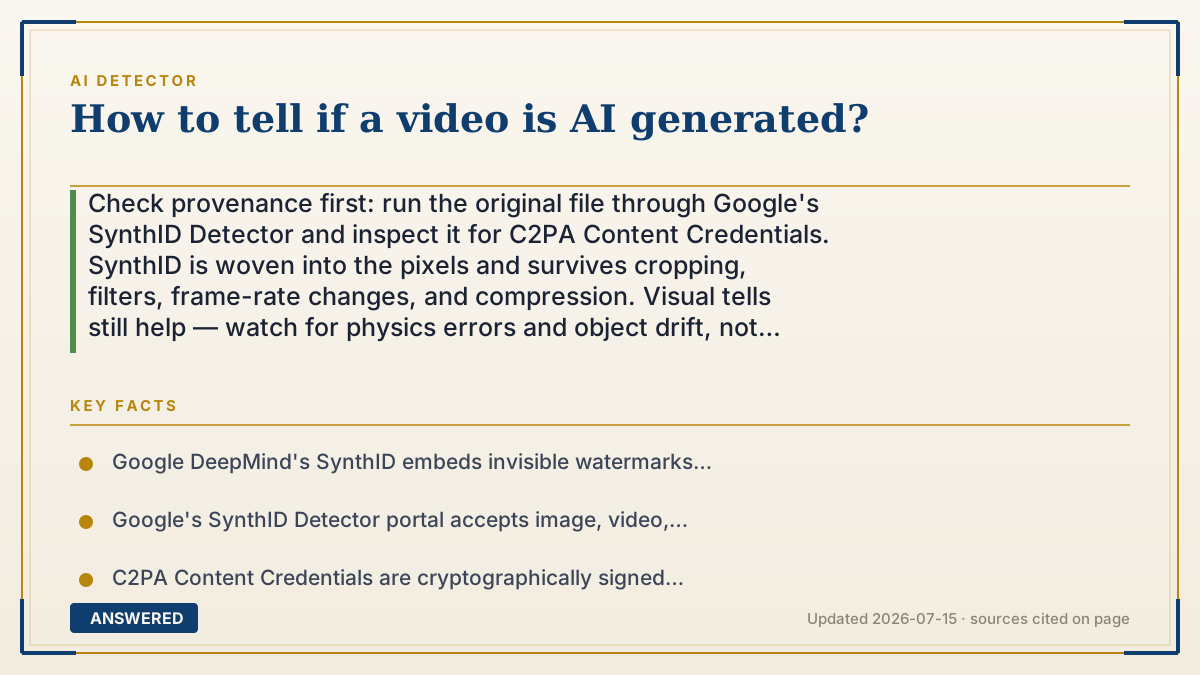
How to tell if a video is AI generated?
Check provenance first: run the original file through Google's SynthID Detector and inspect it for C2PA Content Credentials. SynthID is woven into the pixels and survives cropping, filters, frame-rate changes, and compression. Visual tells still help — watch for physics errors and object drift, not blinking. A hit proves AI; a miss proves nothing.
Why — the first-principles explanation
AI video models generate frames by denoising — starting from static and refining toward a picture your prompt describes. There's no object model underneath. Nothing in the system knows that a coffee cup is a rigid thing that exists continuously, or that a dropped ball accelerates at 9.8 m/s². The model only learned what those look like, frame to frame.
That gap is where the durable tells live, and it's why you should ignore most of the advice you've heard. Appearance is solved; consequence is not. Skin, hair, and lighting look immaculate — those are texture problems, and texture is exactly what these models are good at. What still breaks is anything requiring a thing to persist or obey a rule over time: a hand passing through a railing, a shadow falling the wrong way, a logo on a shirt reshuffling between shots, water that pours without volume, a crowd where one person's stride resets. "Count the blinks" was 2019 advice against an old class of face-swap models and is dead now. Physics and object permanence are the live signal, because they're structurally harder to fix than pretty pixels.
But don't lead with your eyes. Lead with the file. SynthID, from Google DeepMind, embeds an invisible watermark into the pixels of AI video from Google's models, deliberately engineered to survive cropping, added filters, frame-rate changes, and lossy compression — the exact handling social platforms inflict on everything. Google's SynthID Detector portal takes a video upload and reports whether the watermark is there. C2PA Content Credentials are signed metadata attached at creation, naming the tool. Both beat squinting, because both look for something the maker deliberately put there.
And hold the asymmetry firmly, because this is where people go wrong in public. A hit proves AI. A miss proves nothing. A clean scan covers three different worlds: real footage, AI video from a model that doesn't watermark, and AI video whose credentials a platform stripped on upload. The FTC's action against an AI-detection vendor — 98% advertised, roughly 53% in independent testing — is a standing reminder that confidence percentages from pixel-guessing detectors are marketing until proven otherwise.
An example that makes it click
You're watching a magic show on TV. The lighting is perfect, the costumes are perfect, the magician's face is perfect — none of that tells you anything, because the production team is excellent at looks.
What gives it away is a chair leg that's behind the table in one shot and in front of it in the next. Nobody moved it. It just... changed. That's an AI video model: superb at how things look, hopeless at remembering that things are. So don't watch the face. Watch the chair leg. And better yet — check the tape's label before you watch at all.
How to do it
- Get the original file at full quality. Screenshots and screen recordings destroy C2PA metadata and degrade every other signal.
- Run it through Google's SynthID Detector, which accepts video uploads and reports whether a SynthID watermark is present.
- Inspect for C2PA Content Credentials in a C2PA-aware viewer — signed metadata naming the generating tool and logging subsequent edits.
- Reverse image search a few keyframes to find the earliest posting and the original context. This often settles it faster than any analysis.
- Check the clip length. Mainstream text-to-video generations run roughly 5-10 seconds as of 2026-07; longer 'AI' videos are usually many short clips cut together, so look for suspiciously frequent cuts on motion.
- Watch for continuity breaks across cuts: clothing details, logos, jewelry, and background objects that change without anyone touching them.
- Watch for physics, not beauty: shadows falling the wrong direction, contact that doesn't deform anything, liquid without volume, gait that resets, hands passing through solid edges.
- Check the source and the upstream. Does a credible outlet, an eyewitness, or a second angle corroborate the event? Fabricated video usually has no origin trail.
- Report a null result honestly: no watermark and no credentials means unknown origin, not authentic footage.
Key facts
- Google DeepMind's SynthID embeds invisible watermarks into AI-generated video and images from Google models, designed to survive cropping, added filters, frame-rate changes, and lossy compression.
- Google's SynthID Detector portal accepts image, video, and audio uploads and reports whether a SynthID watermark is present; as of 2026-07 it identifies SynthID-marked content, not AI video in general.
- C2PA Content Credentials are cryptographically signed metadata stored in the file wrapper, so a screenshot, screen recording, or metadata-stripping upload removes them entirely while pixel-level watermarks persist.
- Mainstream text-to-video clips run roughly 5-10 seconds per generation as of 2026-07, because temporal coherence decays as frames accumulate — longer AI videos are assembled from many short clips.
- The FTC alleged an AI-detection vendor advertised 98% accuracy when independent testing showed about 53% on general-purpose content; the August 2025 final order requires competent and reliable evidence for effectiveness claims.
- Blink-rate analysis targeted an early generation of face-swap models and is no longer a reliable tell; object permanence and physics violations are the durable failure modes because they are structurally harder to train away than texture.
▶ The 60-second explainer (script)
How do you tell if a video is AI-generated? Start with the file, not your eyes. Google DeepMind's SynthID weaves an invisible watermark into the pixels of AI video from Google's models — built specifically to survive cropping, filters, frame-rate changes, and compression, which is exactly what social platforms do to everything. Google runs a SynthID Detector where you upload the video and it tells you. C2PA Content Credentials are signed metadata attached when the file is made. Both beat squinting, because both look for something the maker deliberately put there. Now, if you have to use your eyes, use them correctly. Here's the principle: appearance is solved, consequence is not. Skin, hair, lighting — flawless. Those are texture problems and these models are great at texture. What still breaks is anything that requires a thing to persist or obey a rule over time. A shadow falling the wrong way. A logo reshuffling between cuts. A hand passing through a railing. Water that pours with no volume. The model never knew a coffee cup is a solid object — it only knew what one looks like. And forget counting blinks. That was advice against face-swap models from 2019. It's dead. Also check the length: real generations run five to ten seconds, so longer AI videos are many clips stitched together — watch for constant cuts on motion. Last thing, and it's the one people get wrong in public: a watermark hit proves AI. No watermark proves nothing at all. Real footage, unwatermarked AI, and stripped metadata all look identical to a scanner. Say 'unknown origin.' Don't say 'real.'
What authoritative sources say
People also ask
Do deepfake detector apps work?
Inconsistently. They're classifiers trained on the generators that existed when they were built, and published lab accuracy degrades sharply on compressed social-media video and on generation methods they've never seen. Use them after provenance checks, not instead of them.
Is counting blinks still useful?
No. Irregular blinking was a quirk of an early class of face-swap models and became a direct training target. Current models blink normally, so blink rate tells you nothing about origin either way.
Can you strip a SynthID watermark by re-encoding?
Not reliably. DeepMind designed it to survive lossy compression, cropping, and frame-rate changes precisely because those are routine. Heavy adversarial processing can degrade any watermark, which is one more reason a negative scan can't clear a video.
Why do AI videos have so many cuts?
Because generations run roughly 5-10 seconds each and characters drift between them. Editors cut on motion to hide the discontinuity, so an unusual density of short shots with no long takes is itself a soft signal.
What if the video has no watermark and no credentials?
Then you know nothing about its origin from the file. Move to the world: reverse image search keyframes for the earliest upload, look for a second angle, and check whether any credible source corroborates the event.
The same question, asked other ways
- How to tell if a video is AI?