How to use Turnitin AI checker?
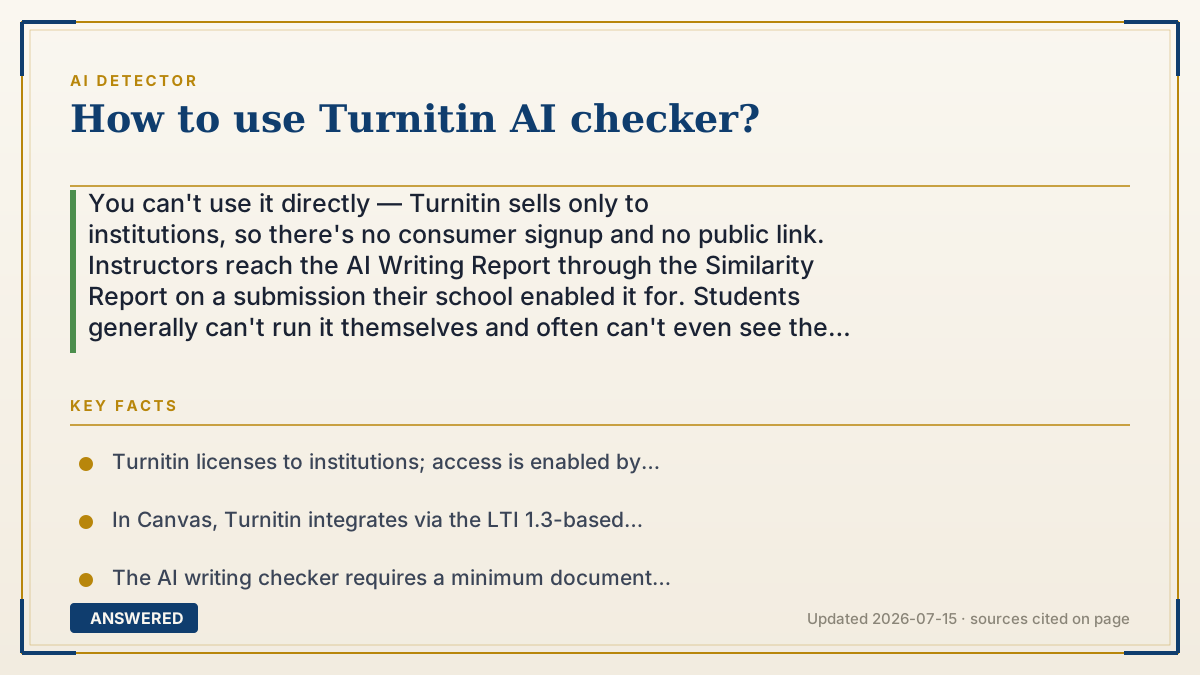
You can't use it directly — Turnitin sells only to institutions, so there's no consumer signup and no public link. Instructors reach the AI Writing Report through the Similarity Report on a submission their school enabled it for. Students generally can't run it themselves and often can't even see the score.
Why — the first-principles explanation
The reason there's no "use Turnitin" button is a deliberate design decision, and understanding it explains the whole workflow.
Turnitin's product is sold to institutions, not people. Access flows down: the school licenses it, an administrator enables AI writing detection, an instructor turns on checks for a specific assignment, and only then does a report exist. Instructure's Canvas integration works exactly this way — Turnitin plugs in via the LTI 1.3 standard, and instructors choose per assignment whether to run full similarity and AI checks, lighter checks on drafts, or none. There is no path around this. Sites promising "free Turnitin AI check" are either running a different detector entirely or are unauthorized resellers with a copy of your essay.
Once it runs, the mechanics are governed by rules you should know before reading any number. The system needs at least 300 words of long-form English prose — bullet points, code, and short answers don't qualify, because the score is an average across sentences and short text makes the average unstable. It scores each sliding window of a few hundred words from 0 to 1, gives each sentence a weighted average, and reports the percentage of sentences that crossed the threshold. Crucially, it suppresses results below 20%: Turnitin found false positives spike below that line, so a low score isn't reported as a finding.
And the most important part of "using" it correctly is knowing what the output is not. It is not a verdict. Turnitin's own position is that instructors must apply professional judgment and context, and its published false positive rate — 0.7% at the document level across 800,000 pre-2019 papers — is small but nonzero, with errors concentrating on plain prose including that of non-native English speakers. Vanderbilt ran the multiplication for its 75,000 annual submissions, got ~750 potentially wrong flags, and disabled the feature in August 2023. Using the tool well mostly means using the number as a reason to read carefully and talk to a person.
An example that makes it click
Turnitin is like the metal detector at a courthouse. You can't buy one and test yourself at home — it belongs to the building. It runs on you when you walk in the door, whether you asked or not, and you don't get to see the screen. The guard does.
And notice what the guard is supposed to do when it beeps: not arrest you. Look in your bag, find your keys, wave you through. The beep was information, not a finding. Turnitin says the same thing about its score in its own documentation — it requires judgment and context. The trouble starts when someone treats the beep as the verdict and skips the part where they look in the bag.
How to do it
- Confirm access: only licensed institutions have Turnitin. There's no individual signup, no free public checker, and no legitimate site that will 'run your paper through Turnitin' for you.
- For instructors — enable it at the assignment level. In Canvas, the Turnitin Advantage Integration (LTI 1.3) lets you choose full similarity and AI checks, lighter review for drafts, or none, when creating the assignment.
- Have the work submitted through the assignment. The check runs on submission; there's no separate 'scan now' step for an ordinary essay.
- Open the Similarity Report for the submission and switch to the AI writing view. The AI score is a separate number from the similarity score — they come from different systems and mean different things.
- Check eligibility before reading the number: 300+ words of long-form English prose. Short answers, bullet lists, and non-English text won't be scored.
- Read the score correctly: it's the share of sentences flagged, not a probability of cheating. Results under 20% are suppressed because false positives rise below that threshold.
- Treat it as a prompt to investigate — compare with the student's earlier writing, check whether cited sources exist, and talk to them. Turnitin states the score requires professional judgment and context, not automatic action.
- For students — you usually can't run it yourself, and whether you can see the report is a setting your instructor controls. Ask before the deadline rather than after.
Key facts
- Turnitin licenses to institutions; access is enabled by administrators and instructors rather than by individual users, and AI detection is configured per assignment.
- In Canvas, Turnitin integrates via the LTI 1.3-based Turnitin Advantage Integration, letting educators choose full similarity and AI checks, lighter review for drafts, or no additional checks.
- The AI writing checker requires a minimum document length of 300 words and is tuned for English only (Turnitin whitepaper, August 2023).
- Only long-form prose written in standard grammatical sentences is analyzed; each sliding window is scored 0–1 and sentence scores are weighted averages of overlapping windows.
- Documents are labeled AI-written only when more than 20% of sentence scores clear the threshold, because Turnitin found a higher incidence of false positives below 20%.
- Turnitin's measured document-level false positive rate is 0.7% across 800,000 pre-2019 papers; Vanderbilt calculated ~750 wrongly flagged papers per year at its 75,000-submission volume and disabled the feature on August 16, 2023.
▶ The 60-second explainer (script)
How do you use Turnitin's AI checker? Here's the thing nobody tells you: you probably can't. Turnitin sells to institutions, not people. There's no consumer signup, no free public link, and any site promising to run your paper through Turnitin is either using a different detector entirely or is an unauthorized reseller now holding a copy of your essay. Access flows downward. The school licenses it. An admin switches AI detection on. Then your instructor decides, per assignment, whether to run it. In Canvas that's the Turnitin integration, and instructors pick full checks, lighter checks on drafts, or nothing. Only then does a report exist. When it does run, know the rules before you read the number. It needs at least three hundred words of long-form English prose. Bullet points, code, short answers — not scored. It slides a window across the text, scores each chunk zero to one, and the percentage you see is just the share of sentences that crossed the line. And it hides anything under twenty percent, because Turnitin found false positives spike below that. Now the part that matters most. That number is not a verdict. Turnitin's own position is that instructors have to apply judgment and context. Their false positive rate is zero point seven percent — small, until Vanderbilt multiplied it by seventy-five thousand papers a year, got seven hundred fifty students, and turned the whole thing off.
What authoritative sources say
People also ask
Can students check their own paper on Turnitin first?
Only if your institution offers a self-check assignment or Draft Coach-style tool, and AI scores are frequently withheld from students entirely. Instructors control report visibility, so many students never see the number.
Are 'free Turnitin AI checker' sites real?
No. Turnitin has no free public checker. Those sites are running some other detector or are unauthorized resellers — and either way you've handed your unpublished work to a stranger.
Why does my report show no AI score?
Common reasons: the document is under 300 words, it isn't long-form English prose, the AI score is below the 20% threshold and suppressed, or your instructor didn't enable AI checking on that assignment.
Does the AI check run automatically?
If your school enabled it and your instructor turned it on for that assignment, yes — it runs on submission alongside the similarity check, no separate action needed.
The same question, asked other ways
- How to use Turnitin AI detector?