How to tell if art is AI generated?
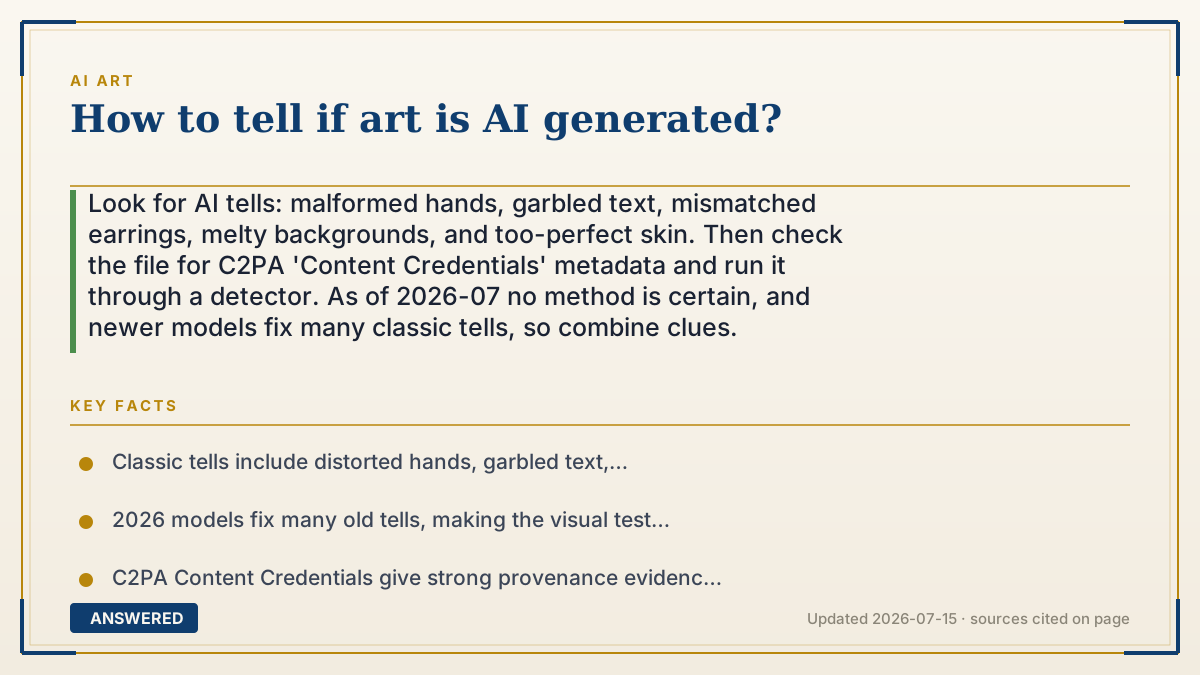
Look for AI tells: malformed hands, garbled text, mismatched earrings, melty backgrounds, and too-perfect skin. Then check the file for C2PA 'Content Credentials' metadata and run it through a detector. As of 2026-07 no method is certain, and newer models fix many classic tells, so combine clues.
Why — the first-principles explanation
Telling AI art apart comes down to spotting where the model's strengths and weaknesses show. Diffusion models are excellent at overall style and mood but historically weak at strict, rule-bound details: exactly five fingers, readable words on a sign, matching earrings, consistent shadows, and unbroken patterns. Those are the classic tells.
The catch in 2026 is that models have gotten much better, so many old giveaways are gone. That makes the eyeball test a weak hint, not proof. A flawless image can still be AI, and a flawed one can be a real amateur photo.
That's why the stronger signal is provenance: many big generators embed C2PA Content Credentials, a tamper-evident label recording that the file was AI-made. If it's there, you have real evidence. But it's easily stripped by screenshots or re-saving, so missing credentials prove nothing.
Finally, detector tools estimate the odds based on pixel-level fingerprints. They're helpful but imperfect, so the reliable habit is to gather several clues and stay humble about certainty.
An example that makes it click
It's like spotting a wig. Up close you might see the hairline looks a little too even, or the part is unnaturally perfect (visual tells). You could also check the tag inside for 'synthetic fiber' (the metadata). And you could ask a stylist for their expert guess (a detector).
Any one of these can fool you, a great wig has no obvious tells, and the tag might be cut out. So you look at everything together before you decide.
How to do it
- Zoom into hands, fingers, teeth, and any text or logos for errors.
- Check fine details: earrings, patterns, reflections, and background objects that don't quite make sense.
- Inspect the file for C2PA Content Credentials using a verify tool.
- Run it through a detector like Hive or Sightengine for a probability estimate.
- Weigh all clues together instead of trusting a single tell.
Key facts
- Classic tells include distorted hands, garbled text, asymmetric accessories, and melty backgrounds.
- 2026 models fix many old tells, making the visual test unreliable on its own.
- C2PA Content Credentials give strong provenance evidence when present but can be stripped.
- Detector tools reach ~94-97% in labs but can fall below 50% on compressed or social-media images.
- False positives happen: real photos are sometimes flagged as AI.
▶ The 60-second explainer (script)
How can you tell if a piece of art is AI-generated? Start with the eyes: look at hands and fingers, any text or logos, earrings, patterns, and reflections. AI is great at mood but historically bad at these strict details. But here's the 2026 reality, models have gotten so good that many old tells are gone, so a clean image can still be AI. That's why you shouldn't stop at looking. Check the file for C2PA Content Credentials, a built-in label that says an image was AI-made. If it's there, that's strong proof, though a screenshot can strip it. And run it through a detector like Hive or Sightengine for a probability. Each method misses some cases, and detectors sometimes flag real photos. So gather several clues, and stay humble, because no single check is proof.
What authoritative sources say
People also ask
Are weird hands still a reliable sign?
Less so in 2026. Newer models render hands and text well, so treat tells as hints, not proof.
Is checking metadata foolproof?
No. If C2PA credentials are present it's strong evidence, but missing credentials don't prove a human made it.
Can a detector be trusted alone?
Not fully. Detectors miss some AI images and flag some real ones, especially after compression.
What's the best overall approach?
Combine visual inspection, metadata check, and a detector, then judge the weight of the evidence.
The same question, asked other ways
- How to spot AI art?
- Is it AI or human made art?