What age groups are the most affected by AI misinformation?
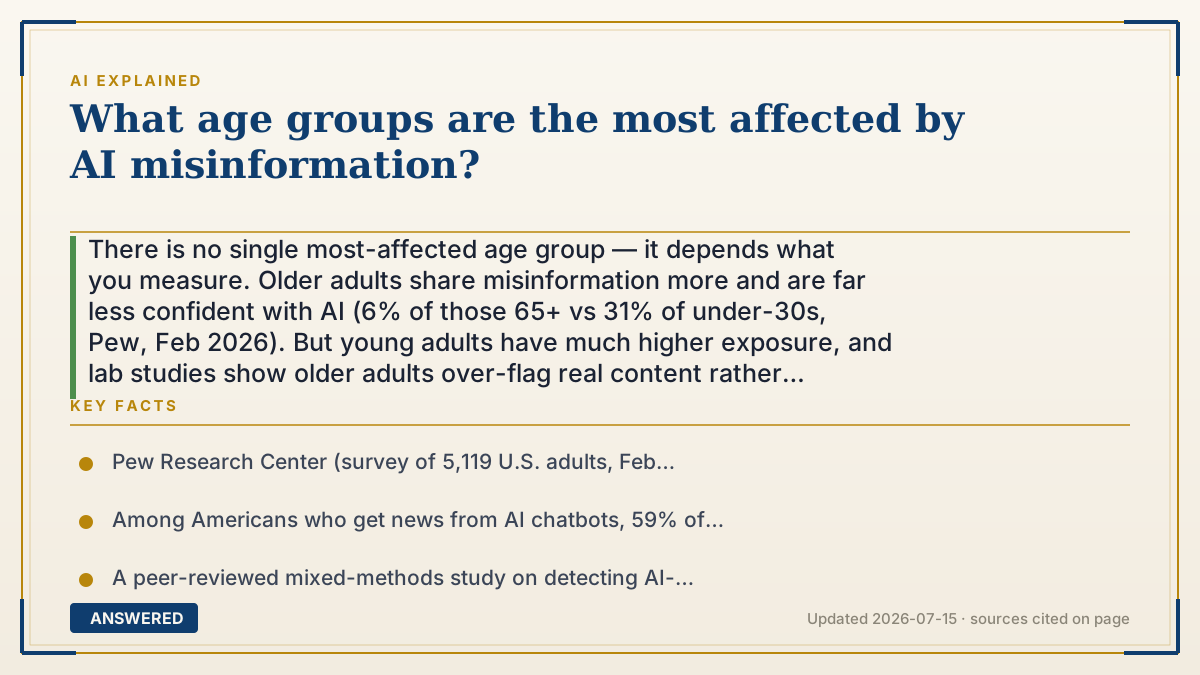
There is no single most-affected age group — it depends what you measure. Older adults share misinformation more and are far less confident with AI (6% of those 65+ vs 31% of under-30s, Pew, Feb 2026). But young adults have much higher exposure, and lab studies show older adults over-flag real content rather than miss fakes.
Why — the first-principles explanation
The reason this question has no clean answer is that "affected" hides three different measurements that point in different directions.
Exposure — how much AI content you encounter. This skews young. Under-30s live in algorithmic feeds where synthetic media concentrates, and among Americans who get news from AI chatbots, 59% of under-30s say they at least sometimes encounter news they think is inaccurate, versus 36% of those 65 and older. But read that carefully: it partly measures noticing, not just encountering. A group that spots more inaccuracy may simply be looking harder.
Detection skill — whether you can tell real from fake. Here the finding is counterintuitive. A study on age-related differences in detecting AI-generated images found older adults showed significantly higher false alarms than younger adults — meaning they wrongly flagged authentic images as fake. That is over-suspicion, not gullibility. It is the opposite of the popular story about credulous grandparents, and it has a real cost: distrusting true information is its own kind of harm.
Sharing behavior — what you actually pass on. This is where older adults look worse. Observational data on real online behavior indicates older adults are more likely to share misinformation than younger adults. This is the most consequential measure, because sharing is what spreads harm to others rather than just to yourself.
So why does the picture flip depending on the lens? Because different mechanisms are at work. Young adults have high exposure and high platform fluency — they see more and are trained by the environment to distrust it. Older adults have less exposure but face a skill-confidence gap: Pew found only 6% of adults 65+ are extremely or very confident using AI chatbots, versus 31% of adults under 30. Low familiarity produces both over-flagging in a lab and, in the wild, difficulty judging which cues matter. Meanwhile sharing is driven less by detection ability than by social motivation and platform norms.
The honest conclusion: pick your metric and you pick your answer. Older adults are more affected on sharing; young adults are more affected on exposure; and on detection, older adults err toward false alarms rather than being fooled. Anyone reporting a single "most vulnerable age group" has quietly chosen one of these and hidden the other two.
An example that makes it click
Imagine two people getting a suspicious phone call. The 22-year-old gets forty spam calls a week, so she's been trained to assume everything is fake — she hangs up on real calls too, but she rarely gets scammed. The 70-year-old gets three calls a week and has less practice, so his judgment is shakier: sometimes he's suspicious of his actual pharmacy, and when he does believe a call, he's more likely to tell his friends about it.
Who's "more affected"? The young woman gets hit far more often. The older man passes it on more when it lands. Those are two different harms, and there's no single number that captures both. That's exactly the trap in this question.
Key facts
- Pew Research Center (survey of 5,119 U.S. adults, Feb 17–23, 2026) found confidence using AI chatbots falls sharply with age: 31% of ages 18–29 are extremely/very confident, 23% of 30–49, 12% of 50–64, and 6% of 65+.
- Among Americans who get news from AI chatbots, 59% of adults under 30 say they at least sometimes encounter news they believe is inaccurate, versus 36% of those 65 and older.
- A peer-reviewed mixed-methods study on detecting AI-generated images found older adults produced significantly higher false alarms than younger adults — over-identifying authentic images as AI-generated.
- Observational data on real online behavior indicates older adults are more likely to share misinformation than younger adults.
- Ofcom's 2026 UK research found confidence in spotting AI-generated content is mixed overall: 44% feel confident and 31% are unsure or neutral, with about one-third of UK adults not confident judging whether an image, audio, or video was AI-created.
- Pew found AI assistants frequently misrepresent news content, meaning exposure to AI-mediated inaccuracy is a platform-level issue, not only a user-skill issue.
▶ The 60-second explainer (script)
Which age group is most affected by AI misinformation? Here's the honest answer: it depends entirely on what you measure — and that's not a dodge, it's the actual finding. "Affected" hides three different things. Exposure. Detection. Sharing. And they point in different directions. Exposure skews young. Among Americans getting news from AI chatbots, fifty-nine percent of under-thirties say they run into news they think is inaccurate — versus thirty-six percent of the sixty-five plus crowd. But careful: that partly measures noticing, not just encountering. Detection is where it gets surprising. A study on spotting AI-generated images found older adults had significantly more false alarms — they wrongly flagged real photos as fake. That's over-suspicion, not gullibility. The opposite of the credulous-grandparent story. And it has a real cost: distrusting true information is its own harm. Sharing is where older adults look worse. Observational data on actual behavior shows they pass misinformation on more often. And that's the one that hurts other people, not just yourself. Why the flip? Different mechanisms. Young people see more and have been trained by the environment to distrust everything. Older adults face a confidence gap — Pew found only six percent of adults sixty-five plus feel confident using AI chatbots, against thirty-one percent of under-thirties. So pick your metric, pick your answer. Anyone selling you one vulnerable age group just quietly chose one and hid the other two.
What authoritative sources say
People also ask
Are older people more gullible about AI content?
The lab evidence points the other way. In image-detection testing, older adults produced more false alarms — flagging real content as fake. That is over-suspicion, not gullibility, though it carries its own cost.
Then why do older adults share more misinformation?
Sharing is driven more by social motivation and platform habits than by detection skill. Observational studies of real behavior consistently find higher sharing rates among older adults, even where detection differences are small or reversed.
Are young people safe from AI misinformation?
No. They have far higher exposure, and 59% of under-30s who get news from AI chatbots report encountering content they think is inaccurate. High familiarity reduces some risks and not others.
Why do studies disagree?
Because they measure different outcomes — exposure, detection accuracy, false-alarm rate, or sharing — and use different methods (surveys vs lab tasks vs observed behavior). A study's design largely determines which age group looks worse.
What actually helps?
Evidence supports specific, checkable habits over general warnings: verifying claims at the source, pausing before sharing, and lateral reading. Nudge interventions have been tested across age groups with modest but measurable effects.