What are the benefits and risks of AI in schools?
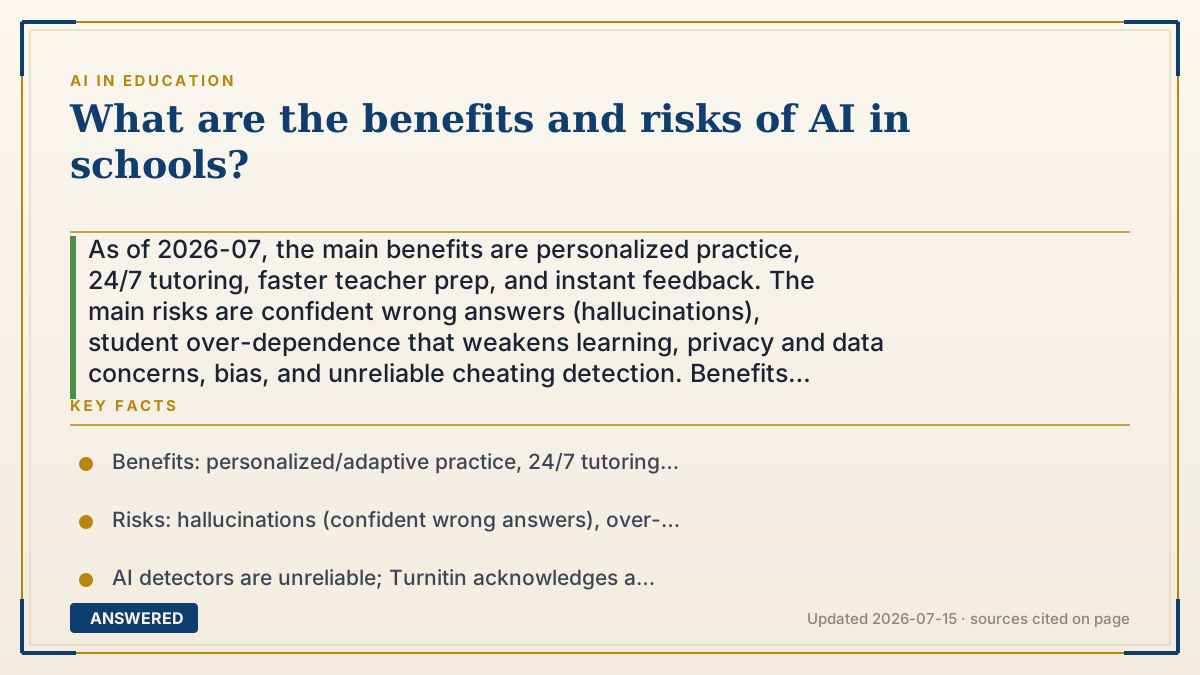
As of 2026-07, the main benefits are personalized practice, 24/7 tutoring, faster teacher prep, and instant feedback. The main risks are confident wrong answers (hallucinations), student over-dependence that weakens learning, privacy and data concerns, bias, and unreliable cheating detection. Benefits appear when a human stays in the loop; risks grow when AI replaces thinking.
Why — the first-principles explanation
Both the benefits and the risks flow from one fact: an AI language model generates fluent text by predicting likely words from huge datasets. That single ability is why it's helpful, and why it's dangerous. Because it produces good-looking text instantly, it can personalize practice, draft lessons, and give feedback at scale. Because it only predicts plausible words, it can also produce confident falsehoods and absorb the biases in its training data.
The benefits cluster around scale and speed. One teacher can differentiate a lesson into three reading levels in minutes; one student can get an explanation retried five different ways at midnight. Adaptive software tailors difficulty to each learner, and instant feedback lets students revise before a grade is on the line. These are real gains, especially for stretched teachers and students who lack access to tutors.
The risks cluster around trust and effort. Hallucinations mean a learner can absorb errors; over-reliance means the brain skips the effortful practice that actually builds skill; privacy concerns arise when student data flows to outside companies; and cheating detection is unreliable, so it can falsely accuse honest students. The through-line in every serious guideline, including the Department of Education's, is that a human must stay in the loop, checking accuracy, protecting data, and designing tasks that still require students to think.
An example that makes it click
Think of AI in school like a powerful power tool, say a nail gun, on a construction site. In a trained worker's hands, it does in seconds what a hammer does in minutes, so the whole house goes up faster. That's the benefit. But hand it to someone untrained, or let it fire unsupervised, and it can drive a nail into the wrong beam, or into a hand. That's the risk.
The tool didn't change; the supervision did. AI raises test scores and saves teacher hours when a knowledgeable human guides it, and it spreads errors and dependence when it runs unchecked.
Key facts
- Benefits: personalized/adaptive practice, 24/7 tutoring access, faster lesson prep, and instant draft feedback.
- Risks: hallucinations (confident wrong answers), over-dependence weakening learning, privacy/data concerns, and bias.
- AI detectors are unreliable; Turnitin acknowledges a sentence-level false-positive rate near 4%.
- The U.S. Department of Education's 2023 report stresses 'humans in the loop' as the key safeguard.
- Adaptive tools work best in subjects with clear right answers, like early math and reading.
▶ The 60-second explainer (script)
What are the benefits and risks of AI in schools? Both come from the same fact: AI generates fluent text by predicting likely words. That's why it's useful, and why it's risky. The benefits are about scale and speed. One teacher can turn a lesson into three reading levels in minutes. One student can get a concept explained five different ways at midnight. Adaptive apps tailor difficulty to each kid, and instant feedback lets students fix drafts before a grade counts. Now the risks. Because AI only predicts plausible words, it can be confidently wrong, so learners can absorb errors. Over-reliance lets the brain skip the effort that builds real skill. There are privacy concerns when student data leaves the school, plus bias, and cheating detectors that can falsely accuse honest kids. Notice the pattern: benefits show up when a knowledgeable human guides the tool, and risks grow when it runs unchecked. That's why every serious guideline says keep a human in the loop.
What authoritative sources say
People also ask
What's the single biggest benefit of AI in schools?
Personalization at scale: giving each student practice and feedback matched to their level, which one teacher can't do alone.
What's the biggest risk?
Over-dependence that skips real learning, closely followed by confident wrong answers that students may believe.
Are privacy concerns serious?
Yes. Student data flowing to outside companies is a real concern, which is why schools prefer education-specific accounts with stronger protections.
Do the benefits outweigh the risks?
They can, but only with human oversight, privacy protection, and task designs that keep students thinking.
The same question, asked other ways
- Do the risks of AI in schools outweigh the benefits?