What is AI governance?
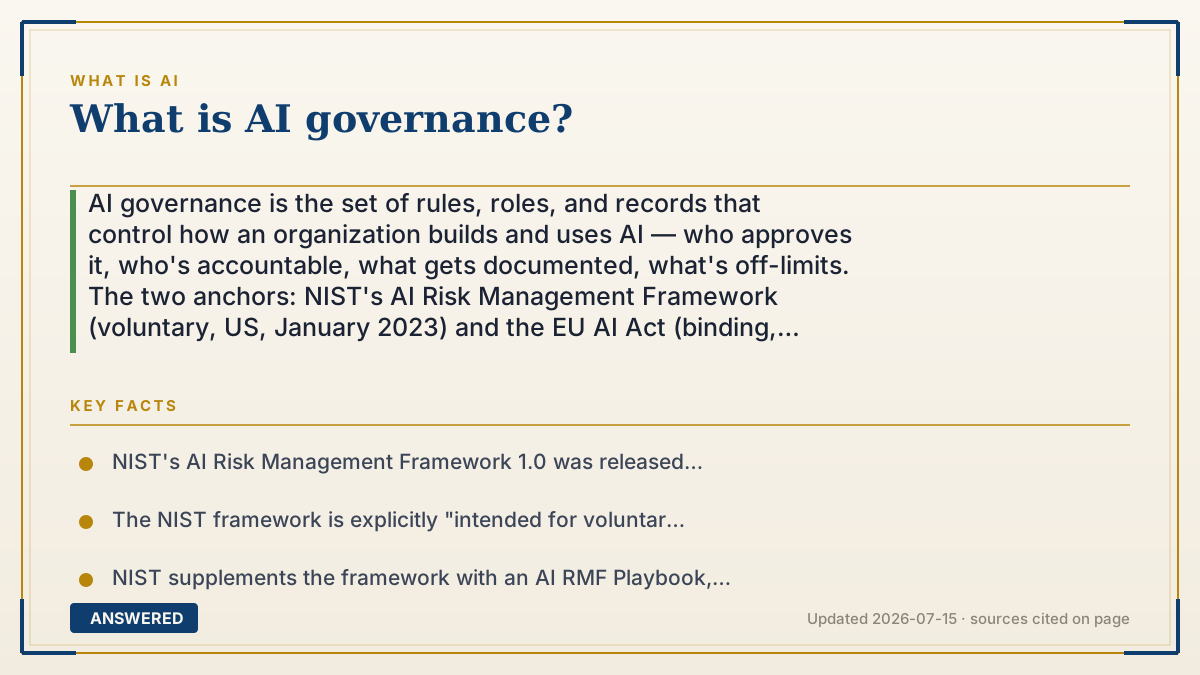
AI governance is the set of rules, roles, and records that control how an organization builds and uses AI — who approves it, who's accountable, what gets documented, what's off-limits. The two anchors: NIST's AI Risk Management Framework (voluntary, US, January 2023) and the EU AI Act (binding, Regulation 2024/1689).
Why — the first-principles explanation
AI governance exists because AI breaks the assumption underneath every existing control system: that a person made the decision and can explain it.
Traditional corporate controls work by naming a decision-maker. Someone approved the loan; if it was wrong, you ask them why. AI removes that anchor. The model decided, based on patterns nobody wrote and often can't articulate, using data collected by another team, deployed by a third, inside a product owned by a fourth. Every step is defensible on its own and nobody owns the outcome. Governance is the machinery for putting the anchor back — assigning an accountable human to a decision that no single human made.
That's why real governance is mostly boring paperwork, and why the boring parts are the whole point. You need an inventory (which AI systems do we even run? — most large firms genuinely don't know), classification by risk (a chatbot answering FAQs is not a system deciding who gets hired), an approval gate before deployment, documentation of training data and known limits, monitoring after launch, and a named owner for each system.
The two reference points differ in a way that matters. NIST's AI Risk Management Framework, released January 26, 2023, is structured around four functions — Govern, Map, Measure, Manage — and is explicitly voluntary. It tells you how to think; it can't make you. The EU AI Act is law. It sorts AI by risk tier, bans some uses outright, imposes duties on high-risk systems, and has applied to general-purpose AI models since August 2, 2025. If you sell into the EU, governance stopped being a values exercise and became a compliance requirement.
The honest tension: governance costs time and slows shipping, and voluntary frameworks lose that fight regularly. That asymmetry — not disagreement about ethics — is why the EU wrote a statute.
An example that makes it click
A restaurant kitchen doesn't stay safe because the chefs care about food poisoning. It stays safe because of a system: a thermometer log, a named person on closing duty, a rule that raw chicken never touches the salad board, and an inspector who shows up unannounced. Take away the paperwork and everyone still cares — people just get sick anyway.
AI governance is the kitchen log for algorithms. Which models are running, who's responsible for each one, what temperature they were last checked at, what they're not allowed to touch. It's unglamorous, and it's the only thing standing between "we value fairness" and actually knowing what your systems did last Tuesday.
How to do it
- Build an inventory: list every AI system in use, including vendor tools and features quietly added to software you already bought.
- Classify each system by risk. Decisions about employment, credit, housing, education, or safety sit at the top; internal drafting tools sit near the bottom.
- Name an accountable owner for every system — a person, not a committee.
- Set an approval gate before deployment, with documentation of purpose, data sources, known limitations, and tested failure modes.
- Define prohibited uses in writing, including what data may never be entered into third-party AI tools.
- Monitor after launch. Model behavior drifts as the world changes; a system validated at launch is not validated forever.
- Map your obligations if you operate in the EU — the AI Act applies by risk tier and its GPAI rules have been in force since August 2, 2025.
Key facts
- NIST's AI Risk Management Framework 1.0 was released January 26, 2023 and is organized around four functions: Govern, Map, Measure, and Manage.
- The NIST framework is explicitly "intended for voluntary use" and carries no legal force in the US.
- NIST supplements the framework with an AI RMF Playbook, Roadmap, and Crosswalks, plus a Generative AI Profile (NIST-AI-600-1) released July 26, 2024.
- The EU AI Act is Regulation (EU) 2024/1689, adopted June 13, 2024 — binding law, not guidance.
- EU governance rules and obligations for general-purpose AI models became applicable on August 2, 2025.
- As of 2026-07 the US has no comprehensive federal AI statute equivalent to the EU AI Act; NIST AI RMF 1.0 is being revised.
▶ The 60-second explainer (script)
AI governance is the set of rules, roles, and records that control how an organization builds and uses AI. And it exists because AI breaks the assumption underneath every control system we already had: that a person made the decision and can explain it. Think about how normal corporate controls work. Someone approved the loan. If it was wrong, you go ask them why. AI removes that anchor. The model decided, using patterns nobody wrote, on data collected by one team, deployed by a second, inside a product owned by a third. Every step looks defensible alone. Nobody owns the outcome. Governance is the machinery for putting the anchor back. That's why real governance is mostly boring paperwork — and why the boring parts are the entire point. You need an inventory: which AI systems do we actually run? Most big companies genuinely don't know. You need risk classification, because a chatbot answering FAQs is not the same as a system deciding who gets hired. You need an approval gate. Documentation of training data and known limits. Monitoring after launch, because models drift as the world changes. And a named owner for each system — a person, not a committee. Two anchors matter. NIST's AI Risk Management Framework, January 2023, built around four functions: Govern, Map, Measure, Manage. It's explicitly voluntary. It tells you how to think; it can't make you do anything. The EU AI Act is law. Risk tiers, outright bans on some uses, real duties for high-risk systems, and rules covering general-purpose models since August 2025. Here's the honest tension. Governance costs time and slows shipping. Voluntary frameworks lose that fight, over and over. That asymmetry is exactly why Europe wrote a statute instead of a suggestion.
What authoritative sources say
People also ask
What's the difference between AI governance and AI ethics?
Ethics asks what's right. Governance is the machinery that makes it happen — inventories, owners, approval gates, documentation, and audits. Ethics without governance is a poster on a wall.
Is AI governance legally required?
In the EU, yes — the AI Act is binding, with general-purpose AI obligations since August 2, 2025. In the US there's no equivalent federal statute, and the NIST framework is voluntary.
What is the NIST AI RMF?
The US voluntary standard for AI risk, released January 26, 2023. It organizes work into four functions — Govern, Map, Measure, Manage — and ships with a Playbook and Generative AI Profile.
Where should a company start with AI governance?
With an inventory. You cannot govern systems you can't list, and most organizations underestimate how many AI features vendors have added to tools they already use.