What is AI ethics?
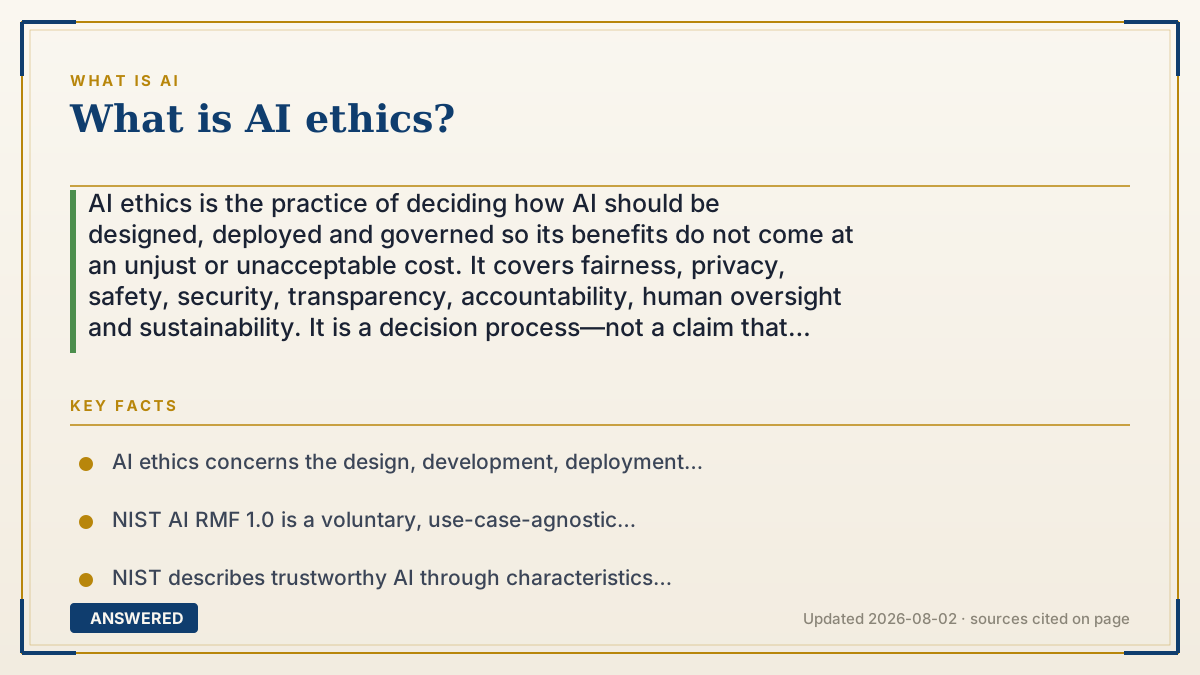
AI ethics is the practice of deciding how AI should be designed, deployed and governed so its benefits do not come at an unjust or unacceptable cost. It covers fairness, privacy, safety, security, transparency, accountability, human oversight and sustainability. It is a decision process—not a claim that an AI tool is simply “ethical” or “unethical.”
Why — the first-principles explanation
AI ethics is not about whether a machine has a conscience. It is about the human choices around a socio-technical system: what problem is automated, whose data and interests shape it, who can be harmed, who can challenge an output, and who is accountable when the system fails. The same model can be acceptable for drafting a low-stakes outline and unacceptable for making an unreviewed eligibility decision. Context is part of the ethics.
The risks enter throughout the lifecycle. Historical data can encode unequal access; labels can reflect past decisions rather than the outcome we actually want; an objective can reward the wrong proxy; a user can over-trust a fluent answer; and a deployment can expose private data or create a security path into another system. Bias is therefore broader than a biased model parameter, and a high benchmark score does not prove that a use is fair or safe.
Major frameworks converge on values but do not turn them into one universal score. NIST describes trustworthy AI characteristics such as validity and reliability, safety, security and resilience, accountability and transparency, explainability and interpretability, privacy enhancement, and fairness with harmful bias managed. OECD's five values-based principles emphasize inclusive growth and well-being; human rights, fairness and privacy; transparency and explainability; robustness, security and safety; and accountability. UNESCO places human rights and dignity, proportionality, do-no-harm, oversight, sustainability, inclusion and redress at the center. These are lenses for tradeoffs, not a certificate.
The useful move is to operationalize values. NIST's AI Risk Management Framework uses four functions: Govern, Map, Measure and Manage. Govern assigns policies, roles and accountability. Map describes the purpose, context, affected people and plausible harms. Measure tests performance, safety, privacy, security, fairness and explainability with evidence. Manage chooses mitigations, monitoring, escalation and stop conditions. The loop repeats when data, models, users or risks change.
Ethics and law overlap but are not synonyms. NIST's framework is voluntary; legal duties depend on the jurisdiction, sector, contract and use case. The EU AI Act entered into force on 1 August 2024, with prohibitions and AI-literacy obligations applying from 2 February 2025, general-purpose AI obligations from 2 August 2025, and the regulation's general application date on 2 August 2026 subject to stated exceptions and transition rules. That timeline does not answer whether a particular deployment is lawful, and it is not a substitute for qualified legal advice.
A responsible product claim should therefore be specific. Say what data is used, for what purpose, under whose authority, with what retention and access controls; publish meaningful limitations; test relevant groups and contexts; preserve a human route to review or appeal; log decisions and incidents; and name the person or organization that can pause or remediate the system. “Powered by ethical AI” without those details is marketing, not evidence.
For a buyer, ethics is a selection criterion and an operating cost. Ask for model cards or system documentation, evaluation results, data-processing terms, security controls, auditability, deletion and export paths, incident notification, accessibility, and a clear division of provider versus deployer responsibility. Prefer a tool whose controls match the stakes of your use case, even if it is less feature-rich.
The ethical question is ultimately comparative: is AI necessary for this goal, is this level of automation proportionate, and is the expected benefit worth the residual risk after safeguards? Sometimes the right answer is to use a smaller model, keep a human in the loop, limit the data, narrow the action, or not automate at all.
An example that makes it click
Imagine a hospital using a model to prioritize follow-up calls. A high overall accuracy number is not enough. The team must ask whether the training labels reflect actual need, whether language or disability changes error rates, whether the model sees more data than necessary, whether a nurse can override a recommendation, and whether a patient can get an explanation or correction. The ethical work is the evidence, ownership and remedy around the prediction—not the word “AI” in the product description.
How to do it
- Write the intended purpose in one sentence and name what the system must not decide. First ask whether automation is necessary and proportionate to the goal.
- Map affected people, non-users, downstream recipients and groups likely to bear errors. Include accessibility, language, geography and power differences instead of treating one average user as everyone.
- Inventory the data and inputs: provenance, consent or authority, sensitive fields, retention, sharing, licensing, quality and known gaps. Do not send more data than the task requires.
- Define harm scenarios and measurable acceptance criteria for accuracy, reliability, safety, security, privacy, fairness, explainability and environmental or resource impact where relevant.
- Test before launch and after meaningful changes. Compare error types and outcomes in the contexts and groups that matter; document uncertainty, sample limits and residual risk.
- Design human oversight as a real control: a trained reviewer, sufficient time, access to evidence, authority to override, and a route for the affected person to ask for correction or appeal.
- Assign accountability across provider, integrator, deployer and operator. Put data use, model changes, audit access, incident notice, deletion and exit rights in the contract rather than relying on a brochure.
- Log inputs, versions, prompts or policies, outputs, overrides and incidents in a privacy-conscious way. Set triggers for investigation, rollback, restricted use or shutdown.
- Tell users when and how AI is involved, what it can and cannot do, and how to obtain human help. Make the disclosure meaningful for the context, not a buried legal sentence.
- Review the deployment on a schedule and when the purpose, data, model, users or surrounding risks change. If safeguards cannot reduce residual risk to an acceptable level, narrow the use or stop it.
Key facts
- AI ethics concerns the design, development, deployment and governance of AI systems and their effects on people, society and the environment; it is not a test of whether a model has intentions.
- NIST AI RMF 1.0 is a voluntary, use-case-agnostic resource and organizes risk work into Govern, Map, Measure and Manage; NIST says a revised version is in progress.
- NIST describes trustworthy AI through characteristics including validity and reliability, safety, security and resilience, accountability and transparency, explainability and interpretability, privacy enhancement, and fairness with harmful bias managed.
- The OECD AI Principles, updated in 2024, set five values-based principles: inclusive growth and well-being; human rights, fairness and privacy; transparency and explainability; robustness, security and safety; and accountability.
- UNESCO's Recommendation on the Ethics of Artificial Intelligence was adopted by 193 Member States in 2021 and uses a human-rights approach that includes proportionality, safety, privacy, accountability, transparency, human oversight, sustainability and fairness.
- Ethical principles can conflict. More transparency can create privacy or security risk, and a fairness metric that improves one group-level outcome may change another; the tradeoff and rationale must be documented.
- A model's average benchmark or an ethics badge does not prove that a particular deployment is safe, fair or lawful. Evidence must match the use case, affected people and decision stakes.
- The EU AI Act is binding law in the EU, while NIST, OECD and UNESCO materials are frameworks or recommendations; obligations vary by jurisdiction, sector, role and use case.
- Google's AI Principles describe human oversight, due diligence, rigorous design/testing/monitoring, safeguards, privacy, security and intellectual-property respect as part of responsible development and deployment.
- Responsible AI requires an accountable owner and a remedy. If no person can pause the system, investigate an incident or correct an affected person's outcome, the governance design is incomplete.
Turn AI ethics principles into deployment decisions
Define the use case, identify affected people, test performance and harms, assign a human owner, and document what happens when the system is wrong. Compare tools on evidence and controls—not on an “ethical AI” marketing badge.
▶ The 60-second explainer (script)
What is AI ethics? It is the practice of deciding how AI should be built and used so its benefits do not come at an unjust or unacceptable cost. It is not about whether a model has a conscience, and it is not an “ethical AI” badge. Ask five lifecycle questions: What is the purpose? Whose data and interests shape the system? What can go wrong? Who reviews and can override an output? Who fixes the harm? NIST makes this operational with Govern, Map, Measure and Manage. OECD and UNESCO add human rights, fairness, privacy, transparency, safety, accountability, oversight and sustainability. The law is separate and jurisdiction-specific: NIST is voluntary, while rules such as the EU AI Act create binding duties for covered actors. Before adopting a tool, request evidence, data-processing terms, evaluation results, human review, audit logs, incident notice and an exit path. If no one can pause or remediate the system, the ethics design is incomplete.
What authoritative sources say
People also ask
What does AI ethics mean in simple terms?
It means making and using AI in a way that respects people, limits avoidable harm and gives someone accountable the power to explain, correct or stop the system.
What are the main principles of AI ethics?
Common themes are fairness, human rights, privacy, safety, security, transparency, explainability, accountability, human oversight and sustainability. Frameworks differ in wording and in how they resolve tradeoffs.
Is AI ethics the same as responsible AI?
They overlap. AI ethics supplies values and questions about harm, rights and fairness; responsible AI usually refers to the engineering, governance and operational practices used to act on those values. Neither is a universal certification.
Is AI ethics legally required?
Sometimes. NIST's AI RMF is voluntary, while laws such as the EU AI Act impose duties on covered actors and uses. The answer depends on jurisdiction, sector, role, contract and the system's purpose; get legal advice for a live deployment.
How does AI ethics address bias?
Start by identifying who may be affected and how the data, labels, objective and workflow can create unequal outcomes. Test relevant error and outcome measures, document tradeoffs, mitigate where possible and keep a human remedy.
Can AI ever be completely ethical?
There is no context-free yes-or-no label. A system can meet a defined risk tolerance for one use and fail in another. Ethical practice is continuous evidence, oversight and remediation—not a permanent status.
Who is responsible when an AI system causes harm?
Responsibility can be distributed across the provider, integrator, deployer and operator, but it should never be ownerless. Contracts, logs, escalation routes and applicable law determine duties; name an accountable owner before launch.
What is the difference between NIST, OECD and UNESCO AI ethics frameworks?
NIST is a practical voluntary risk-management framework; OECD is an intergovernmental set of principles and policy recommendations; UNESCO uses a human-rights and human-dignity framework with policy actions. They can complement one another, but none is a global legal license.
Does following an AI ethics framework make a tool safe?
No. A framework improves the questions, evidence and accountability around a use case. Safety still depends on the model, data, interfaces, permissions, users, monitoring and the actual context of deployment.
How should I choose an AI tool ethically?
Match controls to the stakes: ask for data-use and retention terms, security, evaluation evidence, limitations, human override, auditability, incident notice, accessibility and exit options. Choose the least risky tool that can meet the real need.