What is AI literacy?
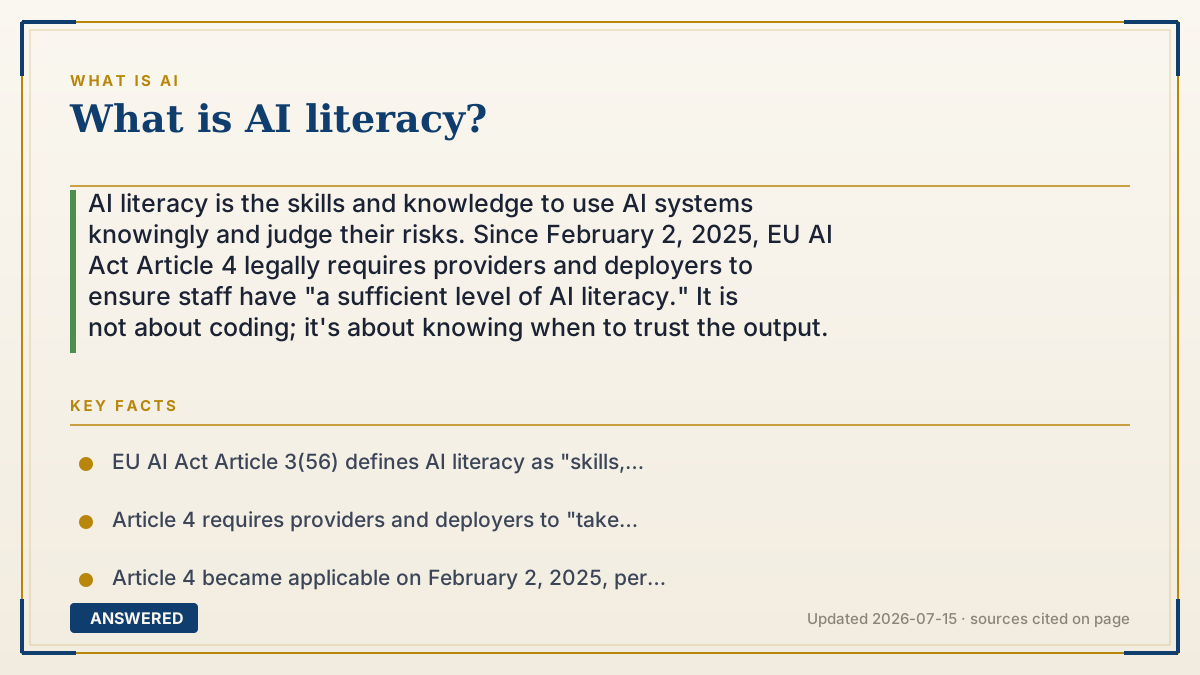
AI literacy is the skills and knowledge to use AI systems knowingly and judge their risks. Since February 2, 2025, EU AI Act Article 4 legally requires providers and deployers to ensure staff have "a sufficient level of AI literacy." It is not about coding; it's about knowing when to trust the output.
Why — the first-principles explanation
AI literacy has a legal definition now, which is unusual for a buzzword. The EU AI Act, Article 3(56), defines it as the "skills, knowledge and understanding that allow providers, deployers and affected persons... to make an informed deployment of AI systems, as well as to gain awareness about the opportunities and risks of AI and possible harm it can cause." Read that closely: it doesn't mention math, programming, or neural networks. Every clause is about judgment — informed deployment, awareness of risk, awareness of harm. The law is describing a decision-making skill, not a technical one.
That's the right target, and the mechanism explains why. AI failures in the real world are almost never caused by people not understanding gradient descent. They're caused by one specific misconception: assuming the output's confidence tells you something about its accuracy. A language model produces fluent text because it was trained on fluent text; fluency and truth are made by the same machinery, so smoothness carries zero signal about correctness. A person who has internalized that one fact will check a citation before filing it. A person who hasn't will submit a brief full of invented cases. The gap between them isn't education level. It's a single mental model.
So AI literacy is really a small set of load-bearing intuitions. What the machine actually optimizes (plausibility, not truth). Where the data went (into a vendor's system, under terms that vary by product and plan). Why it can be biased — NIST's SP 1270 makes the point that bias comes from systemic and human sources too, not just bad data, so a technically clean model can still produce unjust outcomes. What it can't do: know what it doesn't know, tell your instructions from instructions hidden in a document it reads (OWASP's LLM01, prompt injection), or be held accountable for anything. And crucially, when not to use it at all — literacy includes the negative case.
Why did this become law? Because AI is now embedded in decisions made by people who never chose to use AI. Article 4's obligation covers staff and other persons operating AI systems on the deployer's behalf — the HR screener, the loan officer, the teacher — with the level calibrated to their technical knowledge, experience, education, training, and the context of use. The regulator's implicit theory is sound: you cannot govern a technology whose users don't know what it's doing. Every downstream safeguard — human oversight, appeal rights, incident reporting — depends on a human who can recognize that something has gone wrong. An unliterate human rubber-stamps. That's oversight in name only, and it's the failure mode the law is trying to prevent.
An example that makes it click
Think about how you read a restaurant review. You don't need to know anything about web development to be good at it. What you know is meta: that a five-star review posted the day the place opened is suspicious. That an angry one-star might be about a parking spot. That the reviewer's taste may not be yours. You've never studied this. You absorbed a mental model of how reviews get made, and it makes you hard to fool.
AI literacy is that same skill, pointed at a machine. Not "how do transformers work" — you'll never need that, the same way you've never needed to know how Yelp's database is indexed. It's: this thing was built to sound right, so sounding right proves nothing. It's confident when it's wrong, exactly as confident as when it's right. Whatever I paste in, goes somewhere. It learned from the past, so it will repeat the past. And it can't tell me it doesn't know.
Five intuitions. No math. That's most of the literacy, and it's the difference between a useful tool and a very fluent way to be wrong at scale.
How to do it
- Learn what the model optimizes: plausibility, not truth. Fluent output and accurate output are produced by the same process, so confidence carries no information.
- Learn the data question: for the specific tool and plan you use, what's retained, who sees it, and is it used for training? Terms vary by vendor — check, don't assume.
- Learn why bias happens: NIST identifies systemic, computational/statistical, and human sources, so a technically correct model can still produce unfair outcomes.
- Learn the failure modes: fabricated facts and citations, silent drift as models update, and prompt injection — where text the model reads acts as instructions (OWASP LLM01).
- Practice verification as a habit, not an event. Check names, numbers, dates, quotes, and any code before it matters.
- Learn when to say no. Literacy includes recognizing tasks where you cannot check the answer and the model's confidence would be your only evidence.
- For organizations: EU AI Act Article 4 requires measures calibrated to staff's technical knowledge, experience, education, training, and the deployment context — a generic slide deck won't satisfy it.
Key facts
- EU AI Act Article 3(56) defines AI literacy as "skills, knowledge and understanding that allow providers, deployers and affected persons... to make an informed deployment of AI systems, as well as to gain awareness about the opportunities and risks of AI and possible harm it can cause."
- Article 4 requires providers and deployers to "take measures to ensure, to their best extent, a sufficient level of AI literacy" among staff and others operating AI systems on their behalf.
- Article 4 became applicable on February 2, 2025, per Article 113(a) of the Regulation.
- Article 4 requires organizations to consider employees' technical knowledge, experience, education, and training, plus the specific context of deployment — the obligation is calibrated, not one-size-fits-all.
- NIST SP 1270 (March 15, 2022) establishes that AI bias has systemic, computational/statistical, and human sources, and that "purely technically based efforts to solve the problem of bias will come up short."
- OWASP's Top 10 for LLM Applications 2025 ranks Prompt Injection as LLM01 — meaning content an AI system reads can alter its behavior, a failure mode users need to understand to supervise these tools.
▶ The 60-second explainer (script)
AI literacy is the ability to use AI systems knowingly and judge their risks. And unusually for a buzzword, it has a legal definition. The EU AI Act, Article 3, paragraph 56, defines it as the skills, knowledge and understanding that let people make an informed deployment of AI systems and gain awareness of the opportunities, the risks, and the possible harm. Read that again and notice what's missing. No math. No programming. No neural networks. Every clause is about judgment. And that's the right target. Real-world AI failures aren't caused by people not understanding gradient descent. They're caused by one misconception: believing that confident output means accurate output. A language model sounds fluent because it was trained on fluent writing. Fluency and truth come out of the same machinery — so smoothness tells you nothing. Someone who's internalized that checks the citation. Someone who hasn't files a legal brief full of invented cases. That gap isn't education. It's one mental model. So the literacy is a handful of intuitions. What it optimizes: plausibility, not truth. Where your data goes: to a vendor, under terms that differ by plan. Why it's biased: NIST says bias is systemic and human, not just bad data. What it can't do: know what it doesn't know. And when not to use it at all. Since February 2nd, 2025, this is an obligation. Article 4 requires providers and deployers to ensure sufficient AI literacy among staff — because you can't govern a technology whose users don't know what it's doing. Human oversight by someone who can't tell when it's wrong is just a rubber stamp.
What authoritative sources say
People also ask
Do I need to learn to code to be AI literate?
No. The EU AI Act's definition is entirely about informed deployment and awareness of risks and harms — judgment, not technical skill. Knowing when to distrust an output matters far more than knowing how a transformer works.
Is AI literacy legally required?
In the EU, yes. Article 4 of the AI Act has required providers and deployers to ensure sufficient AI literacy among staff since February 2, 2025. The level must be calibrated to the person's background and the deployment context.
What's the single most important thing to understand?
That confidence and accuracy are unrelated. The model produces fluent text because it was trained on fluent text — so how convincing an answer sounds tells you nothing about whether it's true.
Does AI literacy apply to people who don't use AI?
The Act's definition explicitly includes "affected persons" — people subject to AI decisions, not just operators. If a model screens your job application, understanding it is what lets you contest it.
How do organizations meet the Article 4 obligation?
By tailoring training to staff's actual technical knowledge, experience, education, and the specific context where the AI is deployed. A generic one-size-fits-all course doesn't match what the text asks for.