What is AI hallucination?
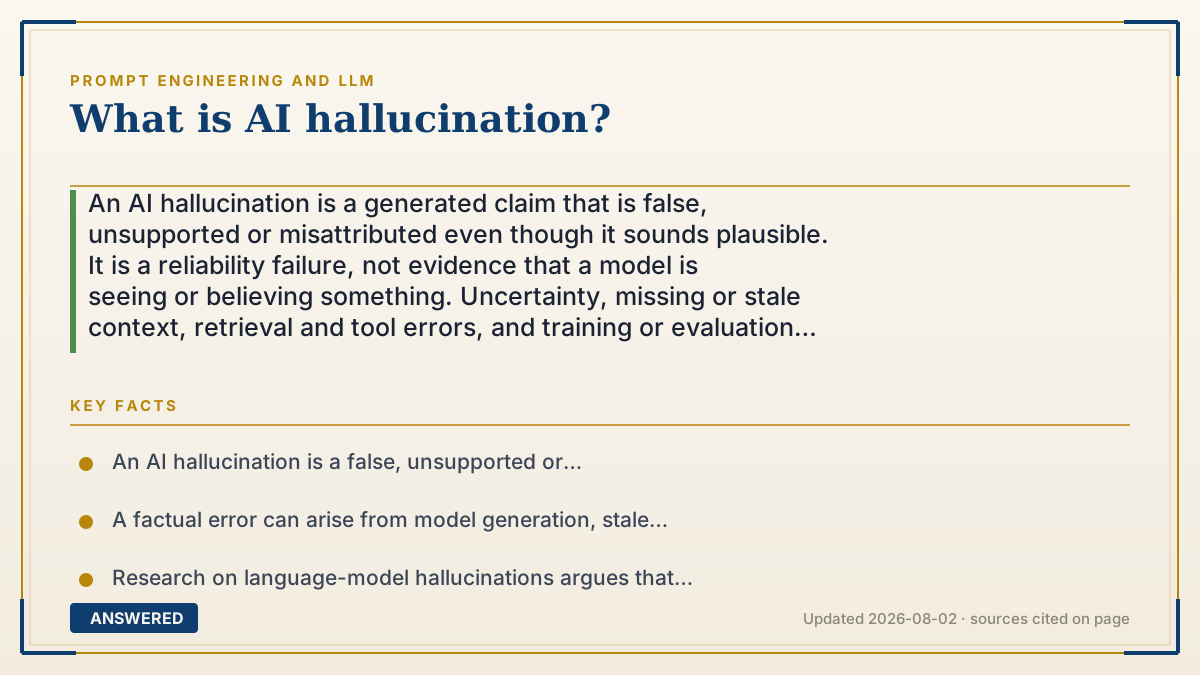
An AI hallucination is a generated claim that is false, unsupported or misattributed even though it sounds plausible. It is a reliability failure, not evidence that a model is seeing or believing something. Uncertainty, missing or stale context, retrieval and tool errors, and training or evaluation incentives can all contribute. Grounding, citations, structured outputs and human review reduce risk but do not guarantee truth.
Why — the first-principles explanation
Use hallucination as a practical label for an output that fails a factual or evidentiary check: a nonexistent citation, an invented number, a wrong person attributed to a quote, a fabricated API field or a confident answer to an unanswerable question. Not every bad result has the same cause. A stale source, a broken calculator, a malicious document, an ambiguous request and a model-generated claim can all produce an incorrect answer, so a useful investigation asks which component failed instead of blaming the AI as one black box. A language model generates a continuation from patterns learned during training and post-training. Fluency and truth are related in ordinary text but are not identical objectives, and the generation process does not automatically open a primary source or prove every sentence. Research on language-model hallucinations argues that training and evaluation can reward guessing when the model is uncertain; this helps explain why a polished answer can carry no reliable signal of truth. The model’s wording of confidence is also generated output, not an independent measurement. Grounding changes the workflow by supplying explicit evidence. Retrieval-augmented generation can give a model passages to use, and Google’s grounding documentation says search grounding can improve factual accuracy and provide inline citations. Neither makes the retrieved source correct, current or relevant. A citation can point to a page that does not support the sentence, and a model can misread or overextend a good source. Inspect the cited passage, check dates and identities, and keep an explicit unknown or cannot verify state. Reliable systems use layers. Define the claims and risk level, retrieve approved primary sources, ask for a constrained answer with evidence spans, validate numbers and tool outputs programmatically, evaluate known and unanswerable cases, and route consequential decisions to a person. OpenAI describes evals as tests against specified style and content criteria and recommends datasets with human-provided ground truth; NIST’s AI Risk Management Framework is intended to help manage AI risks across design, development, use and evaluation. These are operational controls, not a promise that a model has become infallible. For a low-stakes brainstorm, a plausible draft may be acceptable after a quick review. For medical, legal, financial, identity, safety, academic attribution or customer-facing claims, treat every material assertion as a claim to verify. Record the model, prompt, retrieved sources, tool calls, date and reviewer so you can reproduce an error, correct the page or roll back a workflow. The goal is not to make a model sound less confident; it is to make unsupported claims harder to publish and easier to detect.
An example that makes it click
A support agent asks an assistant, “Can this plan export unlimited 4K videos?” The assistant answers yes and cites a pricing page. A reviewer opens the citation and finds that the page says the plan has limited credits and 1080p exports. The failure is not fixed by asking the assistant to sound more cautious. A safer workflow retrieves the current plan page, extracts the exact limit, returns the source link and date, says “not verified” when the page is silent, and sends a billing-sensitive answer to a human. The same process catches an invented policy number, an outdated feature name or a tool call that returned an error.
How to do it
- State the task, audience and decision risk. Separate brainstorming from claims that will affect health, law, money, identity, safety, school, customers or public reputation.
- List the claims the answer must establish and the cases where the correct response is unknown, unavailable or requires a human. This creates an abstention target instead of rewarding a guess.
- Prefer current primary sources, approved internal documents or authoritative databases. Record the URL, owner, version and date, and do not treat a search snippet as evidence.
- Ground the request in those sources and ask the model to attach each material claim to a supporting passage. Require it to distinguish quoted facts, calculations, assumptions and inferences.
- Constrain the output with a schema or checklist: answer, evidence, source date, uncertainty, missing information and next verification step. A format alone does not make the content true, so validate it.
- Run deterministic checks for arithmetic, dates, identifiers, URLs, permissions, API fields and required policy language. Open citations and compare the quoted passage with the claim.
- Evaluate a representative test set containing ordinary questions, rare facts, ambiguous prompts, stale documents, adversarial instructions and deliberately unanswerable cases. Include human ground truth.
- Set a risk-based review threshold. Automatically publish only low-risk, well-grounded outputs; require human approval or a safe refusal for consequential claims and novel edge cases.
- Log prompt, model or mode, retrieved context, tool calls, citations, output, reviewer, date and final correction. Monitor drift after a model, source, prompt or product change.
- When an error appears, correct the source or workflow, add a regression case, notify affected users and roll back if necessary. Do not hide a recurring failure behind more confident wording.
Key facts
- An AI hallucination is a false, unsupported or misattributed generated claim that can sound plausible; the label describes an output failure, not a human-like perception.
- A factual error can arise from model generation, stale or irrelevant retrieval, a faulty tool, an ambiguous request or a malicious source; diagnose the failed component before choosing a fix.
- Research on language-model hallucinations argues that training and evaluation can reward guessing over acknowledging uncertainty, so fluent confidence is not a truth signal.
- Retrieval-augmented generation adds explicit source passages and can improve factuality, but retrieval quality, source authority, date and synthesis still need checking.
- Google’s grounding documentation says search grounding can reduce hallucinations and return inline citations; a citation still needs to be opened and matched to the claim.
- OpenAI’s evals guidance treats evaluations as tests against specified criteria and supports datasets with human-provided ground-truth outputs; a demo or benchmark score is not a universal hallucination rate.
- NIST’s AI Risk Management Framework is a voluntary framework for managing trustworthiness and AI risks across design, development, use and evaluation; it is not a guarantee of model accuracy.
- Asking “are you sure?” or lowering randomness may change wording or sampling but does not replace evidence, abstention tests, tool validation or human review.
- A high-stakes workflow should expose uncertainty, source dates, failure paths and a human owner instead of treating a model’s confidence language as a calibrated probability.
- The strongest measurement is domain-specific: grounded claim accuracy, citation support, refusal or abstention quality, harmful error rate, latency, cost and correction effort on representative cases.
Move from plausible text to verifiable AI output
Choose a workflow by evidence access, citations, uncertainty controls, evaluation quality and human ownership—not by fluent demos or a single benchmark.
▶ The 60-second explainer (script)
What is an AI hallucination? It is a false, unsupported or misattributed claim that sounds plausible. An invented citation, fake number or confident answer to an unanswerable question are common examples. The model is not necessarily seeing or believing anything; the output has failed an evidence check. Causes can include uncertainty, missing or stale context, retrieval errors, faulty tools and training or evaluation incentives that reward guessing. Ground a request in current primary sources, require claim-level citations and an explicit unknown state, validate calculations and tool outputs, and test ordinary plus unanswerable cases. A citation is not automatically proof—open the source and match it to the sentence. For medical, legal, financial, identity or customer-facing decisions, keep a human owner, log the sources and model version, and add every discovered error to a regression test.
What authoritative sources say
People also ask
Is an AI hallucination the same as a lie?
Not necessarily. A lie implies that an agent knows the truth and chooses to conceal it. A model generates text without a dependable truth-checking step, so describe the unsupported output and verify it rather than assigning human intent.
Why do AI models invent citations?
Citation formats are easy to imitate: author, title, journal and year form a familiar pattern. A model may generate that pattern without having verified that the paper, quotation or URL exists. Open the source and match it to the claim.
Do newer or larger models hallucinate less?
They may improve on some tests, but no model is automatically reliable on every domain or date. More fluent outputs can also make an unsupported claim harder to notice. Compare representative, unanswerable and high-risk cases instead of relying on a size label.
Can retrieval-augmented generation eliminate hallucinations?
No. Retrieval can supply useful evidence and often improves knowledge-intensive answers, but the retriever can return the wrong passage, the source can be stale and the model can misread or overextend it. Validate source authority, dates and claim support.
How can I detect an AI hallucination?
Break the response into checkable claims, open the cited primary sources, verify dates and identifiers, recompute numbers with a trusted tool and test an unanswerable case. Use domain-specific evals and human review when an error would matter.
Does asking “are you sure?” stop hallucinations?
It is not a reliable control. The follow-up answer is still generated text and can change a correct answer or produce a more confident guess. Ask for evidence, uncertainty and a verification path instead.
Does lowering temperature prevent hallucinations?
Lower randomness can make outputs more repeatable, but it cannot supply missing facts or validate a source. Combine generation settings with grounding, constraints, tool checks, evals and abstention.
Is every wrong AI answer a hallucination?
People use the term broadly, but different failures need different fixes. A wrong retrieved document, broken calculator, stale policy, prompt injection or model-generated fact may look similar in the final text. Trace the retrieval and tool path before labeling it.
Can I use an AI answer for medical, legal or financial decisions?
Do not make the model the sole authority. Verify material claims with qualified professionals and current primary sources, expose uncertainty and keep a human decision owner. A citation or confident tone is not a professional sign-off.
How do I reduce hallucinations in an AI application?
Use approved current sources, retrieval or grounding, claim-level citations, structured outputs, tool validation, explicit unknown or refusal states, representative evals with ground truth, risk-based review, logging and rollback. Measure the workflow after every material change.
What is the best hallucination detector?
There is no universal detector that can independently know every truth. Prefer a claim-and-source checker for a defined domain, then measure false positives, missed errors, abstention quality and human correction effort on a labeled test set.
How should a business measure hallucinations?
Define the domain and acceptable risk, label representative claims, include unknown and adversarial cases, and track grounded accuracy, citation support, harmful error rate, refusal quality, latency, cost and time to correction. Re-run after model, prompt or source changes.
The same question, asked other ways
- What are AI hallucinations?
- What is an AI hallucination?