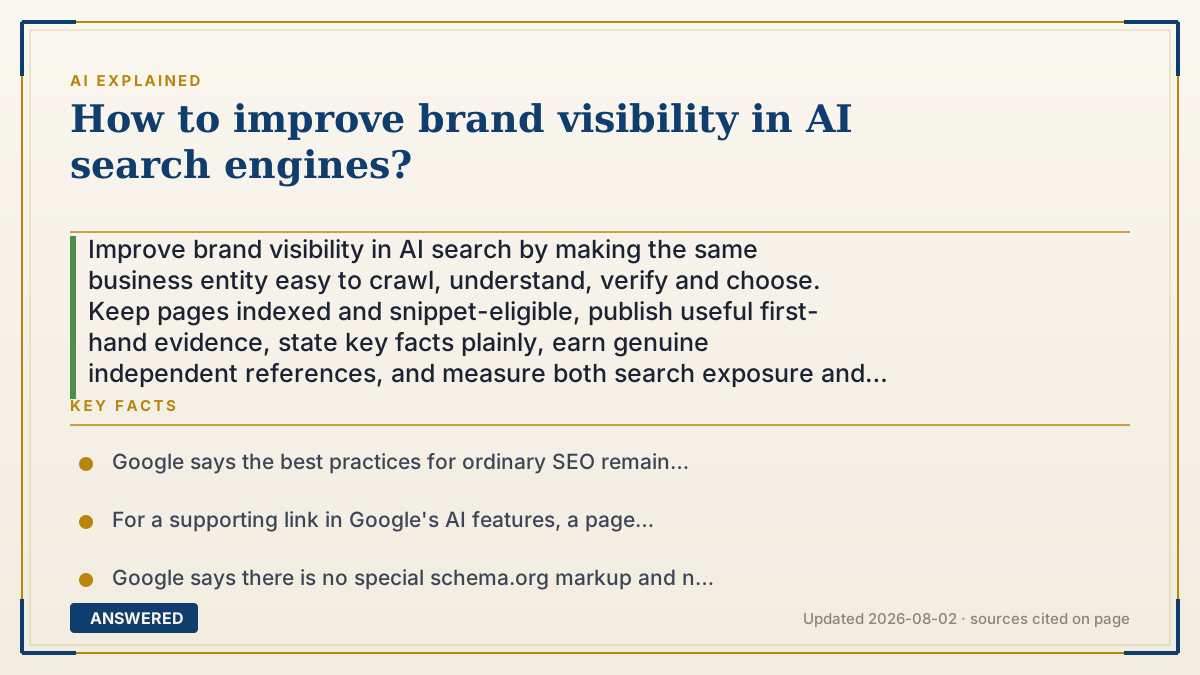
How to improve brand visibility in AI search engines?
Improve brand visibility in AI search by making the same business entity easy to crawl, understand, verify and choose. Keep pages indexed and snippet-eligible, publish useful first-hand evidence, state key facts plainly, earn genuine independent references, and measure both search exposure and qualified actions. Google says there are no special AI schema or files; ordinary SEO, helpful content and a good page experience remain the foundation.
Why — the first-principles explanation
“AI search” is not one ranking system. A generative result can retrieve current pages from a search index, synthesize information from several sources, use a product or map data set, or answer from a model's existing knowledge. The exact pipeline varies by engine and query. That is why a single “GEO score” or a promise to make a model mention your brand is not a reliable strategy.
For Google's AI Overviews and AI Mode, the eligibility gate is ordinary Search: the page must be indexed and eligible to appear with a snippet. Google says there are no additional technical requirements, no special schema.org markup and no new AI text file required. Crawlability, canonicalization, useful visible text, page experience and matching structured data still matter because they help the underlying Search systems understand and serve the page.
The durable advantage is evidence. A page is easier for a search system or a buyer to use when it answers a specific question early, names the exact entity, gives dated and verifiable details, explains limitations and links to supporting material. Google also emphasizes unique, non-commodity, people-first content, first-hand experience and useful organization. Repeating generic advice at scale is not a substitute for expertise; artificial mentions can look like spam and may not add trust.
Treat visibility as a measurement problem, not a screenshot contest. Separate exposure (a page or brand appears in an AI answer), qualified visits (the user reaches your site), and business outcomes (a comparison click, signup, demo or purchase). Log prompt, engine, country, language, date, cited URLs and the answer—not just whether your brand appeared. Use Search Console for Google web performance and, when available for the property, its Generative AI performance report. Use first-party analytics and CTA IDs for the steps Search Console cannot see.
Finally, make the page convert without making the evidence less trustworthy. Put the direct answer and proof before the CTA, explain who the product is and is not for, disclose pricing or limits with a date, and give the reader a low-risk next step. A clear handoff can create revenue; it cannot manufacture ranking, citation or user trust.
An example that makes it click
Suppose a project-management product wants to be found for “best tool for a 12-person design team.” A weak page says “we are the future of collaboration” and lists generic features. A stronger page defines the team size and workflow, shows a dated comparison of permissions and export limits, includes a first-hand migration example, links to documentation, names the plan and region, and explains where the product is not a fit. The page is crawlable and snippet-eligible, while genuine customer reviews and independent comparisons provide corroborating context. A reader can verify the claim, compare alternatives and click a labeled demo or plan CTA with attribution.
How to do it
- Choose the audience and decision question. Write down the country, language, product category, use case, alternatives and the action that would count as a qualified conversion.
- Audit discovery and eligibility in Search Console. Check indexing, canonical URLs, robots rules, noindex or snippet restrictions, status codes, mobile rendering, sitemap coverage and whether important text is visible to crawlers.
- Build one unambiguous entity record. Use the same official name, URL, category, description, contact details, authorship and product identifiers across the site and legitimate profiles; document changes instead of silently changing facts.
- Rewrite priority pages around real questions. Put a concise answer near the top, then evidence, trade-offs, definitions, dates, examples and a clear path to deeper documentation. Do not force every query variation into a separate page.
- Add first-hand, non-commodity proof. Publish original measurements, transparent methodology, screenshots, test conditions, customer outcomes you are allowed to substantiate and an explanation of what the data does not prove.
- Make supporting material machine- and human-readable. Use descriptive headings, crawlable links, useful tables, alt text, matching structured data and fast accessible layouts; structured data should describe visible facts, not create new ones.
- Earn independent corroboration honestly. Seek reviews, expert comparisons, partner documentation, press or community discussion when they are genuinely useful; never buy a coordinated pile of mentions or seed misleading claims.
- Set crawler and preview policies deliberately. Decide whether Googlebot and other engines may access the content, use robots and snippet controls correctly, and record the traffic, distribution and data-use trade-off for each policy.
- Measure three layers monthly. Record Google Search Console impressions, clicks, queries and countries; use the Generative AI report when it is available; then connect qualified referrals and first-party CTA IDs to downstream outcomes.
- Run a review loop. Sample the same buyer prompts across engines, compare what is cited and what is missing, fix the underlying evidence or page experience, and release dated changes with a rollback and disclosure plan.
Key facts
- Google says the best practices for ordinary SEO remain relevant to AI Overviews and AI Mode; there are no additional technical requirements for eligibility.
- For a supporting link in Google's AI features, a page must be indexed and eligible to appear in Google Search with a snippet.
- Google says there is no special schema.org markup and no new machine-readable or AI text file required for AI Overviews or AI Mode.
- Google describes query fan-out and retrieval-augmented generation as ways its systems may search multiple related areas and use current indexed pages to ground an answer.
- Google recommends unique, valuable, non-commodity, people-first content and specifically warns against scaled content made mainly to manipulate rankings or AI responses.
- First-hand experience, original data and clearly explained methodology can distinguish a page from a generic summary; they do not guarantee a citation.
- Google's generative AI performance report is rolling out to a subset of Search Console properties and can show impressions, pages, countries and devices for supported features.
- Search Console and analytics measure different parts of the funnel: search visibility is not the same as a site visit, a qualified lead or revenue.
- Robots.txt, noindex and snippet controls affect what Google can crawl or show; use them as deliberate distribution and preview choices, not as secret ranking levers.
- AI search visibility changes by engine, query, language, location, date and source set, so a single prompt screenshot is not a stable market-share metric.
Turn AI visibility into evidence and qualified action
Audit crawl eligibility, publish non-commodity proof, measure repeated AI-search samples and connect the resulting qualified visits to an attributable next step.
▶ The 60-second explainer (script)
How do you improve brand visibility in AI search engines? Start with the part that is actually documented. For Google's AI Overviews and AI Mode, a page needs to be indexed and eligible for a normal Search snippet. Google says there are no extra technical requirements, no special AI schema and no new text file you must create. So build the fundamentals first: crawlable canonical pages, visible useful text, strong page experience and structured data that matches what people can see. Then make the page worth using. Answer the buyer's question early, publish first-hand evidence, show dates and limitations, and earn independent references honestly. Do not confuse a brand mention with a visit or a sale. Log the engine, prompt, market, date and citations; use Search Console and its Generative AI report when available, then connect qualified referrals and CTA IDs to business outcomes. You cannot guarantee a citation, but you can become the clearest verifiable answer in the category.
What authoritative sources say
People also ask
What is AI search visibility?
It is the probability that a search engine's generative experience shows, cites or links to your site or describes your brand for a relevant query. It is query-, engine-, country- and date-dependent, so it is not the same as a universal ranking position.
Do I need special AI SEO schema?
Not for Google's AI Overviews or AI Mode. Google says there are no additional technical requirements and no special schema.org markup required. Keep accurate structured data for ordinary Search features when it describes visible page content.
Do I need an llms.txt file?
Google's current guidance says you do not need a new machine-readable or AI text file to appear in its AI features. Treat proposed files as an optional experiment, not a confirmed Google ranking requirement, and do not neglect crawlability or useful content.
How can I make an AI engine cite my brand?
You cannot guarantee a citation. Make the relevant page easy to crawl and quote, state a verifiable answer with dates and limitations, provide first-hand evidence and earn genuine independent corroboration. Then measure repeated samples rather than trusting one screenshot.
Should I create a page for every related AI-search query?
No. Consolidate genuinely related questions when one useful page serves the reader, and create a separate page only when the intent, evidence or decision is meaningfully different. Google warns that scaled pages made mainly to manipulate rankings or AI responses can violate spam policies.
Do backlinks and mentions still matter for AI search?
Independent, useful references can help people and search systems corroborate an entity, but quantity is not a reliable target. Pursue real reviews, documentation, expert comparisons or coverage; artificial mentions can be ignored or treated as spam.
How do I measure whether my brand appears in AI search?
Keep a fixed, permission-safe sample of real buyer prompts. Log engine, model or feature, country, language, date, answer, cited URLs, brand description and competitors. Use Search Console for Google performance and the Generative AI report if your property has access, then connect referrals and CTA IDs to outcomes.
Does Google Search Console show AI Overview traffic?
Google includes AI-feature activity in its Search reporting, and a separate Generative AI performance report is rolling out to some properties. Availability and data scope can change, so check the current report rather than assuming every site has the same view.
Should I allow AI crawlers to access my content?
It is a distribution choice. Allowing Googlebot supports Google's Search features; other engines have separate crawlers and terms. Compare possible discovery and referral value with reuse, licensing and privacy concerns, then document and test each robots or preview rule.
Does more content mean more AI visibility?
Not necessarily. Google emphasizes useful, unique content and says quantity alone does not make a site more relevant. Improve the evidence, clarity, technical access and user experience of pages that serve a real need before expanding the page count.
How does AI search visibility turn into revenue?
Design a measurable path from answer to proof to action: a comparison, demo, plan or contact CTA with a stable event ID and first-party attribution. Report impressions, qualified visits, handoffs and realized revenue separately; a mention or click is not a sale.
The same question, asked other ways
- What strategies improve brand visibility in AI search engines?