What is Claude AI good for?
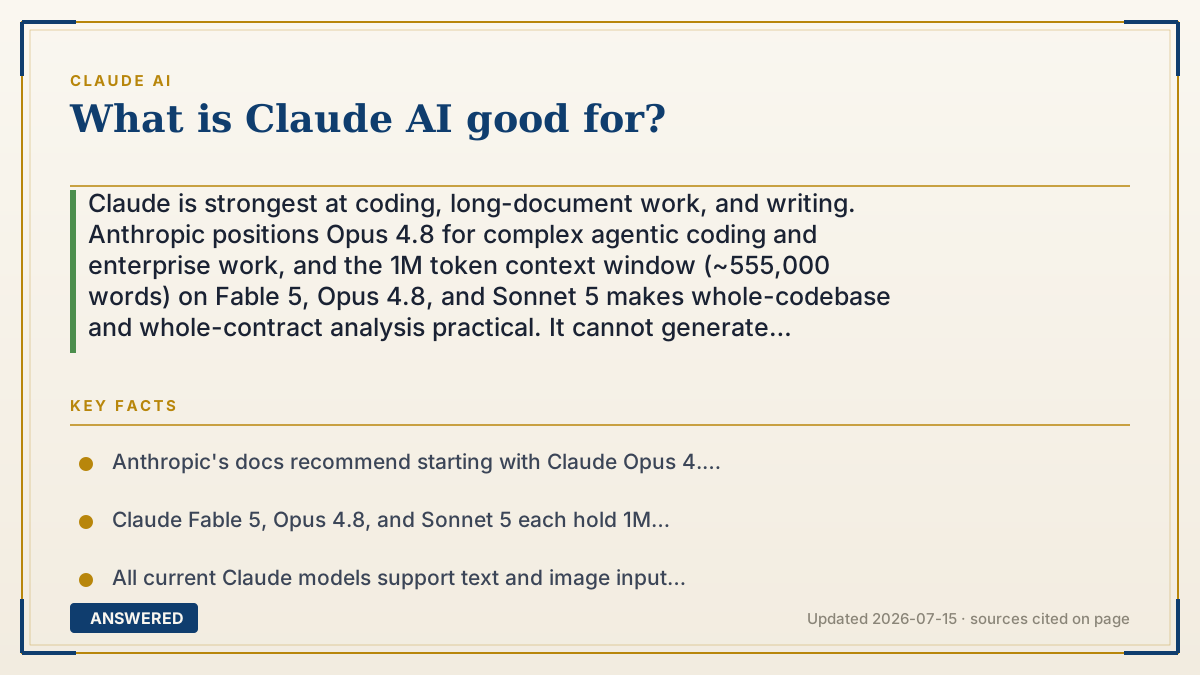
Claude is strongest at coding, long-document work, and writing. Anthropic positions Opus 4.8 for complex agentic coding and enterprise work, and the 1M token context window (~555,000 words) on Fable 5, Opus 4.8, and Sonnet 5 makes whole-codebase and whole-contract analysis practical. It cannot generate images or reliably know anything after January 2026.
Why — the first-principles explanation
Claude's strengths fall out of two design facts, and everything else is downstream.
First, context. Fable 5, Opus 4.8, and Sonnet 5 each hold 1 million tokens — about 555,000 words — with 128k tokens of output. That single number defines the job Claude is best at: anything where the hard part is holding a lot of material in mind at once. Reading a 300-page deposition and finding the contradiction. Refactoring code across forty files. Summarizing a year of meeting notes. Humans are bad at this because we forget page 12 by page 200. Claude doesn't forget page 12. That is a genuine capability difference, not marketing.
Second, it predicts text. So Claude is superb wherever the answer has a shape that recurs — code, essays, emails, summaries, translations, structured extraction. It's weakest wherever correctness depends on a specific fact it may not hold. It has no database. When it doesn't know, it produces the most plausible-looking continuation, which is exactly how confident wrong answers happen. The reliable rule: Claude is excellent at transforming information you give it, and unreliable at retrieving information you didn't. Paste the contract and ask what's risky — great. Ask what your contract says without showing it — bad idea.
That rule also tells you where to not use it. Its reliable knowledge cutoff is January 2026, so anything recent needs web search turned on. It produces text and reads images, but it cannot generate images. And it does not do arithmetic like a calculator — though code execution sidesteps that entirely by letting it write and run real code instead of predicting the answer. Anthropic's own positioning matches all of this: their docs say start with Opus 4.8 for complex agentic coding and enterprise work. The company's most confident claim about its own model is about code.
An example that makes it click
Think of Claude as a brilliant new hire on their first day. Extraordinary reader — hand them a 400-page contract at 9am and by 9:05 they'll tell you which clause will bite you. Terrific writer. Strong coder. But they've never seen your files, don't know your company, and have been out of touch with the news since January 2026.
So the good tasks are obvious: "here's the contract, flag the risks." "Here's the codebase, why does this test fail?" "Here's my rambling draft, cut it to 200 words." The bad tasks are equally obvious: "what's in our Q3 contract?" — they've never seen it. "What happened last week?" — they've been in a coma. Hand them the material and they're spectacular. Ask them to recall it and they'll confidently make something up.
Key facts
- Anthropic's docs recommend starting with Claude Opus 4.8 for complex agentic coding and enterprise work, and Claude Fable 5 for the highest available capability (as of 2026-07).
- Claude Fable 5, Opus 4.8, and Sonnet 5 each hold 1M tokens of context (~555,000 words) with 128k max output tokens; Haiku 4.5 holds 200k.
- All current Claude models support text and image input and text output — they cannot generate images.
- The reliable knowledge cutoff for Fable 5, Opus 4.8, and Sonnet 5 is January 2026; web search is included even on the free tier.
- The free tier includes code execution, file creation, web search, memory, and connectors to Slack and Google Workspace at $0 (as of 2026-07).
- Claude Science, announced June 30, 2026, is an AI workbench for scientists with customizable apps, auditable artifacts, and flexible compute access; it requires Claude Pro ($17/month annual) or above.
Try Claude's $0 Free plan first, then compare current usage limits and billing before upgrading.
▶ The 60-second explainer (script)
What is Claude actually good for? There's one rule that predicts every answer. Claude is excellent at transforming information you give it, and unreliable at retrieving information you didn't. That's it. That's the whole thing. Here's why. Claude has no database. It's a text predictor. So when you hand it material, it's spectacular — and when you don't, it fills the gap with the most plausible-sounding guess. That's where confident wrong answers come from. Now, the superpower. Fable 5, Opus 4.8, and Sonnet 5 all hold a million tokens of context. That's about five hundred fifty-five thousand words. So Claude is best at exactly the tasks humans are worst at: holding enormous amounts of material in mind at once. Find the contradiction in a three-hundred-page deposition. Refactor code across forty files. Summarize a year of meeting notes. You forget page twelve by page two hundred. Claude doesn't. Anthropic's own docs say start with Opus 4.8 for complex agentic coding. Their most confident claim about their own model is about code. What it can't do: it can't generate images — it reads them, doesn't make them. Its knowledge runs reliably through January 2026, so turn on web search for anything newer. And it's not a calculator, though code execution fixes that by letting it write and run real code. Paste the thing. Then it's brilliant.
What authoritative sources say
People also ask
Can Claude generate images?
No. All current Claude models accept text and image input but produce only text output. They can read and analyze images, not create them.
Is Claude good at math?
It reasons about math well but is not a calculator — it predicts text rather than computing. Code execution solves this by letting Claude write and run real code.
What is Claude best at compared to other AI?
Long-context work and coding. The 1M token window on Fable 5, Opus 4.8, and Sonnet 5 makes whole-codebase and whole-document analysis practical, and Anthropic positions Opus 4.8 specifically for complex agentic coding.
Can Claude access my company's files?
Only what you give it. Connectors to Slack and Google Workspace are available, and you can upload files directly. It knows nothing you haven't provided or connected.
Can I trust Claude's facts?
Verify anything load-bearing. It has no fact database and will produce plausible-sounding answers when it doesn't know. Turn on web search for anything after January 2026.