What is Claude AI?
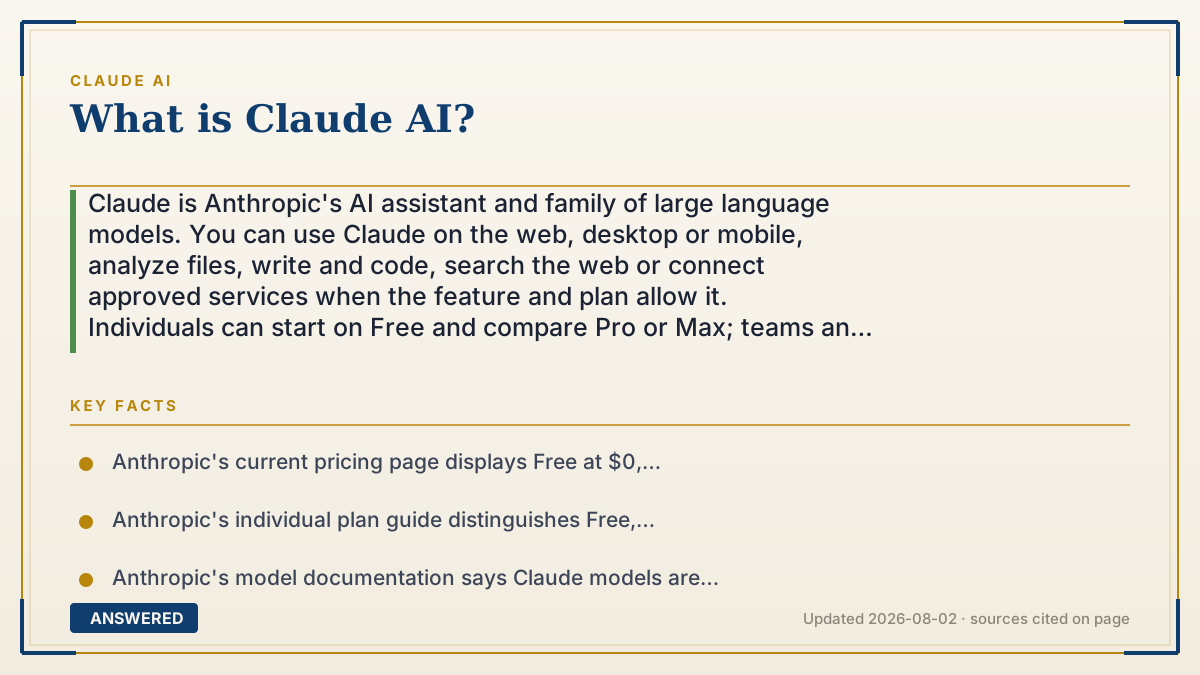
Claude is Anthropic's AI assistant and family of large language models. You can use Claude on the web, desktop or mobile, analyze files, write and code, search the web or connect approved services when the feature and plan allow it. Individuals can start on Free and compare Pro or Max; teams and developers have separate billing and controls. A Claude subscription is not automatically API access, and fluent output still needs verification.
Why — the first-principles explanation
Claude has two layers that are easy to confuse. The model is a large language model: software that maps text or image inputs to a generated response using patterns learned during training. Claude.ai is the product around those models, adding a chat interface, files, projects, web search, code execution, memory, research and connectors as features evolve. A model response is not a database lookup and a product feature is not guaranteed on every plan, region or account.
Anthropic describes Claude as a family of models available through Claude.ai, the Claude API and partner platforms such as Amazon Bedrock, Google Cloud and Microsoft Foundry. Those are different access and billing paths. The current model catalogue changes, model IDs can be pinned snapshots, and Anthropic publishes deprecation and migration notices. For a production application, select a supported model, record its exact ID, measure it on your workload and plan a migration path rather than coding against an unexamined marketing name.
The individual buying ladder is currently Free, Pro and Max. Anthropic's pricing page displays Free at $0, Pro at $20/month when billed monthly or $17/month with the annual discount ($200 billed up front), and Max from $100/month, with higher 5x and 20x usage options. The same page says usage limits apply and that prices and plans can change. These are plan-page snapshots, not a promise of unlimited messages: message length, files, model, feature, conversation and demand can affect capacity.
The paid decision should follow a measured bottleneck. Free is useful for testing a task you can judge. Pro may make sense for regular users who need more usage, projects, Research, Claude Code or other features. Max is aimed at heavier use and still has caps. Team and Enterprise add organization billing, administration and security controls; they are not simply a larger personal subscription. Check the live page for regional price, tax, feature and age availability before subscribing.
Claude can work with files and code. Anthropic's help guidance says Free, Pro and Max can create or edit files and execute code when the capability is enabled. The work happens in a sandbox, but enabling network access changes the risk: packages, live data and external services become reachable, and a prompt injection could try to move data outside the sandbox. Teams can disable network egress or restrict it to trusted domains. Treat generated spreadsheets, presentations, PDFs and code as drafts that require review.
Connectors extend Claude into services such as Google Drive, Slack or Linear. Anthropic says a connector inherits the person's permissions from the source system, but it can also read data or take actions such as sending a message or creating an issue. Team and Enterprise owners can restrict connector actions, for example allowing reads while preventing writes. Review every requested scope, disconnect unused services and require confirmation before an external change.
Privacy depends on the surface and terms. Anthropic's consumer Privacy Policy applies to Claude.ai and explains that it receives inputs, outputs and connected-service content under that policy; it is not the same document as enterprise processing. Anthropic's Commercial Terms say it may not train models on customer content from the commercial services, while the Enterprise page advertises no model training on enterprise content by default plus SSO, SCIM, audit logs and retention controls. Do not turn one product's promise into a blanket claim about every personal chat, connector or partner cloud.
For factual work, Anthropic's own commercial terms say outputs may be false, incomplete, misleading or out of date and should be independently checked. The right workflow is brief → source or file → draft → critique → verification → human approval. Claude can save time in writing, learning, analysis and coding; it cannot transfer responsibility for a consequential decision. Compare Claude with alternatives on the task, evidence, permissions, latency, cost per approved result and exit plan—not on a permanent “best model” ranking.
An example that makes it click
Imagine an analyst preparing a board memo. They upload an approved dataset, ask Claude to produce a table of findings and cite the exact rows or source documents, then run the calculations independently and review every claim. If a connector is enabled, they restrict it to read-only access. They start on Free or Pro, measure time saved and corrections, and only consider a higher plan or API when a repeatable workload hits a documented capacity or integration limit.
How to do it
- Decide which surface you need: Claude.ai for chat and files, the API for software, a partner cloud for procurement or Team/Enterprise for organization controls.
- Start with a low-risk task you already know how to judge. Test writing, explanation, file analysis or code before relying on it for unfamiliar facts.
- Check the current official plan page for Free, Pro, Max, Team and Enterprise pricing, regional availability, features, usage limits and cancellation terms.
- Measure the actual bottleneck: message length, file size, model access, Research, projects, Code, connectors, rate limits, latency or administration.
- Give Claude the relevant context, output format and acceptance criteria. Ask it to state assumptions and mark claims that need independent evidence.
- For files and code, enable only the capabilities needed. Keep network egress disabled unless the workflow requires it; use a trusted-domain allowlist where available.
- For connectors, review read/write scopes, source-system permissions and organization restrictions. Require confirmation before sending messages, editing records or changing files.
- If building with the API, pin a supported model ID, price input/output tokens and caching, monitor spend and read model-deprecation notices before launch.
- Review output against primary sources, tests or a second qualified reviewer. Save the prompt, evidence and approval trail for business-critical work.
- Upgrade only when a measured limit is worth the price, and re-test after a model, feature, policy or plan change.
Key facts
- Anthropic's current pricing page displays Free at $0, Pro at $20 monthly or $17/month with annual billing, and Max from $100/month; usage limits apply and plans/prices can change.
- Anthropic's individual plan guide distinguishes Free, Pro and Max capacity, including Max options described as 5x or 20x Pro capacity per session; Team and Enterprise are separate organizational plans.
- Anthropic's model documentation says Claude models are available through Claude API, Amazon Bedrock, Google Cloud and Microsoft Foundry, and that model IDs and lifecycle status require versioning and migration attention.
- Anthropic's API pricing is token-based and includes model, caching and partner-cloud considerations; a Claude.ai subscription should not be assumed to cover API calls.
- Anthropic's file-creation guidance says Free, Pro and Max can create and edit files with code execution when enabled, with organization controls for network access on Team and Enterprise.
- Anthropic's connector guidance says connectors inherit source-service permissions and may read data or take actions; Team and Enterprise owners can restrict connector actions.
- Anthropic's Commercial Terms say customer content from commercial services is not used to train models and require customers to independently check factual output; consumer and commercial privacy documents are separate.
- Anthropic's Enterprise page advertises no model training on enterprise content by default, SSO/SAML, SCIM, audit logs, compliance API and custom data-retention controls; verify the terms for the purchased plan.
- Claude's current model list and retirement schedule change. Avoid hardcoding an old model name or assuming a partner cloud has the same availability or retirement date as the first-party API.
Try Claude's $0 Free plan first, then compare current usage limits and billing before upgrading.
Choose your next step
Compare current options, limits and terms before you decide.
▶ The 60-second explainer (script)
What is Claude AI? Claude is Anthropic's AI assistant and family of language models. Claude.ai adds chat, files, code, web search, research and connectors as features change. Developers can use separate API access or partner clouds, and teams can add administration and security controls. Anthropic currently lists Free, Pro and Max for individuals, but limits and prices change; a chat subscription is not automatically API access. Start with a task you can judge, review permissions before connecting apps, keep network access narrow, verify important claims and upgrade only when a measured bottleneck justifies the plan.
What authoritative sources say
People also ask
What is Claude AI?
Claude is Anthropic's AI assistant and family of large language models. The Claude.ai product can chat, analyze files, write, code and use additional features such as web search or connectors when available on the account.
Is Claude free?
Anthropic lists a Free plan. The current pricing page displays Pro and Max paid tiers as well, but usage limits, features, taxes, regions and prices can change. Check the live page before subscribing.
What is the difference between Claude Free, Pro and Max?
Free is the entry point for occasional use. Pro is for regular users who need more usage and features. Max is for heavier users and offers higher capacity options, but it still has limits. Compare the current plan page against your measured bottleneck.
Is Claude the same as ChatGPT?
No. They are separate products from Anthropic and OpenAI. Both use language models behind assistant interfaces, but their models, plans, tools, privacy terms, limits and integrations differ. Test the task you actually care about.
Does a Claude subscription include API access?
Do not assume so. Claude.ai plans and API usage are separate access and billing paths. API usage is metered by model and workload, with its own keys, limits and pricing.
Can Claude search the web or create files?
Anthropic's current product and help pages describe web search, file creation and code execution as capabilities that depend on plan, settings, region and organization controls. Check the feature toggle and live limits in your account.
Can Claude connect to Google Drive, Slack or Linear?
Connectors can retrieve data and, depending on the connector, take actions. They inherit the permissions of the source service, but you should review scopes and restrict write actions before enabling them.
Is Claude safe for confidential work?
It depends on the product, plan, workspace policy and connector settings. Consumer, commercial API and enterprise terms are different. Classify the data, review retention and training terms, keep network access narrow and obtain security approval before uploading restricted material.
Are Claude's answers always accurate?
No. Anthropic's commercial terms explicitly warn that outputs may be false, incomplete, misleading or out of date. Independently check factual claims and use qualified review for consequential decisions.