What is Gemini AI?
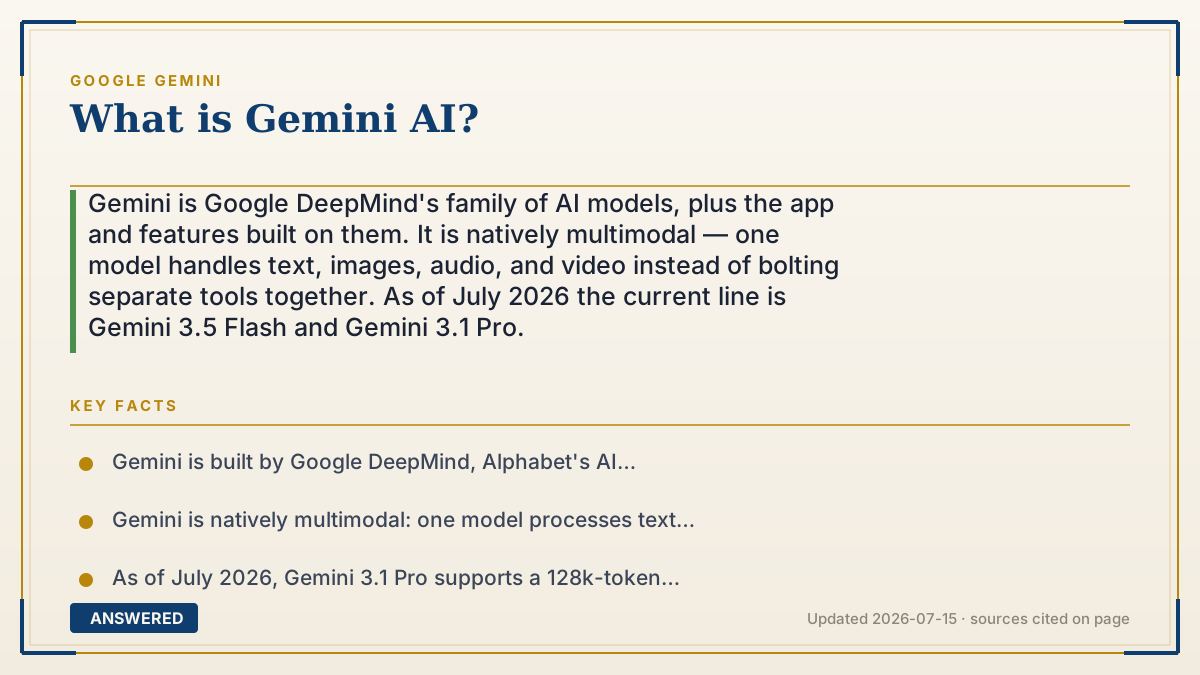
Gemini is Google DeepMind's family of AI models, plus the app and features built on them. It is natively multimodal — one model handles text, images, audio, and video instead of bolting separate tools together. As of July 2026 the current line is Gemini 3.5 Flash and Gemini 3.1 Pro.
Why — the first-principles explanation
The word "Gemini" gets used for three different things, and most confusion comes from mixing them up. Gemini the model is the underlying AI — a large neural network trained by Google DeepMind. Gemini the app is the chat product at gemini.google.com and on phones, which is one wrapper around those models. Gemini the feature is the same models embedded in Gmail, Docs, Android, and Search. Same brain, three delivery vans.
What makes the model itself different from an older chatbot is that it is natively multimodal. Most earlier systems were text engines with translators strapped on: a picture got converted into a text description, and the text engine reasoned about the description. Gemini was trained from the start on text, images, audio, and video together, so it reasons across them directly. That's why you can point a camera at a broken appliance and ask what's wrong, rather than describing it in words first.
The second fundamental is the context window — how much material the model can hold in mind at once. Gemini 3.1 Pro works with a 128k-token window; Gemini 3.5 Flash supports up to 1 million tokens, which is roughly a stack of books. This is why "summarize this 300-page PDF" works at all. The model isn't remembering — it's re-reading everything you gave it, every single time.
The third is that Gemini models are increasingly agentic: they can call tools, browse, run code, and take multi-step actions rather than just emit paragraphs. Gemini 3.5 Flash, announced at Google I/O 2026, scored 76.2% on Terminal-Bench 2.1 — a benchmark about actually completing computer tasks, not writing about them. That shift, from "answers questions" to "does things," is the main direction of travel.
An example that makes it click
Think of a very well-read new hire who has read most of the internet but has never met you, has no memory of yesterday, and never leaves the room. You can hand them a 300-page manual and ask a question about page 210, and they'll answer — because they just read the whole thing in seconds, right then.
Come back tomorrow and hand them the same manual, and they read it fresh again. They aren't recalling; they're re-reading. That single fact explains most of Gemini's behavior: why it's dazzling on a document you paste in, why it can be confidently wrong about things nobody handed it, and why "how much can it hold at once" is the number that actually matters.
Key facts
- Gemini is built by Google DeepMind, Alphabet's AI research division, and is described by Google as its frontier AI system for multimodal, agentic tasks.
- Gemini is natively multimodal: one model processes text, images, audio, and video, rather than routing each type to a separate specialized system.
- As of July 2026, Gemini 3.1 Pro supports a 128k-token context window and Gemini 3.5 Flash supports up to 1 million tokens.
- Gemini 3.5 Flash, announced at Google I/O 2026, scored 76.2% on Terminal-Bench 2.1 and 83.6% on MCP Atlas — benchmarks for agentic and coding work, not chat.
- Free users of the Gemini app can access Gemini Flash-Lite, Gemini Flash, and Gemini 3 Pro, subject to compute-based usage limits (as of 2026-07).
- Gemini Omni, announced at I/O 2026, generates video from image, text, video, or audio inputs and embeds imperceptible SynthID watermarks in its output.
Google's multimodal assistant, built into Search, Workspace, and Android.
▶ The 60-second explainer (script)
What is Gemini AI? Gemini is Google DeepMind's family of AI models — and also the app and the features built on top of them. That's the first thing to untangle. One name, three things. The models are the brain. The Gemini app is one way to talk to it. And the same brain shows up inside Gmail, Docs, Android, and Search. Now, what makes it different from an older chatbot? Two things. First, it's natively multimodal. Older systems were text engines with translators bolted on — a photo got turned into a text description, and the engine reasoned about the description. Gemini was trained on text, images, audio, and video together, so it reasons across them directly. Point a camera at a broken appliance and ask what's wrong. Second, the context window — how much it can hold at once. Gemini 3.1 Pro handles 128 thousand tokens. Gemini 3.5 Flash handles up to a million, roughly a stack of books. That's why summarizing a 300-page PDF works. But here's the catch worth remembering: it isn't recalling that document. It's re-reading it, every time you ask. No memory, just very fast reading.
What authoritative sources say
People also ask
Is Gemini the same as Google Bard?
Gemini replaced Bard. Bard was the earlier chat product name; Google retired the name and rebranded the app and the underlying models as Gemini.
Is Gemini the same as ChatGPT?
No. They are competing products from different companies — Gemini from Google DeepMind, ChatGPT from OpenAI. Both are chat interfaces over large multimodal models, so they do broadly similar jobs.
Does Gemini remember our previous conversations?
Only if features that store your history are on. The model itself has no memory between turns — anything it 'remembers' is text being fed back into its context window each time.
What's the difference between Gemini Flash and Gemini Pro?
Flash models are tuned for speed and high volume; Pro models are tuned for harder reasoning. As of July 2026 Gemini 3.5 Flash actually beats the older 3.1 Pro on several benchmarks, so newer often beats bigger.
Can Gemini be wrong?
Yes. It predicts plausible output, and plausible is not the same as true. It's most reliable when working from material you gave it and least reliable when recalling facts from training.
The same question, asked other ways
- Is Gemini AI?480/mo