What is inference in AI?
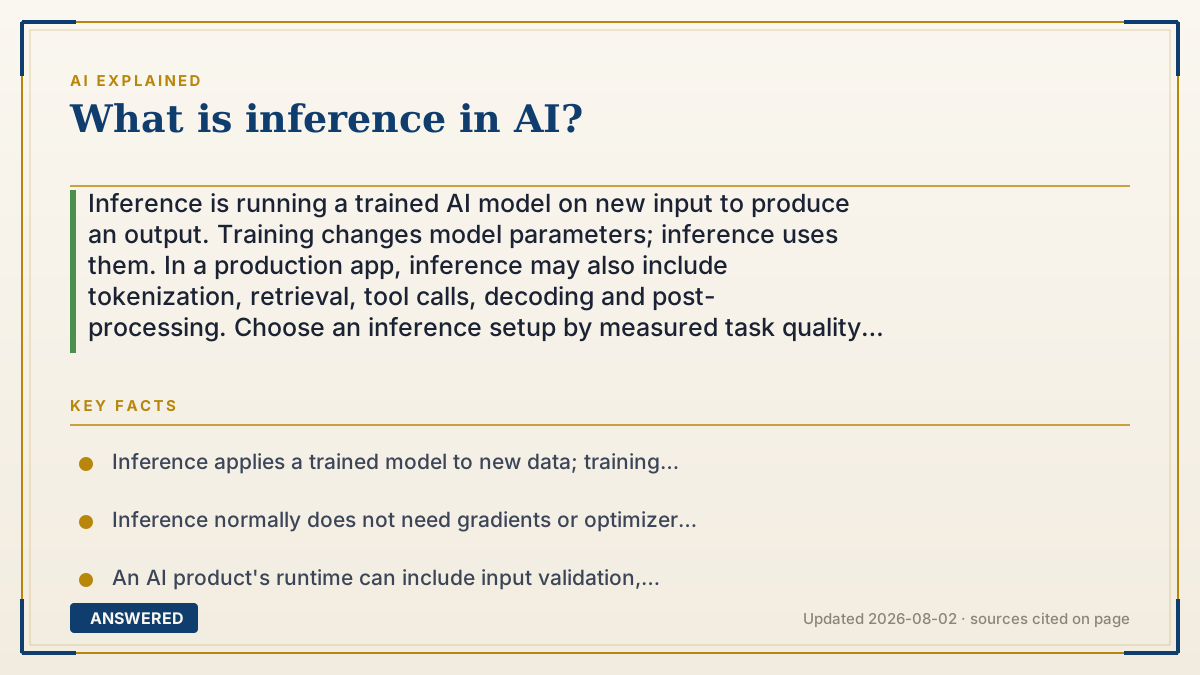
Inference is running a trained AI model on new input to produce an output. Training changes model parameters; inference uses them. In a production app, inference may also include tokenization, retrieval, tool calls, decoding and post-processing. Choose an inference setup by measured task quality, latency, throughput, memory, privacy and cost—not by a benchmark or model size alone.
Why — the first-principles explanation
A trained model is a function with learned parameters. During inference, new input is passed through that function and the result is returned; the model's weights do not change. NVIDIA describes this as applying what a model learned to new data, while PyTorch's inference mode exists to run code without recording autograd information needed for backward passes.
That distinction is simple, but a real AI product has more than one stage:
1. Prepare: validate the request, tokenize or encode it, and attach permitted context. 2. Retrieve or call tools: fetch current documents, query an API, or ask an external service when the workflow allows it. These are runtime operations, not weight updates. 3. Forward pass: run the model with its current parameters. 4. Decode and post-process: turn tokens or scores into text, labels, images or an action proposal; validate the output against the application's schema and policy.
For an autoregressive language model, the prompt is processed in a prefill phase and generated text is produced token by token in a decode phase. The implementation may reuse a key-value cache, so “the model rereads the entire conversation every token” is an oversimplification. Longer inputs and outputs still consume more memory and compute, and reasoning or tool loops can add multiple model calls.
Training is often a large development cost, but inference is the recurring serving workload. There is no universal training-to-inference cost ratio: traffic, output length, batching, model size, hardware, caching and availability all change it. The correct business question is whether the chosen serving path delivers the required quality and service level at an acceptable cost.
An example that makes it click
Imagine a support classifier. Training taught a model to map ticket text to a queue; inference is what happens when today's ticket arrives. The service validates the text, may retrieve the current routing rules, runs one forward pass, returns a queue and confidence, and sends uncertain cases to a human. If the same model generates a reply, each generated token adds work and streaming can improve perceived time-to-first-token without reducing total computation. A production decision therefore measures accuracy, tail latency, throughput, cost per ticket and escalation rate together.
How to do it
- Define the inference job and failure cost: classification, extraction, generation, ranking or an action proposal. Set quality, latency, availability, privacy and cost targets.
- Create a representative evaluation set and a baseline. Measure the exact model and prompt on normal, rare, adversarial and long-context inputs before optimizing infrastructure.
- Choose the serving boundary. Decide what is local, what is sent to a provider, and whether retrieval or tools are allowed; document data residency, retention and access controls.
- Pin the model version and configuration. Record tokenizer, context limits, system prompt, decoding parameters, quantization, hardware and library versions.
- Measure the whole request path, not only model time: queue wait, time to first token, time per output token, end-to-end latency, error rate, throughput and tail percentiles.
- Control memory and compute. Test context length, output limits, batching, caching, quantization and concurrency; optimize only after the quality baseline is stable.
- Separate perceived and actual speed. Streaming can show early tokens sooner, while total tokens, tool calls and post-processing still determine total work and cost.
- Validate outputs before they reach users or tools. Enforce schemas, permissions, citation or retrieval rules, refusal handling and human approval for consequential actions.
- Add resilience: timeouts, retries with budgets, provider or model fallback, circuit breakers, rate limits and a rollback path for a bad model release.
- Monitor production drift. Sample outputs for quality and safety, track traffic and context distributions, compare cost and latency to the SLA, and re-run the evaluation set after changes.
Key facts
- Inference applies a trained model to new data; training updates the model's parameters.
- Inference normally does not need gradients or optimizer state. PyTorch provides inference mode to avoid autograd bookkeeping when gradients are not required.
- An AI product's runtime can include input validation, retrieval, tool calls, model execution, decoding and output validation; only model execution is the forward pass itself.
- Autoregressive language models generally process the prompt in a prefill phase and generate output in a decode phase, often using a key-value cache.
- Longer context and output increase serving work, while batching and caching can improve throughput under suitable traffic patterns.
- Time to first token, time per output token, end-to-end latency and tail latency answer different user and operations questions.
- Streaming can improve perceived responsiveness without necessarily lowering total tokens, compute or cost.
- Retrieval and tool calls can provide current context, but they add dependencies, latency, permission boundaries and new failure modes.
- A model that is cheap or fast but fails the task can have a higher total cost through retries, human review, incidents or lost conversions.
- Inference settings, model snapshots, hardware, provider routing and pricing change; pin versions and record the measurement date.
Choose an inference path that survives real traffic
Benchmark the complete request path—model, context, tools, latency, safety and cost—then add monitoring and a fallback before you scale usage.
▶ The 60-second explainer (script)
What is inference in AI? It is the serving step: a trained model receives new input and produces a prediction, classification, generation or score. Training changes parameters; inference uses them without a backward pass. A real request may also validate input, retrieve current context, call tools, decode tokens and validate the output. For a language model, the prompt is processed first and generated text is decoded token by token, often with a cache. Measure time to first token, total latency, throughput, memory, quality, safety and cost together. Streaming can feel faster without reducing total work. The best inference setup is not automatically the biggest or cheapest model—it is the one that meets your task and service-level requirements with a safe fallback.
What authoritative sources say
People also ask
Is inference the same as prediction?
In everyday machine-learning usage, running a trained model to produce a prediction or generation is inference. The word can mean something else in formal logic, so context matters.
What is the difference between training and inference?
Training updates model parameters using examples and an optimization procedure. Inference uses the resulting parameters on new inputs; it normally does not update the weights or compute gradients.
Does an AI model learn during inference?
Not in the sense of changing its weights. A conversation can supply context for the current request, and a product may store information outside the model, but a new training or adaptation process is needed to change model parameters.
Why does AI text arrive one token at a time?
Autoregressive language models generate a sequence incrementally. The service can stream each token as it is available, which improves perceived responsiveness; it does not mean the model is learning during the response.
What are prefill and decode?
Prefill processes the supplied prompt or context. Decode generates new output tokens step by step. They have different compute and latency profiles, so production systems often measure both.
Can inference run on a phone or laptop?
Often, for models and quantizations that fit the device's memory and compute budget. Measure quality, battery, thermal limits, privacy and latency; a model that runs is not automatically a good product choice.
Why is inference expensive?
It is a recurring serving workload. Traffic volume, model size, context and output length, tool calls, concurrency, hardware and provider pricing all contribute, so there is no universal cost ratio.
How can I reduce inference latency?
Measure first. Then test shorter context, smaller or quantized models, caching, batching, better routing, streaming and fewer tool calls while checking that quality and safety remain acceptable.
What is inference-time scaling or reasoning?
It is additional computation during serving—such as multiple drafts, verification passes or tool steps—to improve an answer. It can raise quality, latency and cost, so evaluate the full workflow rather than the model call alone.
What should I monitor in production?
Track quality and safety samples, time to first token, total and tail latency, throughput, error/retry rates, token or request cost, memory, tool failures, input drift and human overrides.
Is a larger model always better for inference?
No. Compare models on your real task and constraints. A smaller model with retrieval, validation and a fallback can outperform a larger model on total cost, latency or reliability.
The same question, asked other ways
- What is AI inference?