What is an AI model?
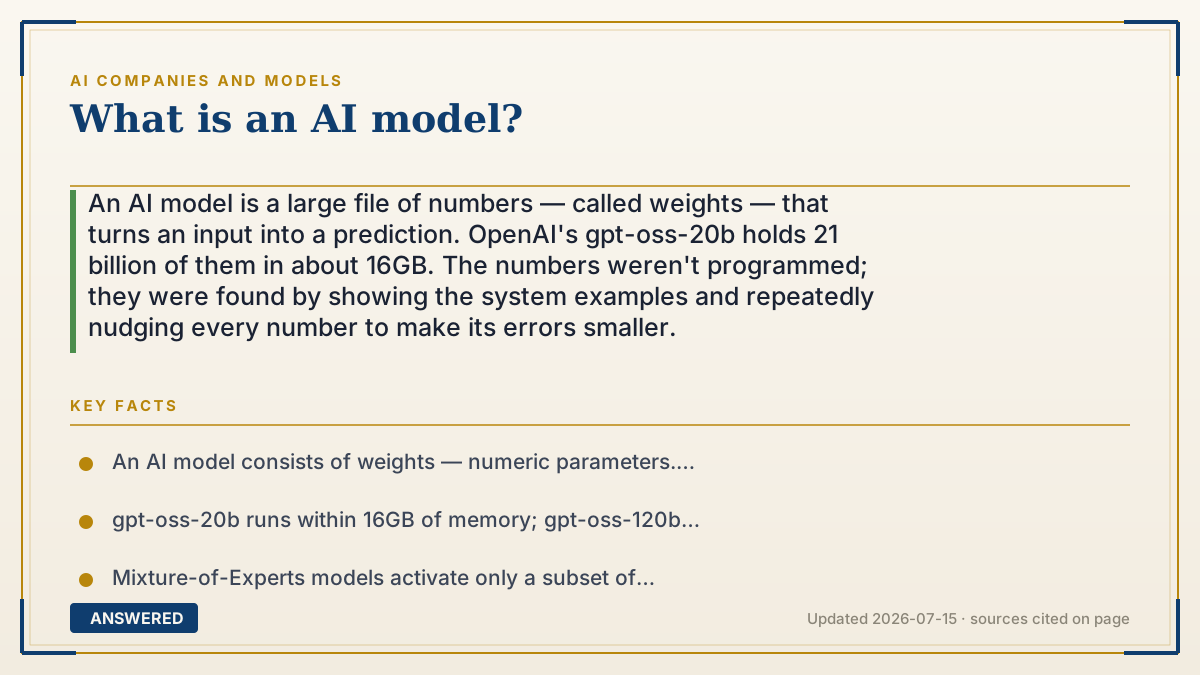
An AI model is a large file of numbers — called weights — that turns an input into a prediction. OpenAI's gpt-oss-20b holds 21 billion of them in about 16GB. The numbers weren't programmed; they were found by showing the system examples and repeatedly nudging every number to make its errors smaller.
Why — the first-principles explanation
An AI model is not a program in the way people imagine. Nobody wrote rules saying "if the sentence is about cats, mention whiskers." A model is a giant mathematical function with billions of adjustable knobs, and those knobs were set by an automated process rather than by a person.
The knobs are called weights. gpt-oss-20b has 21 billion of them and takes about 16GB on disk — that file is the model. Copy it to another computer and you've copied the whole intelligence. There's nothing else. No database of facts, no rulebook. Just numbers arranged in layers, and the arithmetic that pushes an input through them.
How did the numbers get their values? Training. Start random. Show the system an example. Compare its output to the right answer. Calculus tells you which direction to nudge each of the 21 billion weights to make the error slightly smaller. Nudge. Repeat, trillions of times. What emerges is not a lookup table — it's a compressed statistical shape of the patterns in the data. This is why models can answer questions never asked before, and equally why they confidently invent things: they're producing what fits the pattern, and a plausible-sounding falsehood fits the pattern just fine.
A useful distinction most explanations skip: "model" is the file; the app is everything around it. ChatGPT is not a model — it's a website wrapped around models, with search, memory and safety systems attached. Gemini is a model family; the Gemini app is the wrapper. When someone says "which model," they mean the file. When they say "which AI," they usually mean the product.
Modern models are also specialized. gpt-oss-20b has 21B weights but activates only 3.6 billion per token — a Mixture-of-Experts design that routes each word to the relevant subset. That's why a 21-billion-parameter model fits in a laptop's memory.
An example that makes it click
Think of a music student who has heard 100,000 songs. Nobody handed her a rulebook of music theory. She absorbed patterns — this chord tends to follow that one, this rhythm fits this mood.
Now ask her to improvise. She produces something new that sounds right, because she learned the shape of music, not a list of songs. Her whole ability lives in adjustments to the neurons in her head — you can't open her skull and find the songs.
An AI model is that, written down: 21 billion numbers in a 16-gigabyte file. And it has the same weakness. Ask her to play a song that doesn't exist, and she'll happily improvise something that sounds exactly like it should exist.
Key facts
- An AI model consists of weights — numeric parameters. gpt-oss-20b has 21 billion total parameters; gpt-oss-120b has 117 billion.
- gpt-oss-20b runs within 16GB of memory; gpt-oss-120b requires a single 80GB GPU such as an H100 or AMD MI300X.
- Mixture-of-Experts models activate only a subset of weights per token: gpt-oss-20b activates 3.6B of its 21B, and gpt-oss-120b activates 5.1B of its 117B.
- Both gpt-oss models are released under the Apache 2.0 license, meaning the weights file itself can be downloaded, modified and used commercially.
- The transformer architecture underlying modern language models was published by Google researchers in 2017.
- Models are distinct from products: ChatGPT, Gemini and Claude are applications built around model files, adding search, memory and safety systems.
▶ The 60-second explainer (script)
What is an AI model? It's not a program the way you're picturing. Nobody wrote rules saying 'if the sentence is about cats, mention whiskers.' A model is a giant mathematical function with billions of adjustable knobs — and the knobs were set by a machine, not a person. The knobs are called weights. gpt-oss-20b has twenty-one billion of them, about sixteen gigabytes on disk. That file is the model. Copy it to another computer and you've copied the entire intelligence. There's nothing else in there. No database of facts. No rulebook. Just numbers in layers, and the arithmetic that pushes your input through them. So how'd the numbers get their values? Training. Start random. Show it an example. Compare the output to the right answer. Calculus tells you which way to nudge each of the twenty-one billion weights to shrink the error. Nudge. Repeat, trillions of times. What comes out isn't a lookup table — it's a compressed statistical shape of the patterns in the data. That's why models answer questions never asked before. And it's exactly why they confidently make things up. They produce what fits the pattern, and a plausible lie fits the pattern perfectly well. One distinction most explanations skip: the model is the file. ChatGPT isn't a model — it's a website wrapped around models, with search and memory bolted on. When someone asks 'which model,' they mean the file. 'Which AI' usually means the product.
What authoritative sources say
People also ask
What's the difference between an AI model and AI?
'AI' is the broad field or the product you use. A model is the specific trained file of weights doing the predicting inside it. ChatGPT is a product; GPT is a model.
What are parameters?
The individual adjustable numbers — the weights. gpt-oss-20b has 21 billion. More parameters generally means more capability and more compute per answer.
Why do AI models make things up?
Because they generate what fits the learned pattern, not what's verified true. A plausible-sounding falsehood fits the pattern just as well as a fact does.
Can I download an AI model?
Some, yes. OpenAI's gpt-oss models are Apache 2.0 licensed and downloadable. The frontier models behind ChatGPT and Gemini are closed and cloud-only.
Do models know things or just predict text?
They predict — but the prediction requires compressing enormous regularities about the world, which produces something that behaves a lot like knowledge, without any check on whether it's true.