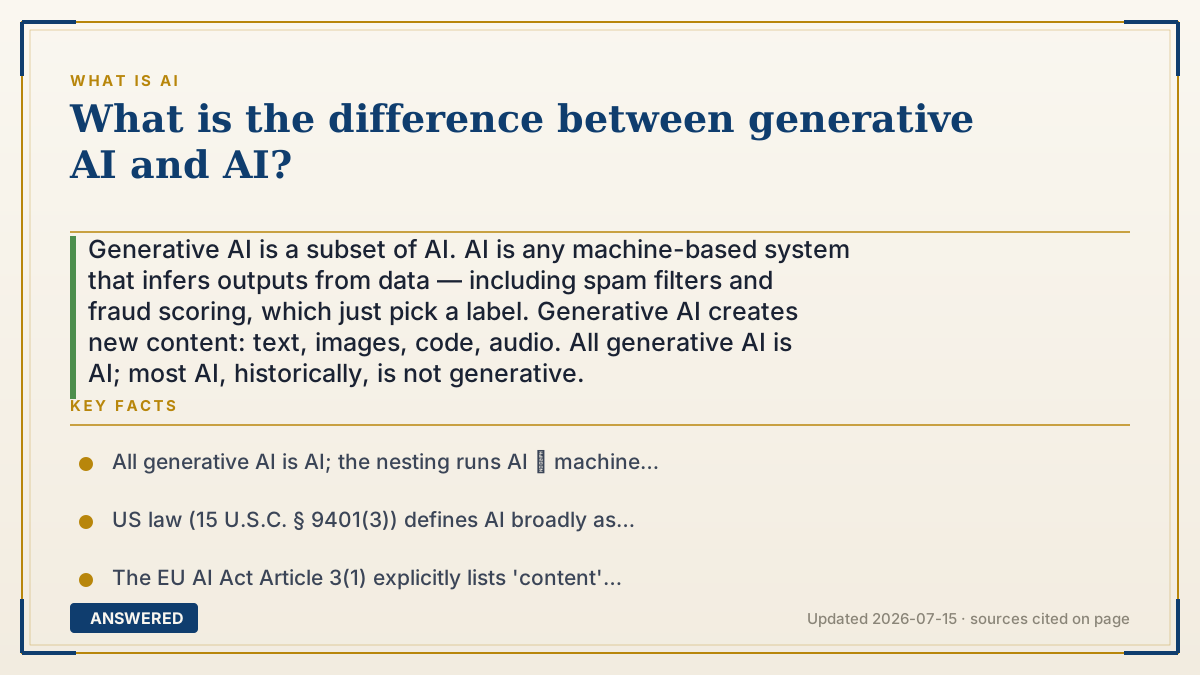
What is the difference between generative AI and AI?
Generative AI is a subset of AI. AI is any machine-based system that infers outputs from data — including spam filters and fraud scoring, which just pick a label. Generative AI creates new content: text, images, code, audio. All generative AI is AI; most AI, historically, is not generative.
Why — the first-principles explanation
It's not a rivalry — it's a nesting. Generative AI sits inside AI the way a sports car sits inside "vehicles."
AI is the broad category, and the legal definitions draw it wide. US law: a machine-based system that makes predictions, recommendations, or decisions for human-defined objectives. The EU AI Act: a system that infers from input how to generate outputs. Under both, your spam filter is unambiguously AI. It's been AI since the 1990s.
The split inside that category comes down to output shape. Most AI is discriminative: it takes something that exists and assigns a label or score. Spam or not. Fraud risk 0.87. This face is Maria. The set of possible answers is fixed before the model runs. Generative AI constructs its output piece by piece — token by token for text, denoising step by step for images — so the possible answers are effectively unlimited.
That difference in shape drives every practical difference. A classifier can be scored: run it on 10,000 labeled emails and compute exactly how often it's right. That's why classic AI could be deployed in banking and medicine for decades — you could measure it. Generative AI has no such scoreboard. There's no single correct paragraph, so "accuracy" isn't defined. You can't compute the error rate of an essay, which is why evaluation is the hardest open problem in the field and why generative systems get deployed on vibes in ways classifiers never were.
It also explains the hallucination gap. A spam filter's worst case is a wrong label — annoying, obvious, correctable. A generative model's worst case is fluent, confident, invented content that looks exactly like the true kind. Same underlying technology; wildly different failure surface.
An example that makes it click
A restaurant has a food critic and a chef. The critic tastes a dish and scores it — 7 out of 10. That's classic AI: something already exists, and she assigns a label. You can even check her: give her the same dish twice and see if she says 7 both times.
The chef invents a new dish. There's no right answer to compare against — that's generative AI. And notice the asymmetry. If the critic is wrong, you shrug; the dish is still sitting there and you can taste it yourself. If the chef confidently serves you something that looks like a classic French dish but isn't, you might not find out until you tell someone the recipe. Scoring is checkable. Creating isn't. That gap is the whole difference.
Key facts
- All generative AI is AI; the nesting runs AI ⊃ machine learning ⊃ deep learning ⊃ generative AI.
- US law (15 U.S.C. § 9401(3)) defines AI broadly as making predictions, recommendations, or decisions — covering both generative and non-generative systems.
- The EU AI Act Article 3(1) explicitly lists 'content' alongside predictions, recommendations, and decisions as AI outputs, covering generative systems within the same definition.
- The EU AI Act separately defines general-purpose AI models (Article 3(63)) as trained with self-supervision at scale and displaying significant generality across many tasks.
- NIST needed a separate Generative AI Profile (NIST-AI-600-1), released July 26, 2024, because generative AI's risks differ from those of classifying AI.
- Non-generative AI can be scored against labeled test data; generative AI has no single correct output, making accuracy measurement structurally harder.
▶ The 60-second explainer (script)
Generative AI versus AI isn't a rivalry. It's a nesting. Generative AI sits inside AI the way a sports car sits inside vehicles. AI is the broad category, and the law draws it wide. US statute: a machine-based system that makes predictions, recommendations, or decisions toward human-defined objectives. The EU AI Act: a system that infers from input how to generate outputs. Under both, your spam filter is unambiguously AI. It's been AI since the nineties. The split inside that category comes down to the shape of the output. Most AI is discriminative — it takes something that already exists and assigns a label or a score. Spam or not spam. Fraud risk zero point eight seven. This face is Maria. The possible answers are fixed before the model even runs. Generative AI builds its output piece by piece — token by token for text, denoising step by step for images. So the possible answers are effectively unlimited. And that difference in shape drives everything else. A classifier can be scored. Run it on ten thousand labeled emails, compute exactly how often it's right. That's why classic AI got deployed in banking and medicine for decades — you could measure it. Generative AI has no scoreboard. There's no single correct paragraph, so accuracy isn't even defined. You cannot compute the error rate of an essay. That's why evaluation is the hardest open problem in the field, and why generative systems get shipped on vibes in ways classifiers never were. It also explains hallucination. A spam filter's worst case is a wrong label — annoying, obvious, fixable. A generative model's worst case is fluent, confident, invented content that looks exactly like the real thing. Same technology underneath. Completely different failure surface.
What authoritative sources say
People also ask
Is all AI generative AI?
No. Most AI historically is not — spam filters, fraud detection, face recognition, and forecasting all output labels or scores rather than new content.
Is generative AI better than regular AI?
Different, not better. For measurable decisions like fraud scoring, a classifier is more accurate, cheaper, and easier to audit. Generative AI wins only when you need new content.
Why does generative AI hallucinate but spam filters don't?
A spam filter picks from two options, so its errors are visible and countable. A generative model constructs unlimited outputs, so a fabricated answer looks exactly like a true one.
Which came first?
Non-generative AI, by decades. Classification and prediction systems were in commercial use from the 1990s; generative AI reached the mainstream with ChatGPT in November 2022.