What is the AI Core app?
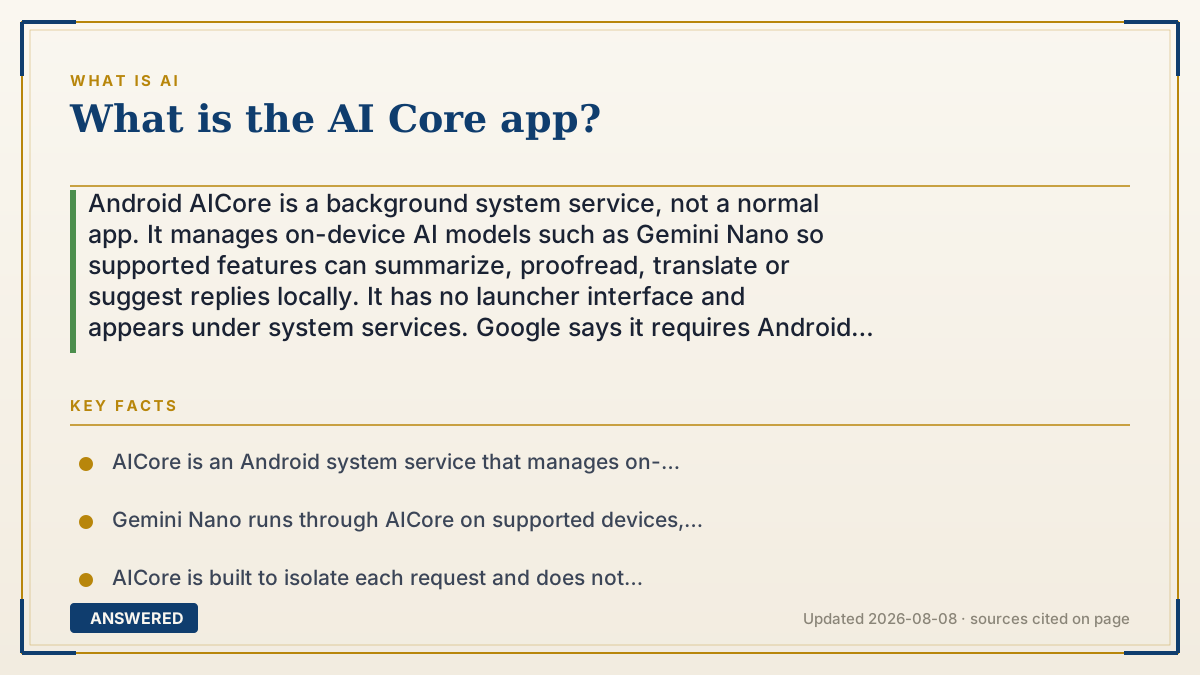
Android AICore is a background system service, not a normal app. It manages on-device AI models such as Gemini Nano so supported features can summarize, proofread, translate or suggest replies locally. It has no launcher interface and appears under system services. Google says it requires Android 14 or later; service and feature availability vary by device and manufacturer. Verified 2026-08-08.
Android AICore at a glance
| Question | Answer | Boundary |
|---|---|---|
| What is it? | An Android system service for on-device AI models | Not a chatbot or app you launch |
| What does it do? | Runs supported Gemini Nano features on device | Features vary by phone, manufacturer and app |
| Does it need the cloud? | Inference for supported tasks is local | Model downloads and updates still use a protected system path |
| Why can it use storage? | Model files are large and update in the background | Old and new versions may coexist temporarily during updates |
| Where is it listed? | Settings > Google profile > All Services > System services | It may not appear in ordinary Play Store search |
Why — the first-principles explanation
AICore can appear in an installed-package list even though you never chose it from the Play Store. That is expected: Android lists both apps that people launch and system services that other software calls. AICore belongs to the second group, so it normally has no launcher icon or user-facing home screen.
Its job is to provide a shared interface to on-device foundation models such as Gemini Nano. A supported app can ask the system to perform tasks such as summarization, proofreading, smart reply or translation. AICore manages the model and uses compatible device hardware for inference instead of forcing every app to ship and update its own large model copy.
This architecture matters for privacy and reliability. Google documents that AICore isolates requests, does not retain input or output records after processing, and has no direct internet access. Model downloads and updates are routed through the separate Private Compute Services component. That lets supported inference stay local and work offline while the system can still maintain model files.
Do not generalize that promise to every AI feature on the phone: AICore-backed tasks are local, while other apps may independently use cloud services under their own policies. Google currently says Android 14 or later is required, and both service and feature availability vary by device and manufacturer.
An example that makes it click
Open your kitchen drawer and you'll find a can opener. Nobody uses a can opener as an activity. It has no purpose on its own — it exists so that other things can happen, and it sits in the dark until a can shows up.
AICore is the can opener. It appears in a system-service list because Android shows machinery as well as apps. It has no launcher screen for everyday use, although Android provides a system-services settings path where you can view it.
And the reason there's one can opener instead of ten: imagine if every food you bought came with its own opener welded to the box. Ten cans, ten openers, drawer full, all of them slightly different versions. That's what would happen if every app shipped its own copy of a large AI model. Android can manage one system copy and its updates for supported features.
Key facts
- AICore is an Android system service that manages on-device AI models; it is not a normal app with a launcher interface.
- Gemini Nano runs through AICore on supported devices, using device hardware for low-latency local inference.
- AICore is built to isolate each request and does not store any record of the input data or the resulting outputs after processing.
- AICore has no direct internet access; model downloads and updates are routed through the Private Compute Services companion component.
- Google says Android 14 or later is required, while service and feature availability vary by device and manufacturer.
- During a model update, storage can temporarily increase because old and new model versions may coexist for up to three days as a rollback safeguard.
Understand on-device AI before changing system services
Compare AICore with other phone AI concepts and verify what runs locally versus in the cloud.
▶ The 60-second explainer (script)
If AICore appeared in your Android system list, it is not a mystery chatbot you installed. It is a background system service. Supported apps use it to run Gemini Nano features such as summarization, proofreading, translation or smart replies on your device. That is why it normally has no launcher icon or screen to open. Google says AICore isolates each request, does not keep input or output records, and has no direct internet access. Model downloads and updates use the separate Private Compute Services path, so local inference and model maintenance are different things. Android 14 or later is required, and both service and feature availability vary by device and manufacturer. Temporary storage growth can be normal during a model update because the system may keep both versions briefly for rollback. This privacy description applies to AICore-backed tasks; other apps can still use their own cloud AI services.
What authoritative sources say
People also ask
Is AICore spyware or malware?
It is an official Android system service, not a normal downloaded app. Google documents local Gemini Nano processing, request isolation and no retained input/output record for AICore-backed tasks.
Why can't I open the AICore app?
Because it is a background service other apps and system features call. Google lists it under Settings > Google profile > All Services > System services, not as a normal launcher app.
Can I uninstall or disable AICore?
It is managed as a system service rather than an ordinary Play Store app. Leave it enabled unless your device maker, administrator or an official troubleshooting guide specifically tells you otherwise; disabling it can make supported on-device features unavailable.
Does AICore send my data to Google?
For AICore-backed tasks, Google says the personal input is processed locally and not sent to the cloud. Model downloads and updates still use the protected Private Compute Services path. Other apps may separately use cloud AI under their own policies.
Why is AICore using so much storage?
On-device model files are large. Google says an update may temporarily keep both the old and new model versions for up to three days so the phone can roll back if the new one fails.