What makes writing sound human rather than AI-generated?
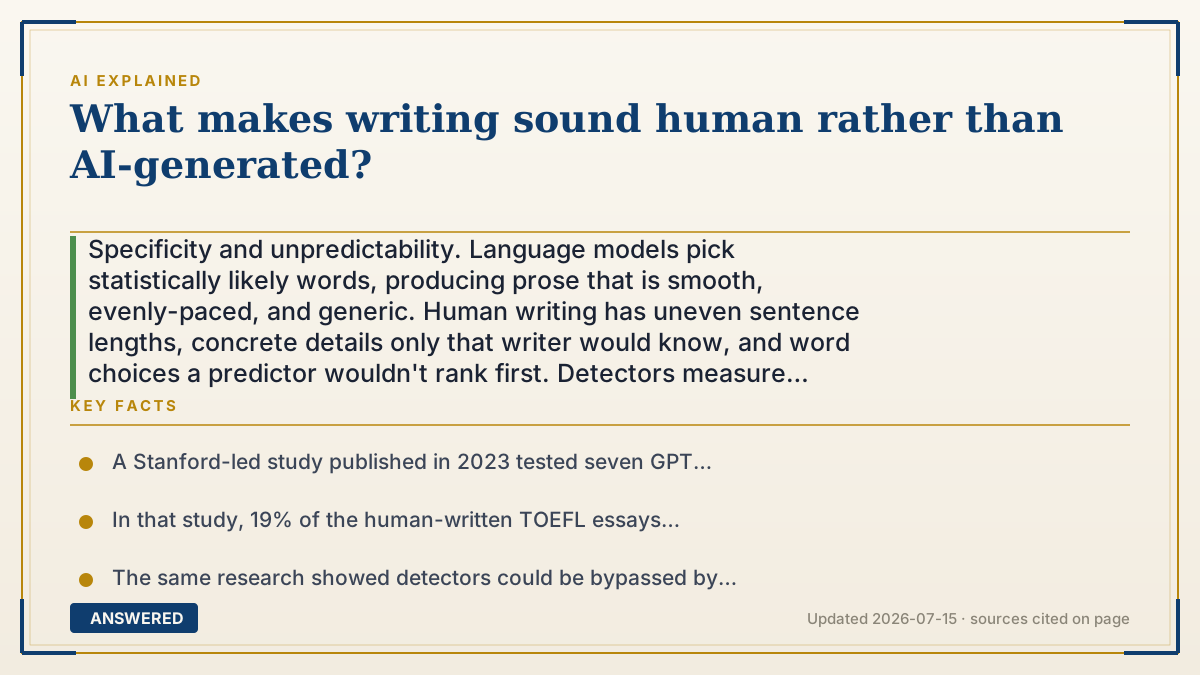
Specificity and unpredictability. Language models pick statistically likely words, producing prose that is smooth, evenly-paced, and generic. Human writing has uneven sentence lengths, concrete details only that writer would know, and word choices a predictor wouldn't rank first. Detectors measure exactly this — and get it badly wrong, falsely flagging 61% of non-native English essays.
Why — the first-principles explanation
A language model generates text by repeatedly answering one question: given everything so far, what's the most likely next token? Even with randomness dialed in, it's drawing from the high-probability region of its distribution. That single mechanism explains nearly every tell.
Low perplexity is the first consequence. Perplexity measures how surprised a model is by each word. Model-written text has low perplexity by construction — it's made of the words a model expected. Humans constantly reach for the fourth-most-likely word because it's more precise, or funnier, or because that's just how they talk. Low burstiness is the second. Humans vary wildly: a forty-word sentence, then three words. Models settle into a comfortable rhythm — sentence after sentence of similar length, paragraph after paragraph of similar shape. That evenness feels smooth, and smooth is the tell.
The deepest one is specificity. A model can't know that your grandmother's kitchen smelled like burnt cardamom, or that the meeting fell apart at 2:47pm when the CFO's screen froze. It only knows what's common across its training data, so it defaults to the average of everything — "a rich tapestry," "in today's fast-paced world," "it's important to note." These phrases feel like writing without saying anything. Human writing carries information only that writer had access to: proper nouns, exact numbers, specific failures, opinions with a cost. This is also why models hedge — averaging a million opinions yields "there are arguments on both sides." A person with a real stake picks one.
Now the part most articles skip. Detectors measure perplexity and burstiness, and this makes them systematically unjust. A Stanford study published in 2023 ran seven detectors over 91 TOEFL essays written by humans and misclassified 61.22% of them as AI-generated, while performing near-perfectly on essays by U.S.-born eighth-graders. Nineteen percent were unanimously flagged by all seven. Why? Non-native writers use more common words and simpler syntax — that's low perplexity, which is exactly the AI signature. Meanwhile the same study showed asking a model to "elevate" the text with literary language defeated the detectors. The result: detectors punish plain human writing and wave through polished AI writing. So "sounding human" and "passing a detector" are different goals, and optimizing for the second one is a mistake.
An example that makes it click
Two people describe the same dog.
The first says: "Dogs are wonderful companions that bring joy and unconditional love into our lives, offering both emotional support and a sense of purpose to their owners." Every word is the word you expected. Nothing in it could only be said by someone who met a dog.
The second says: "He's fourteen, he's deaf, and he still barks at the mailman out of habit — wrong direction, three seconds late, every single day." You believe a dog exists. The details are useless to anyone else, the rhythm is lumpy, and "wrong direction, three seconds late" is not a phrase anybody would predict. That's the whole difference. The first one is the average of every dog sentence ever written. The second one costs something to know.
How to do it
- Add information only you have: real names, exact numbers, dates, times, places. A model cannot invent what it never saw.
- Break the rhythm deliberately. Put a three-word sentence after a long one. Models drift toward even pacing; unevenness reads as human.
- Cut the connective slop — 'moreover,' 'furthermore,' 'it's important to note,' 'in today's fast-paced world.' These are filler the predictor loves and readers skim.
- Take a position that costs you something. Averaging a million opinions produces 'both sides have merit.' A real stake produces a choice.
- Prefer the concrete noun. Not 'a challenging situation' — 'the invoice was $400 short.'
- Do not optimize for AI detectors. They flag low-perplexity writing, which means they punish plain, clear, non-native prose and pass polished AI text. Write well and accept the flag risk; if accused, keep drafts and version history as evidence.
Key facts
- A Stanford-led study published in 2023 tested seven GPT detectors on 91 TOEFL essays written by humans and found 61.22% were misclassified as AI-generated, while the same detectors performed near-perfectly on essays by US-born eighth-graders.
- In that study, 19% of the human-written TOEFL essays were unanimously flagged as AI by all seven detectors, and 97% were flagged by at least one.
- The same research showed detectors could be bypassed by prompting a model to 'elevate' its text using literary language — meaning polished AI text passes while plain human text fails.
- Detectors rely on perplexity, a measure of how predictable each word is; non-native English writers score lower on lexical richness and syntactic complexity, which reads as low perplexity and therefore as 'AI'.
- Turnitin revised its stated false positive rate upward from 1% to 4% after real-world deployment.
- Language models generate text by sampling from a high-probability next-token distribution, which structurally produces low perplexity and low burstiness — the two properties detectors measure.
▶ The 60-second explainer (script)
What makes writing sound human? Two things: specificity and unpredictability. Here's the mechanism. A language model generates text by answering one question over and over — given everything so far, what's the most likely next word? Even with randomness added, it's pulling from the likely region. That one fact explains every tell. First, low perplexity. Perplexity is how surprised a model is by each word. AI text is made of words a model expected, so it's low by construction. Humans grab the fourth-most-likely word all the time, because it's sharper or funnier. Second, low burstiness. Humans go forty words, then three. Models settle into an even rhythm. That smoothness is the giveaway. But the deepest one is specificity. A model can't know your grandmother's kitchen smelled like burnt cardamom, or that the meeting died at 2:47 when the CFO's screen froze. So it writes the average of everything — a rich tapestry, in today's fast-paced world. Human writing carries information only that writer had. Now the part nobody tells you. Detectors measure perplexity and burstiness — and that makes them unjust. A Stanford study ran seven detectors on ninety-one TOEFL essays written by actual humans. Sixty-one percent got flagged as AI. Nineteen percent were flagged by all seven. Why? Non-native writers use common words and simple syntax. That's low perplexity. That's the AI signature. And the same study showed that asking a model to fancy up its language defeated the detectors entirely. So detectors punish plain human writing and pass polished AI writing. Sounding human and passing a detector are different goals. Chase the first one.
What authoritative sources say
People also ask
What's the single biggest tell of AI writing?
Generic specificity — writing that sounds like writing but contains no information the author had to earn. Real names, exact numbers, and particular failures can't be predicted from training data, so their absence is the strongest signal.
Can I make AI text sound human by editing it?
Partly. Adding real specifics and breaking the sentence rhythm helps most. But the fundamental fix is having something only you know — no amount of restructuring adds information that was never there.
Do AI detectors actually work?
Poorly, and unfairly. Stanford's study found seven detectors misflagged 61.22% of human-written TOEFL essays while near-perfectly clearing native eighth-graders. They measure predictability, so they punish plain writing and pass polished AI prose.
Why do detectors flag non-native English speakers so often?
Because they score perplexity — how surprising each word is. Non-native writers naturally use more common vocabulary and simpler syntax, which produces low perplexity. That's mathematically identical to the AI signature the detector hunts for.
Should I write to avoid detector flags?
No. Optimizing for detectors means inflating your vocabulary and complicating your syntax — which makes writing worse and is exactly what the Stanford study showed lets AI text through. Write clearly and keep drafts and version history in case you're wrongly accused.