Why do AI detectors flag human writing?
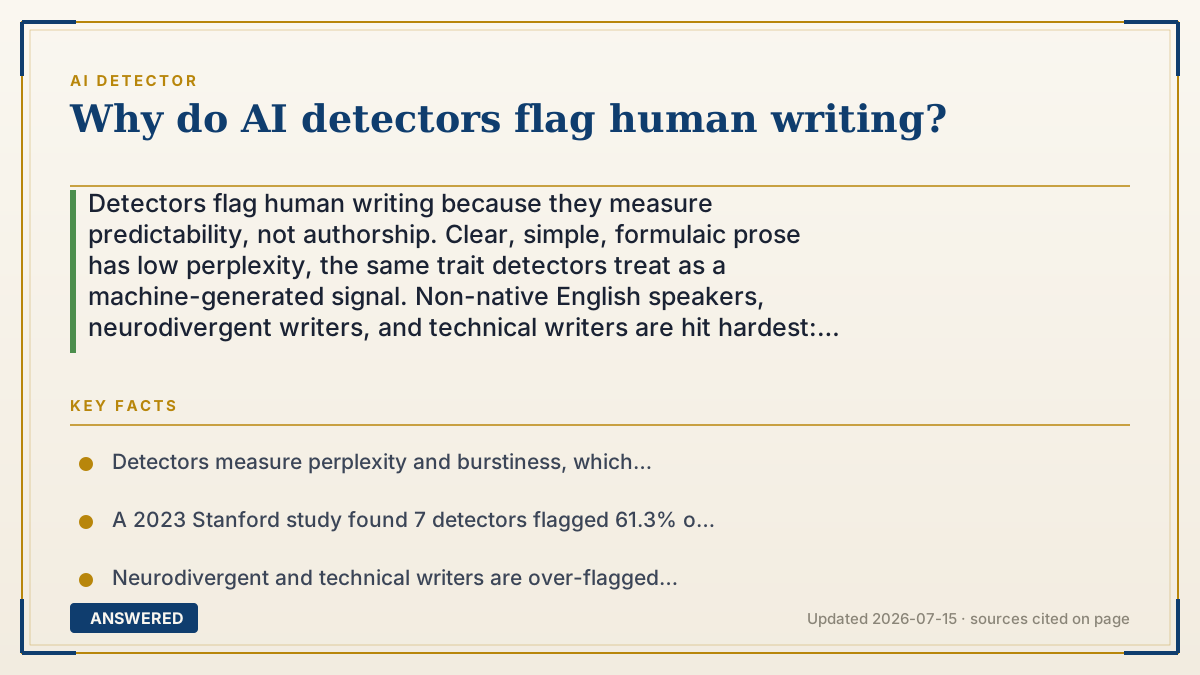
Detectors flag human writing because they measure predictability, not authorship. Clear, simple, formulaic prose has low perplexity, the same trait detectors treat as a machine-generated signal. Non-native English speakers, neurodivergent writers, and technical writers are hit hardest: a Stanford study saw 61% of non-native essays wrongly flagged.
Why — the first-principles explanation
The root cause is a mismatch between what detectors measure and what they claim. They claim to identify AI authorship, but they actually measure perplexity, how predictable each word is, and burstiness, how much sentence rhythm varies. AI writing is smooth and predictable, so detectors flag low-perplexity text. The problem is that many humans write with low perplexity too, and there's no way to statistically separate "predictable because a machine wrote it" from "predictable because a person writes plainly."
This systematically punishes certain writers. Non-native English speakers use a smaller, more common vocabulary, which produces low perplexity, so a 2023 Stanford study found seven detectors flagged 61.3% of their essays as AI, versus about 5.1% for native writers. Neurodivergent students and anyone who writes in a repetitive, structured style get caught for the same reason. So do technical and legal writers, whose fields demand standardized phrasing.
There are secondary triggers too. Very short passages give the model too little signal, so it guesses. Common templates, formal instructions, and heavily-edited or Grammarly-polished text can smooth out the natural quirks that would otherwise mark writing as human. Because the underlying signal is a correlate and not proof, false positives are not a bug that a better model fully removes, they're a built-in cost of the approach, which is why universities warn against treating a flag as evidence of cheating.
An example that makes it click
Imagine a security scanner set to beep at 'suspiciously neat' luggage, on the theory that smugglers pack perfectly. Most travelers pack messily, so it works okay. But the tidy, organized traveler who always folds everything perfectly beeps every single time, even though they've done nothing wrong.
AI detectors beep at 'suspiciously neat' writing. The plain, careful, organized writer, especially someone writing in a second language with simple words, sets off the alarm again and again, not because they cheated, but because neat is exactly what the scanner was told to distrust.
Key facts
- Detectors measure perplexity and burstiness, which correlate with, but do not prove, AI authorship.
- A 2023 Stanford study found 7 detectors flagged 61.3% of non-native English essays as AI (native ~5.1%).
- Neurodivergent and technical writers are over-flagged because they use repetitive, standardized phrasing.
- Turnitin's real-world sentence-level false positive rate was reported near 4%.
- Universities such as USD's Legal Research Center advise detectors are not reliable as sole indicators of misconduct.
▶ The 60-second explainer (script)
Why do AI detectors flag human writing? Because they don't actually measure who wrote something. They measure how predictable your writing is. AI text is smooth and predictable, so detectors treat predictable writing as a machine signal. The trouble is, lots of humans write that way too. If you use clear, simple, common words, your writing has low perplexity, exactly what the detector was told to distrust. That's why some groups get hit hardest. Non-native English speakers use smaller, more common vocabularies, and in one Stanford study, detectors wrongly flagged sixty-one percent of their essays as AI. Neurodivergent students and technical writers get caught for the same reason: repetitive, standardized phrasing looks 'too neat.' Short passages and heavily-edited text trigger it too. The key point: false positives aren't a glitch, they're built into how these tools work, which is why a flag should never be treated as proof.
What authoritative sources say
People also ask
Why was my 100% human essay flagged as AI?
Likely because it's clear and predictable. Low-perplexity writing looks machine-made to detectors, even when a person wrote every word.
Do detectors discriminate against non-native English speakers?
Effectively yes. A Stanford study found detectors flagged 61% of non-native essays as AI because they use simpler, more common vocabulary.
Does using Grammarly cause false flags?
Heavy editing can smooth out the quirks that mark writing as human, which may raise the AI score, though basic grammar fixes usually don't.
Can I prevent false positives?
Keep drafts, version history, and notes so you can show your writing process. That evidence is more persuasive than trying to outwrite a detector.
The same question, asked other ways
- Why did my essay get flagged as AI when I wrote it?
- Why was my writing flagged as AI when my publisher called it too refined?
- Why do AI detectors give false positives?
- Why do AI detectors sometimes flag human-written content?
- Can AI detectors give false positives?