Which AI detectors do colleges use?
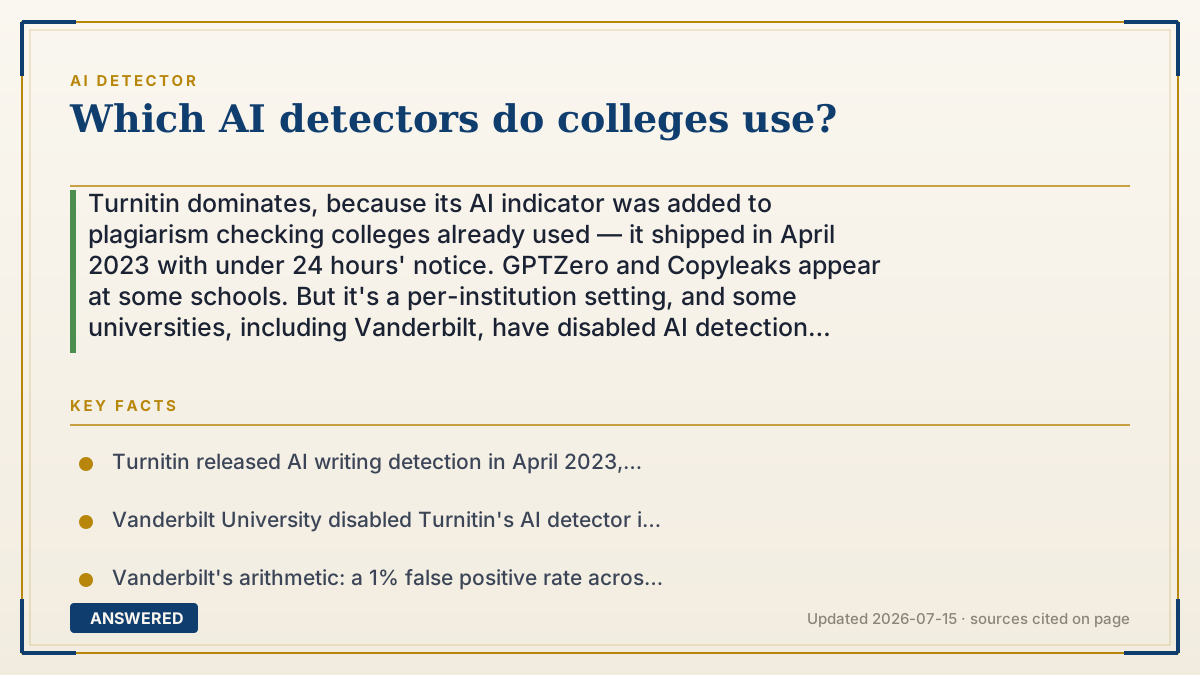
Turnitin dominates, because its AI indicator was added to plagiarism checking colleges already used — it shipped in April 2023 with under 24 hours' notice. GPTZero and Copyleaks appear at some schools. But it's a per-institution setting, and some universities, including Vanderbilt, have disabled AI detection entirely.
Why — the first-principles explanation
Turnitin's dominance isn't a verdict on quality. It's distribution. Colleges already ran Turnitin for plagiarism, already had it wired into Canvas, Blackboard, Moodle, and Brightspace, already had the contracts signed. When Turnitin added AI detection in April 2023 — pushed live to customers with less than 24 hours' notice — thousands of institutions started using an AI detector without ever evaluating one. The tool won by being already installed. Understanding that explains why the most-used detector is not the independently-validated best detector: nobody ran a bake-off.
That's also why the honest answer to "which detector does my college use?" is ask your college. It's an administrator's toggle, not an industry standard. Same product, different settings, wildly different consequences on different campuses — and the same paper can be flagged at one school and never scanned at another.
A real split has opened up. Some institutions kept AI detection on. Others disabled it after doing exactly the arithmetic vendors don't put in the brochure. Vanderbilt ran the numbers on its own submissions: 75,000 papers a year, times Turnitin's claimed 1% false positive rate, equals roughly 750 students wrongly flagged annually. Add the documented bias against non-native English writers, and Turnitin's refusal to explain how the tool decides, and Vanderbilt turned it off in August 2023.
So the landscape isn't "colleges use X." It's a live disagreement between institutions about whether this class of tool should be used at all — and your school's position on that question matters far more to you than which vendor's logo is on the report.
An example that makes it click
Think about why your office uses a particular video conferencing app. Not because a committee tested six of them and this one won. Because it came bundled with the email system you already had, and one day it was just there in the menu.
Now imagine that bundled app suddenly gained a feature that graded whether employees were paying attention in meetings, switched on overnight, and produced a percentage your manager could see and you couldn't. Nobody chose that tool for that job. It arrived, attached to something else, and started making claims about people. That's how AI detection reached most college campuses — riding along in software bought for a different purpose entirely.
How to do it
- Ask your instructor or check the syllabus — AI detection is an institution-level setting, so only your school can tell you what's running.
- Look up your school's academic integrity policy for AI. The policy defines the offense; the tool only produces a number.
- Check whether your school has publicly disabled AI detection — several have, and some publish that guidance openly.
- Assume you can't see the score. Turnitin's AI indicator lives in the instructor view, not the student report.
- Protect yourself with process: write in Google Docs or Word with version history enabled and keep your drafts and notes.
- If you're flagged, ask to see the report itself, ask what evidence exists beyond the score, and offer your version history.
Key facts
- Turnitin released AI writing detection in April 2023, enabled for existing customers with less than 24 hours' advance notice — distribution through installed plagiarism software, not procurement (Vanderbilt University).
- Vanderbilt University disabled Turnitin's AI detector in August 2023, citing false positives, bias against non-native English speakers, and Turnitin's lack of transparency about how the tool works.
- Vanderbilt's arithmetic: a 1% false positive rate across its 75,000 annual submissions implies roughly 750 falsely flagged papers per year.
- Turnitin claims a document-level false positive rate under 1% for documents over 20% AI writing, and accepts missing roughly 15% of AI text as a tradeoff.
- Seven detectors flagged 61.22% of TOEFL essays by non-native English speakers as AI-generated, a direct concern for international students (Liang et al., Patterns, 2023).
- AI detection is an institutional setting that admins can enable or disable, so coverage varies school by school and even course by course.
▶ The 60-second explainer (script)
Which AI detectors do colleges use? Mostly Turnitin — but not for the reason you'd think. It's not because Turnitin won some competition. It's distribution. Colleges already ran Turnitin for plagiarism. It was already wired into Canvas and Blackboard. The contracts were signed. So when Turnitin added AI detection in April 2023 — pushed live with under twenty-four hours' notice — thousands of schools started using an AI detector without ever evaluating one. It won by already being installed. Some schools also use GPTZero or Copyleaks. But here's what actually matters: it's a toggle, not a standard. An administrator decides. The same paper can be scanned at one school and ignored at another. And a real split has opened up. Vanderbilt did the math the brochure leaves out: seventy-five thousand papers a year, times Turnitin's own claimed one percent false positive rate, equals about seven hundred fifty students wrongly flagged. Every year. They added the bias against non-native English writers, the fact that Turnitin won't explain how it decides, and switched it off in August 2023. So ask your school. Their position on whether to use this at all matters more than the brand name.
What authoritative sources say
People also ask
Do all colleges use AI detection?
No. It's an institutional setting, and some universities have deliberately disabled it. Vanderbilt turned Turnitin's detector off in August 2023 and told instructors to set clear expectations with students instead.
Can I see what my college uses?
Ask your instructor or check your academic integrity policy. Many schools publish guidance, and you're entitled to know what's applied to your work.
Do colleges use ChatGPT to check for AI?
They shouldn't — ChatGPT has no ability to detect AI text and will confidently claim it wrote things it didn't. OpenAI withdrew its own purpose-built detector for low accuracy in 2023.
What about admissions essays?
Policies vary widely and are often unstated. Given that detectors flag 61% of non-native English essays as AI in research settings, international applicants face real exposure to a tool with documented bias.
Is a flag automatically a misconduct case?
Not at most schools. Responsible practice treats the score as a prompt to look closer or talk to the student. If yours treats it as proof, ask what evidence exists besides the number.
The same question, asked other ways
- What AI checker do colleges use?
- What AI detectors do colleges use?