What is the best AI detector?
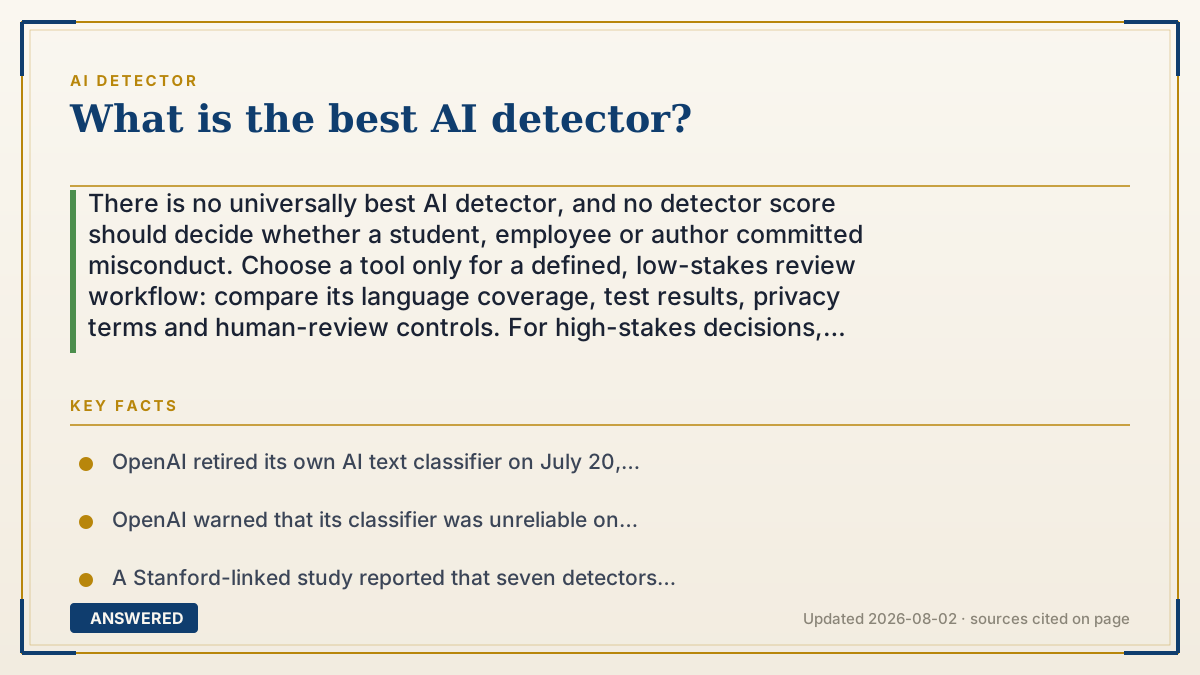
There is no universally best AI detector, and no detector score should decide whether a student, employee or author committed misconduct. Choose a tool only for a defined, low-stakes review workflow: compare its language coverage, test results, privacy terms and human-review controls. For high-stakes decisions, drafts, version history, sources and a conversation with the writer are stronger evidence than a percentage.
Why — the first-principles explanation
An AI detector estimates whether a text resembles examples produced by language models. It does not observe who typed the words, prove intent, recover a chain of custody or distinguish every kind of editing. The score is also not a universal probability: vendors use different training data, thresholds, minimum lengths, languages and labels, so a 70% from one product cannot be compared directly with a 70% from another. Plagiarism or similarity search is a different task again—it looks for matching sources, not authorship.
The word “best” therefore hides the decision. Turnitin's official guidance is relevant when an institution already has its approved workflow, but it warns that the report may misidentify human, AI-generated and AI-paraphrased text and must not be the sole basis for adverse action. GPTZero says its document-level results are stronger than sentence-level results and acknowledges both false positives and false negatives. Copyleaks advertises broad multilingual coverage and API/LMS integrations, but its headline accuracy is a vendor claim, not a reason to skip independent testing.
For website and SEO work, a detector is not a quality gate. Google Search Central says to focus on accuracy, quality and relevance, and warns that generating many pages without added value can violate scaled-content-abuse policies. The useful control is an editorial process: disclose how automation was used when relevant, verify sources, add original analysis and review the final page. A detector can at most prioritize a human check; it cannot certify that a page is helpful or that a person wrote it.
An example that makes it click
A university instructor sees a 91% AI score on a multilingual student's essay. The safe response is not an automatic zero. The instructor checks the published policy, the student's drafts and revision history, the cited sources and the student's ability to explain the argument, then gives the student a chance to respond. The score may be one reason to look closer, but it is not proof of authorship. For an SEO team, the equivalent test is originality, factual accuracy, search intent and reader value—not whether a detector returns “human.”
How to do it
- Name the consequence first. If a false positive could affect a grade, job, publication, visa, contract or reputation, prohibit a detector score from being the deciding evidence.
- Separate the task: AI-likeness detection, plagiarism/similarity search, citation checking and factual review answer different questions and may require different tools.
- Choose the workflow before the vendor: institutional education, multilingual bulk/API review, an editor's private triage or an SEO content-quality audit have different requirements.
- Read the method and scope. Check supported languages, prose length, code/poetry/table limitations, model versions, editing or translation sensitivity and whether scores are document-, paragraph- or sentence-level.
- Get approval before uploading protected work. Review retention, training use, deletion, subprocessors, API versus dashboard handling, copyright and institutional contracts.
- Create a labeled test set from your real workflow: human writing, unedited model output, human-edited output, translated text, second-language writing and short samples.
- Measure false positives and false negatives separately by subgroup and text type. Ignore a vendor's single headline accuracy number when it does not match your task.
- Treat a positive score as a review queue, never as a probability of guilt. Do not multiply similar detectors and call agreement independent corroboration.
- Use process evidence and a fair response path: drafts, revision history, sources, notes, prior work, a live explanation and an appeal or second review where the policy requires one.
- For web content, follow Google's accuracy, quality and relevance guidance; add original value and context rather than trying to pass a detector. Re-test the workflow when the vendor changes its model or terms.
Key facts
- OpenAI retired its own AI text classifier on July 20, 2023 because of low accuracy; in its published challenge set it identified 26% of AI-written text as likely AI-written and falsely labeled human text 9% of the time.
- OpenAI warned that its classifier was unreliable on short text, non-English text, code, predictable text and edited text, and said it should not be a primary decision-making tool.
- A Stanford-linked study reported that seven detectors flagged 61.22% of essays by non-native English writers; 97% were flagged by at least one detector and all seven agreed on only 19%.
- Turnitin says its AI Writing Report may misidentify human, AI-generated and AI-paraphrased text and should not be the sole basis for adverse action against a student.
- Turnitin documents a higher incidence of false positives below 20% and requires at least 300 words of qualifying prose in supported languages for an AI Writing Report.
- GPTZero's own FAQ says document-level classification is more reliable than sentence-level classification, acknowledges human-as-AI and AI-as-human edge cases, and recommends holistic assessment for educators.
- GPTZero says API inputs are not stored, while dashboard inputs may be stored and used in aggregate to improve the service; the product surface matters for privacy.
- Copyleaks advertises more than 30 supported languages, API/LMS integrations and a high accuracy figure; those are vendor claims that still require a representative independent test.
- Google Search Central says AI-assisted web content should meet accuracy, quality and relevance standards and warns that many pages without added value may violate scaled-content-abuse policies.
- A detector score estimates text similarity to a model's training distribution; it does not prove authorship, intent, plagiarism, human originality or the absence of AI assistance.
Choose a review workflow, not a false certainty
For education, work or SEO, compare evidence, privacy and appeal controls first; keep any detector output subordinate to human review and process evidence.
▶ The 60-second explainer (script)
What's the best AI detector? For a grade, job, publication or reputation decision, none is reliable enough to be the deciding tool. A detector estimates whether wording resembles model output; it does not know who typed it or prove intent. OpenAI retired its own classifier for low accuracy. Stanford researchers found seven detectors disproportionately flagged essays by non-native English writers. Turnitin says its report may misidentify text and must not be the sole basis for adverse action. For low-stakes triage, compare language coverage, minimum length, privacy, retention, API controls and real-world false positives. Test human, AI, edited, translated and second-language samples from your workflow. Then use the result only to decide what a person should review. For SEO, follow Google's accuracy, quality and relevance guidance instead of trying to make pages score “human.”
What authoritative sources say
People also ask
What is the best AI detector?
There is no universal winner that is reliable enough for high-stakes authorship decisions. Choose by workflow, language, minimum text length, privacy, integration, support and measured false-positive/false-negative rates on your own samples.
Is Turnitin the best AI detector?
Turnitin may fit an institution that already has its approved workflow and policy, but its own guide says the report can misidentify text and must not be the sole basis for adverse action. Integration is not proof of accuracy.
Is GPTZero better than other detectors?
GPTZero offers document and sentence-level signals and publishes its own limitations, but a vendor's “best” claim is not an independent ranking. Test it against representative human, AI-edited and multilingual samples before relying on it.
Is Copyleaks accurate in multiple languages?
Copyleaks advertises more than 30 languages and multilingual performance. Treat that as a product claim: verify the languages, text types and false-positive rates that matter to your organization before purchasing.
Can an AI detector prove someone used ChatGPT?
No. A detector can estimate that wording resembles model output. It cannot establish who wrote it, which tool was used, whether editing occurred or what the writer intended. Combine any signal with process evidence and a fair response path.
Should teachers use AI detectors to grade papers?
Not as an automatic grading or punishment rule. Follow the institution's approved policy, preserve drafts and revision history, discuss the work with the student and provide the required review or appeal process.
Are AI detectors biased against non-native English writers?
A Stanford-linked study found substantial false-flagging of TOEFL essays by non-native English writers. Test subgroup error rates and never treat a detector percentage as neutral evidence about a person's ability or honesty.
Is an AI detector the same as a plagiarism checker?
No. Plagiarism or similarity tools look for matching sources; AI detectors estimate whether prose resembles generated text. A document can be original but AI-assisted, or copied without being flagged as AI-generated.
Does Google penalize AI-written content?
Google Search Central emphasizes accuracy, quality and relevance, not a detector score. It warns that generating many pages without added value can violate scaled-content-abuse policies. Build useful, source-checked pages with original value instead of optimizing for a “human” score.
Can I upload student, employee or client writing to a free detector?
Only after the responsible institution or employer approves the service and its retention, training, deletion, access and contract terms. A free scan can still create privacy, copyright or confidentiality exposure.
How should a publisher or SEO team choose a detector?
Use it, if at all, as a small triage signal. Prioritize editorial originality, factual review, source quality, reader value, disclosure and Google's people-first guidance; measure cost per accepted page, not scans or detector confidence.
The same question, asked other ways
- What is the most accurate AI detector?
- What is the best AI checker?
- What is the most reliable AI detector?