Who created AI?
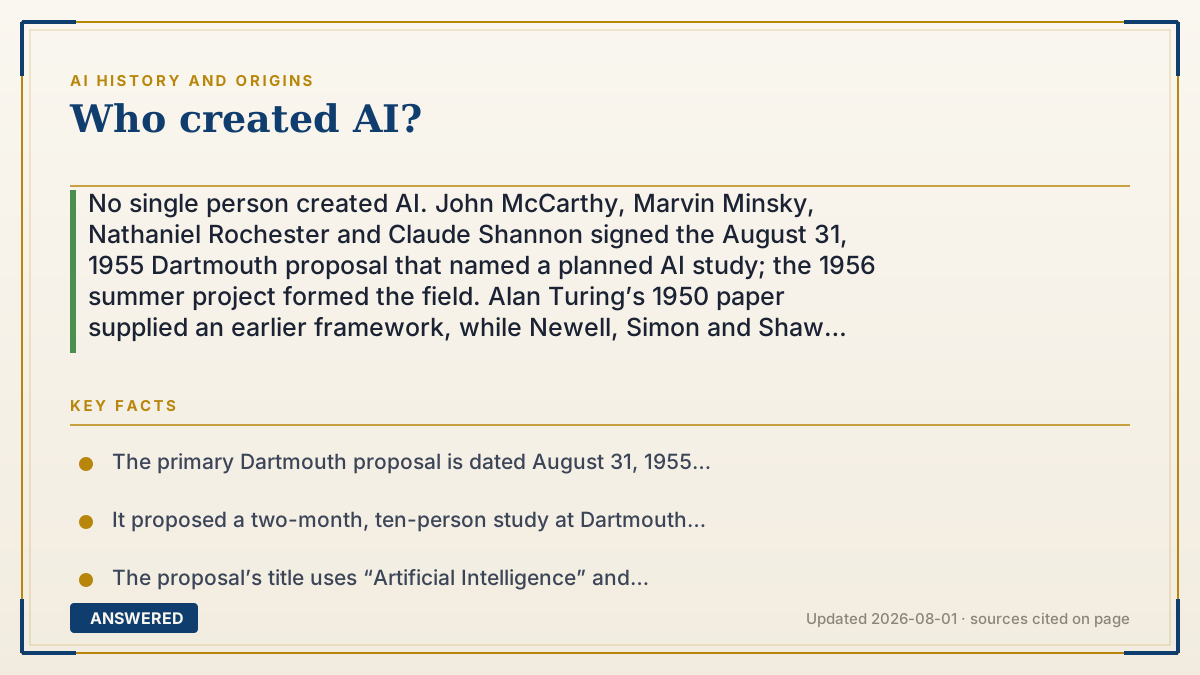
No single person created AI. John McCarthy, Marvin Minsky, Nathaniel Rochester and Claude Shannon signed the August 31, 1955 Dartmouth proposal that named a planned AI study; the 1956 summer project formed the field. Alan Turing’s 1950 paper supplied an earlier framework, while Newell, Simon and Shaw built an early AI program. “Creator” depends on the milestone.
Why — the first-principles explanation
AI is a research field, not a product with one inventor. Several milestones are easy to collapse into the word “created.”
In 1950, Alan Turing published “Computing Machinery and Intelligence” in Mind. He reframed “Can machines think?” as the imitation game, a testable discussion of whether a machine’s written responses could be distinguished from a person’s. That was a major intellectual precursor, but it was not yet a field called AI.
On August 31, 1955, John McCarthy, Marvin Minsky, Nathaniel Rochester and Claude Shannon signed A Proposal for the Dartmouth Summer Research Project on Artificial Intelligence. The primary document proposed a two-month, ten-person study for summer 1956 and listed machine use of language, abstractions, problem solving and self-improvement as research questions. It gave a scattered area a shared name and a concrete research agenda. McCarthy organized the meeting; the proposal was a group document, not proof that one person invented the entire field.
The 1956 Dartmouth project is the conventional founding event. Dartmouth’s institutional history calls it the birth of AI as a field of research. Other researchers immediately expanded what the field could do: Carnegie Mellon’s history credits Herbert Simon, Allen Newell and J. C. Shaw with developing Logic Theorist, often described as the first artificially intelligent computer program. The modern systems people use are later products of many research communities and companies, not creations that can be assigned to the Dartmouth four alone.
So the careful answer is: Turing framed a central question in 1950; the four proposal authors named and organized the 1955 project; the 1956 workshop formed the named field; and many researchers built its early programs and later methods.
An example that makes it click
Think of a new musical genre. Earlier musicians develop the ingredients, someone gives the style a name, a first concert gathers a community, and later artists turn it into an industry. AI has the same pattern: Turing supplied an influential framework in 1950, the 1955 proposal named a research program, Dartmouth’s 1956 project formed the field, and later teams built the programs and products.
How to do it
- Define the milestone: an early idea, the name of the field, the founding research meeting or a working program.
- Use Turing’s 1950 paper when the question is about the intellectual framing of machine intelligence.
- Use the August 31, 1955 proposal when the question is about the named Dartmouth research project and its four authors.
- Use the 1956 Dartmouth project when the question is about the conventional birth of AI as a research field.
- Name Newell, Simon and Shaw separately when discussing an early working AI program; do not turn any one milestone into a sole-inventor claim.
- Link the primary proposal or institutional archive and state which definition of “created” you selected.
Key facts
- The primary Dartmouth proposal is dated August 31, 1955 and is signed by John McCarthy, Marvin Minsky, Nathaniel Rochester and Claude Shannon.
- It proposed a two-month, ten-person study at Dartmouth during summer 1956 and estimated project expenses of $13,500.
- The proposal’s title uses “Artificial Intelligence” and lists language, abstractions, problem solving and self-improvement among its research questions.
- Dartmouth’s institutional history identifies the 1956 summer project as the birth of AI as a field of research and says the initial meeting was organized by John McCarthy.
- Turing’s “Computing Machinery and Intelligence” appeared in *Mind* in 1950 and introduced the imitation game as a way to frame machine intelligence.
- Carnegie Mellon’s institutional history credits Herbert Simon, Allen Newell and J. C. Shaw with developing Logic Theorist, often described as the first artificially intelligent computer program.
- Counting from the conventional 1956 founding event, AI is 70 years old in 2026; that is a field-age convention, not the age of every technique or product.
Choose the historical question you mean
Separate people, milestones and modern products, then compare current AI tools by task, evidence and limits.
▶ The 60-second explainer (script)
Who created AI? No single person did. In 1950, Alan Turing framed machine intelligence through the imitation game. On August 31, 1955, John McCarthy, Marvin Minsky, Nathaniel Rochester and Claude Shannon signed a Dartmouth proposal for a two-month, ten-person study called artificial intelligence. McCarthy organized the 1956 meeting, and Dartmouth describes that summer project as the birth of the field. Around the same time, Herbert Simon, Allen Newell and J. C. Shaw developed Logic Theorist, an early AI program. So the useful answer depends on the milestone: Turing framed the question, the Dartmouth four named and organized the research project, the 1956 workshop formed the field, and many researchers built the programs and products that followed.
What authoritative sources say
People also ask
Is John McCarthy the father of AI?
He is often given that informal title because he organized the Dartmouth meeting and helped establish the field’s name. It is not an official or exclusive credit: the 1955 proposal was signed by four authors, and Turing and many other researchers supplied important earlier work.
Did Alan Turing create AI?
Not the named field. His 1950 paper provided an influential framework for discussing machine intelligence and the imitation game, five years before the Dartmouth proposal used the field’s name.
Who created the first AI program?
Carnegie Mellon’s institutional history credits Herbert Simon, Allen Newell and J. C. Shaw with developing Logic Theorist in 1956 and describes it as the first artificially intelligent computer program. Earlier checkers and cybernetics projects are why “first” should be stated as a conventional historical label, not an absolute fact.
Who created the AI people use today?
Modern assistants and image, video and coding systems are products of large research and engineering teams across many organizations. They are later applications of a field that includes the Dartmouth founders, early program builders and decades of work on statistics, learning, hardware and software.
Was AI created by one company?
No. The named field formed in an academic research setting in the 1950s. Companies, universities and public funders later shaped different methods and products; no single company owns the whole history of AI.
How old is AI in 2026?
Using the conventional 1956 Dartmouth founding date, AI is 70 years old in 2026. If you count Turing’s 1950 paper or earlier precursors, you are using a different historical convention; state that convention instead of presenting one age as the only answer.
The same question, asked other ways
- Who invented AI?
- Who made AI?
- Who started AI?
- Who created AI technology?
- Who invented artificial intelligence programming?
- Who created artificial intelligence?