When was AI invented?
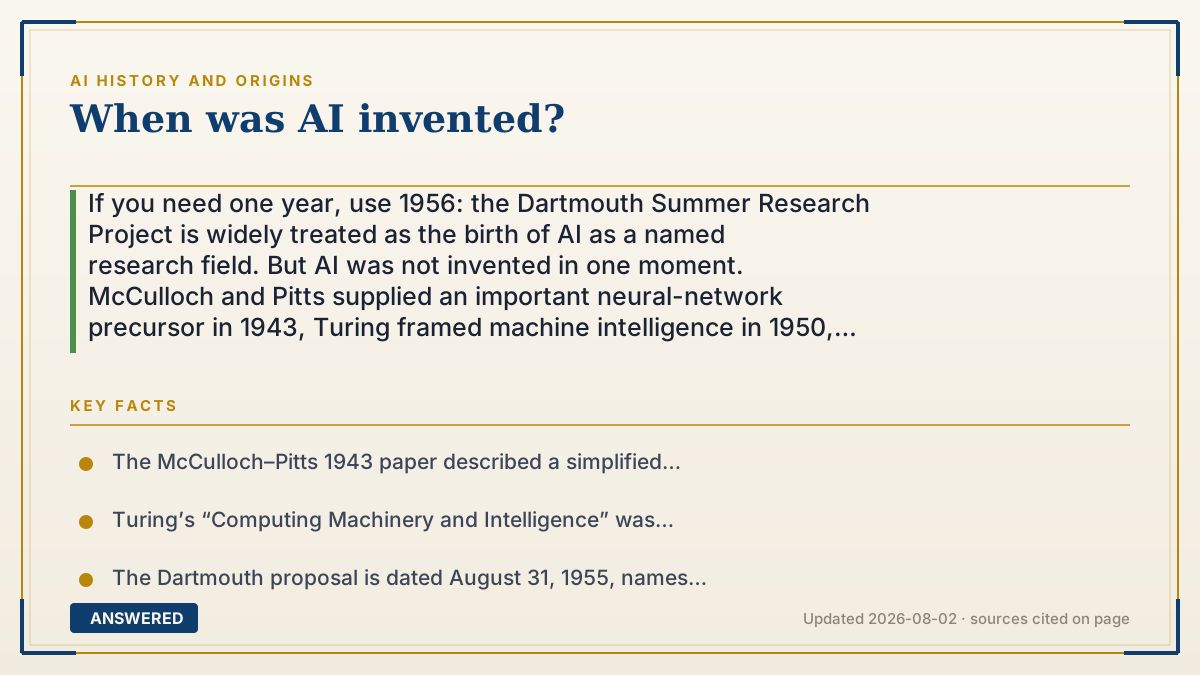
If you need one year, use 1956: the Dartmouth Summer Research Project is widely treated as the birth of AI as a named research field. But AI was not invented in one moment. McCulloch and Pitts supplied an important neural-network precursor in 1943, Turing framed machine intelligence in 1950, the Dartmouth proposal dated August 31, 1955 named the planned project, and the 1956 workshop formed the field. The right date depends on what you mean by invented.
Why — the first-principles explanation
“When was AI invented?” treats a research field as if it were a finished product. A careful answer separates at least four milestones: foundational ideas, a test or theory of machine intelligence, a named research program, and a community that begins treating the work as one field.
There were important precursors before the label AI. The 1943 McCulloch–Pitts paper proposed a simplified mathematical model of neurons, which later influenced artificial-neural-network research. These precursors matter, but they are not the same as the founding of AI as a named discipline.
In 1950, Alan Turing published “Computing Machinery and Intelligence” in Mind. His imitation game gave researchers a concrete way to discuss whether machine behavior could be judged intelligent. That is a major conceptual milestone, not a claim that Turing single-handedly invented the field.
On August 31, 1955, John McCarthy, Marvin Minsky, Nathaniel Rochester and Claude Shannon signed a proposal for a two-month, ten-person study at Dartmouth in summer 1956. The proposal uses artificial intelligence in its title and asks how machines might use language, form concepts, solve problems and improve themselves. It is a primary record of the name and research agenda, but a proposal is not the same thing as the later workshop.
The Dartmouth Summer Research Project took place in 1956. Dartmouth describes it as the birth of AI as a field of research, which is why 1956 is the standard answer in textbooks and general histories. Around the same period, Newell, Simon and Shaw began work on Logic Theorist, an early program that demonstrated how search and heuristics could be used in machine problem solving; that is a technical milestone, not a replacement for the field’s founding date.
So the defensible short answer is: 1943 for a neural-network precursor, 1950 for Turing’s influential framing, 1955 for the named Dartmouth proposal, and 1956 for the field-forming project. None of those dates means modern cloud products or generative AI existed then. Choose the milestone that matches the question and cite the original record instead of declaring one inventor or one year as the whole story.
An example that makes it click
Imagine a company with four dates: an engineer develops a core idea, founders write and name a proposal, the first prototype runs, and the organization opens its doors. Asking when the company was “invented” produces different answers depending on the definition. AI has the same timeline: 1943 for a neural model precursor, 1950 for a major intellectual framework, 1955 for the named proposal, and 1956 for the field-forming workshop.
How to do it
- Define “invented”: an early technical precursor, a theory or test, the first use of the field’s name, the first research project, or a practical product.
- Use 1943 when discussing the McCulloch–Pitts mathematical neuron model as a precursor to neural-network research.
- Use 1950 when discussing Turing’s paper and its imitation game as a framework for machine intelligence.
- Use August 31, 1955 when discussing the Dartmouth proposal that names artificial intelligence and sets out the planned summer study.
- Use 1956 when you need the conventional founding date for AI as a named research field, because the Dartmouth project took place then.
- Treat Logic Theorist as an early machine-reasoning program and technical milestone, not as proof that one person invented all AI.
- Separate the field’s founding from later milestones such as expert systems, neural-network revivals, transformers and consumer chatbots.
- When writing a historical claim, link the primary proposal or paper and state which definition of “beginning” you selected.
Key facts
- The McCulloch–Pitts 1943 paper described a simplified mathematical neural-network model that became a foundational precursor for later AI and neural-network research.
- Turing’s “Computing Machinery and Intelligence” was published in Mind in 1950 and used the imitation game to frame machine intelligence.
- The Dartmouth proposal is dated August 31, 1955, names McCarthy, Minsky, Rochester and Shannon, and proposes a two-month, ten-person study during summer 1956.
- The proposal uses artificial intelligence in its title and describes machine use of language, abstractions, problem solving and self-improvement as research questions.
- Dartmouth identifies the 1956 Summer Research Project on Artificial Intelligence as the birth of AI as a field of research.
- Newell, Simon and Shaw began work on Logic Theorist in 1955; the program is an early machine-reasoning milestone, not an uncontested single “first AI.”
- The conventional 1956 founding date does not erase earlier work in logic, computing, neuroscience, cybernetics or neural models.
- Using the conventional 1956 founding date, AI is 70 years old in 2026; that age is a convention tied to the field’s founding date, not the age of every technique or product.
Move from AI history to today’s choice
Use the timeline to understand the field, then compare current tools, plans, limits and workflow fit before adopting one.
▶ The 60-second explainer (script)
When was AI invented? The honest answer has several dates. In 1943, McCulloch and Pitts described a mathematical neuron model that became an important precursor to neural-network research. In 1950, Alan Turing published Computing Machinery and Intelligence and proposed the imitation game as a way to discuss machine intelligence. On August 31, 1955, McCarthy, Minsky, Rochester and Shannon signed the Dartmouth proposal that used the name artificial intelligence for a planned summer study. The Dartmouth project took place in 1956, the conventional founding date for AI as a research field. Logic Theorist was an early machine-reasoning program from the same period. So 1956 is the standard short answer, but it is not the only defensible milestone.
What authoritative sources say
People also ask
Was AI invented in 1956 or 1950?
Both dates answer different questions. 1950 is Turing’s influential framing of machine intelligence and the imitation game. 1956 is the Dartmouth project, the conventional founding date for AI as a named research field.
Who invented AI?
No single person invented the whole field. Earlier work includes McCulloch and Pitts; Turing supplied an influential framework; and McCarthy, Minsky, Rochester and Shannon authored the 1955 Dartmouth proposal. Many researchers contributed to the surrounding fields.
When was the term artificial intelligence first used?
The August 31, 1955 Dartmouth proposal is a primary and widely cited early record using the phrase as the name of a planned research project. Phrase-history claims should be stated carefully rather than turned into a claim that one document erased every earlier use.
Why is 1956 considered the birth of AI?
A group of researchers gathered for the Dartmouth Summer Research Project, shared a research agenda and helped establish AI as a recognizable field. Dartmouth itself describes that 1956 project as the field’s birth.
What was the first AI program?
There is no universally accepted single first program because the answer depends on whether you count neural simulations, game programs, theorem provers or other precursors. Logic Theorist, begun by Newell, Simon and Shaw in 1955, is often treated as an early machine-reasoning milestone; do not present it as an uncontested first.
Was AI invented before the internet?
Yes. The founding timeline is 1943–1956, decades before the public internet and modern web. Early AI research used programmable computers, formal reasoning, search and models of learning—not today’s cloud chat products.
How old is AI in 2026?
Using the conventional 1956 Dartmouth founding date, AI is 70 years old in 2026. If you count Turing’s 1950 paper or earlier precursors, a different age follows; state the convention instead of presenting one age as the only historical truth.
Is ChatGPT the same thing as the AI field founded in the 1950s?
No. ChatGPT is a modern generative-AI product built from later advances in machine learning, neural networks, data and computing. It belongs to the field’s history but did not exist at the Dartmouth workshop.
The same question, asked other ways
- How long has AI been around?
- When did AI start?
- When was AI made?
- How old is AI?
- When was AI first created?
- When was the first AI created?
- When did AI begin?
- When did artificial intelligence first begin to be studied?
- When was artificial intelligence first applied to computers, and what were the results?