Why is Sarvam AI trending?
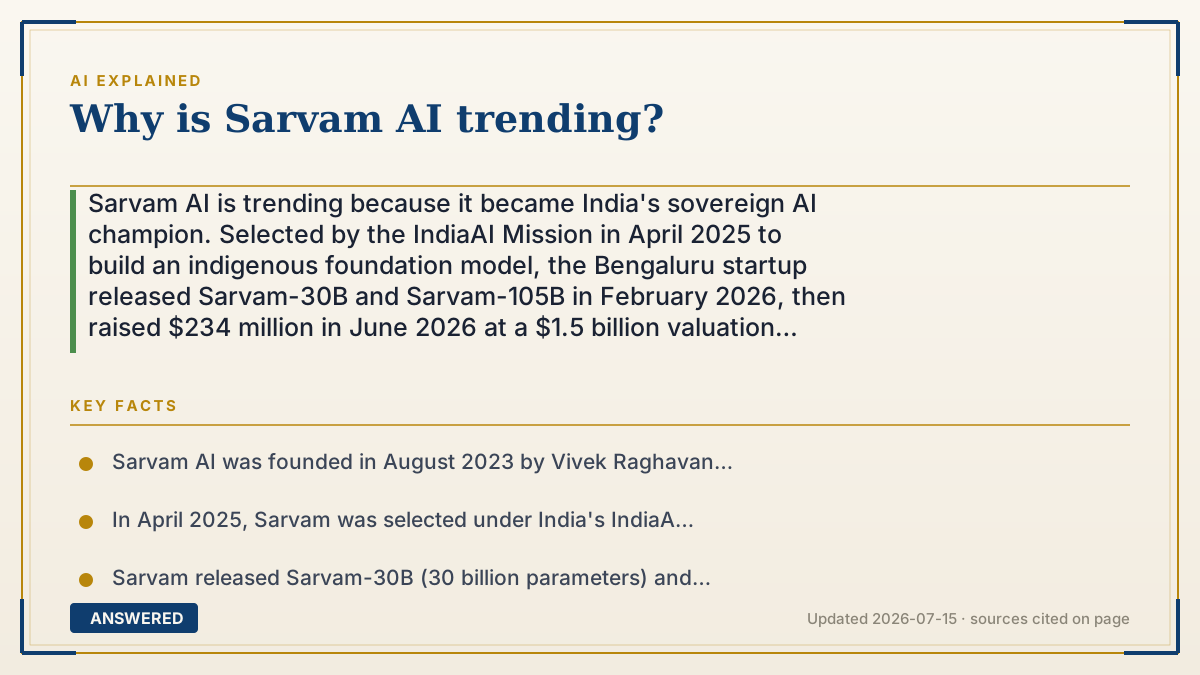
Sarvam AI is trending because it became India's sovereign AI champion. Selected by the IndiaAI Mission in April 2025 to build an indigenous foundation model, the Bengaluru startup released Sarvam-30B and Sarvam-105B in February 2026, then raised $234 million in June 2026 at a $1.5 billion valuation led by HCLTech — India's first foundation-model unicorn.
Why — the first-principles explanation
To understand the attention, you have to understand what a country loses when it has no model of its own. Frontier AI is trained overwhelmingly on English internet text. That's not a policy choice; it's just where the data is. The consequence is that models are excellent at English, decent at a handful of well-documented European languages, and progressively worse the further you get from that center. India has 22 scheduled languages and over a billion speakers, and the internet text for many of those languages is thin. So global models underperform there — not from neglect, but from arithmetic.
That creates a gap that money alone doesn't close, and it's why governments started funding this directly. A sovereign model is an infrastructure argument, not a nationalist one. If every AI service in your country runs on a model trained abroad, hosted abroad, and priced abroad, then your language support, your data residency, and your costs are all decided by someone else's roadmap. India's response was the IndiaAI Mission, which put up state-backed compute and picked companies to build indigenous foundation models. Sarvam won that mandate in April 2025 — the first selection — which is what turned a startup into a national story.
The founders explain a lot of the credibility here. Vivek Raghavan and Pratyush Kumar came out of AI4Bharat at IIT Madras, a research group that spent years on exactly the unglamorous problem this requires: assembling Indian-language data that didn't exist in usable form. That's the actual bottleneck. Compute you can buy; a clean corpus in 22 languages you have to build.
The skeptic's note worth keeping: Sarvam's claims of beating global models are largely on Indian-language benchmarks, which is exactly where a specialized model should win and where independent verification is thinnest. Winning the benchmark you built for yourself is a real achievement and a weak proof. The unresolved question isn't whether Sarvam can train a model — it demonstrably can — but whether India's evaluation infrastructure is mature enough to prove how good it is.
An example that makes it click
Imagine every recipe book in the world was written in French, and you're trying to cook Bengali food. The books are genuinely excellent — beautifully tested, world class. They just don't have your dishes in them, and the few they do have were translated by someone who'd never eaten one.
You can't fix that by buying a better French cookbook. Somebody has to go into the kitchens, write the recipes down, and publish the book. That's what Sarvam's founders spent years doing before they ever trained a model — and it's why the government picked them.
Key facts
- Sarvam AI was founded in August 2023 by Vivek Raghavan and Pratyush Kumar, previously of AI4Bharat at IIT Madras, and is headquartered in Bengaluru, Karnataka.
- In April 2025, Sarvam was selected under India's IndiaAI Mission to develop indigenous foundational models, with access to government-supported GPU compute.
- Sarvam released Sarvam-30B (30 billion parameters) and Sarvam-105B (105 billion parameters) in February 2026, followed by Indus (beta, 105B) on February 20, 2026.
- Earlier models include Sarvam-1 (October 2024) and Sarvam-M (24 billion parameters, May 2025); its speech system Saaras V3 handles Indian-language speech-to-text.
- Funding: $41 million seed and Series A in December 2023 led by Lightspeed; $234 million Series B in June 2026 at a $1.5 billion valuation, led by HCLTech.
- India has 22 scheduled languages; the sovereign-model case rests on global models underperforming on languages with thin internet training data.
▶ The 60-second explainer (script)
Sarvam AI is trending because it became India's sovereign AI champion. Founded in Bengaluru in 2023, picked by the IndiaAI Mission in April 2025 to build the country's indigenous foundation model, it shipped Sarvam-30B and Sarvam-105B in February 2026, then raised 234 million dollars in June 2026 at a 1.5 billion dollar valuation, led by HCLTech. Here's why any of that matters. Frontier AI is trained overwhelmingly on English internet text. That's not a policy choice — that's just where the data is. So models are great at English, decent at a few European languages, and worse the further you get from that center. India has 22 scheduled languages and over a billion speakers, and for many of those, the internet text is thin. Global models underperform there by arithmetic, not neglect. And that's an infrastructure problem, not a pride problem. If every AI service in your country runs on a model trained abroad, hosted abroad, priced abroad — then your language support, your data residency, and your costs are somebody else's roadmap decision. The founders came out of AI4Bharat at IIT Madras, where they'd spent years on the genuinely hard part: assembling Indian-language data that didn't exist in usable form. Compute you can buy. A clean corpus in 22 languages you have to build. One honest caveat — Sarvam's wins are mostly on Indian-language benchmarks, which is exactly where a specialized model should win, and where independent verification is thinnest.
What authoritative sources say
People also ask
Is Sarvam AI government-owned?
No. It's a private startup that won a government mandate under the IndiaAI Mission and received access to state-backed GPU compute. Its investors are private, including Lightspeed and HCLTech.
Can I use Sarvam AI's models?
Sarvam has released foundation models openly, including Sarvam-30B and Sarvam-105B in February 2026, and offers a platform for developers. Check its official site for current access terms.
Is Sarvam better than GPT or Gemini?
On Indian-language tasks it claims strong results, which is what a specialized model should deliver. On general English benchmarks the global frontier models remain ahead, and independent Indian-language evaluation infrastructure is still maturing.
Why does India need its own AI model?
Because frontier models are trained mostly on English web text and underperform on India's 22 scheduled languages. There's also a sovereignty argument: data residency, pricing, and roadmap control.
How big is Sarvam compared to OpenAI?
Vastly smaller. Sarvam's $1.5 billion valuation and 105-billion-parameter models are meaningful for India but an order of magnitude below the frontier labs, whose infrastructure programs run to hundreds of billions of dollars.