Why is AI good?
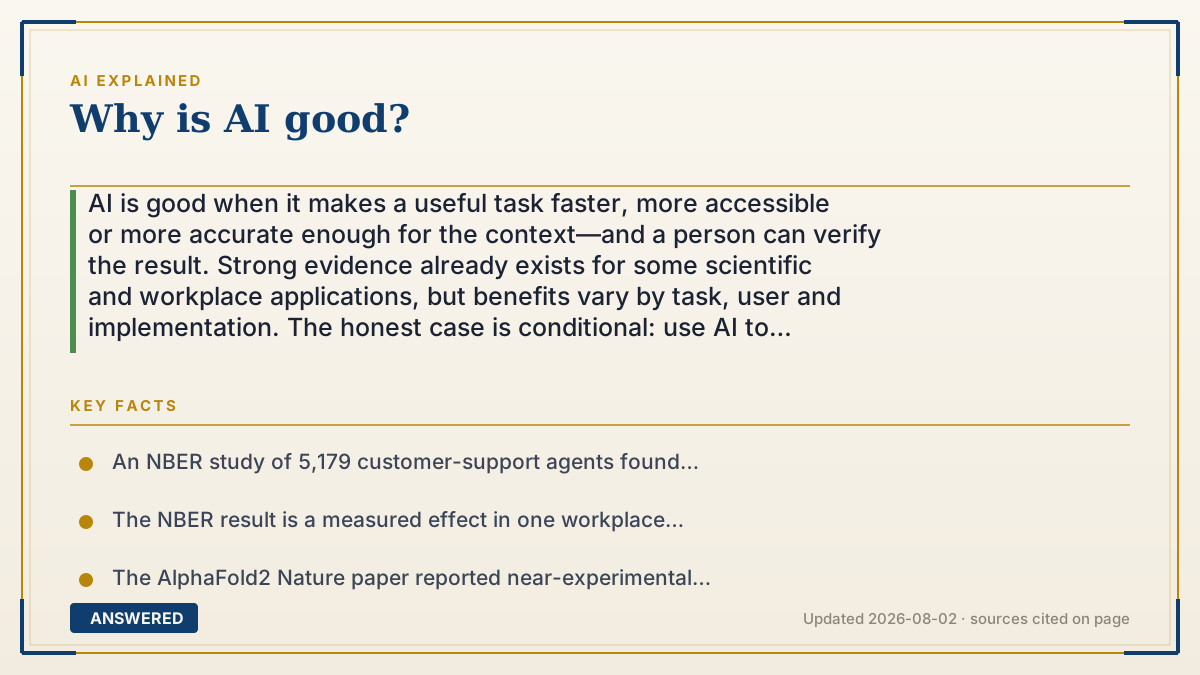
AI is good when it makes a useful task faster, more accessible or more accurate enough for the context—and a person can verify the result. Strong evidence already exists for some scientific and workplace applications, but benefits vary by task, user and implementation. The honest case is conditional: use AI to expand capability, measure the accepted result, protect people and data, and keep a human accountable where mistakes matter.
Why — the first-principles explanation
AI’s clearest benefit is not that it is always smarter than a person. It is that a pattern-rich task can become cheaper to start, easier to repeat and available to people who previously lacked the time, language, specialist or accessibility support to do it. Drafting, translation, search, code assistance, transcription and bounded analysis fit this shape when the inputs are adequate and the output can be checked.
The best evidence is specific. In an NBER study of 5,179 customer-support agents, access to a generative-AI assistant raised issues resolved per hour by 14% on average, with a 34% improvement for novice and lower-skilled workers and little effect for experienced workers. That is a measured result in one workflow, not a promise for every company. In science, the AlphaFold2 Nature paper describes protein structures predicted with near-experimental accuracy in a majority of cases in its evaluation, addressing a structural-biology bottleneck that had required months to years of experimental work.
Benefits also depend on governance. The International AI Safety Report 2026 says general-purpose AI is already being usefully applied in healthcare, research and education, but adoption is uneven and misuse, malfunction and systemic disruption can erode trust. WHO guidance for health AI emphasizes ethics, human rights, accountability and governance. The IEA’s Energy and AI report makes the cost side visible: data-centre growth affects electricity systems and must be planned alongside the benefits.
So “AI is good” is a decision rule, not a slogan. Compare the tool with the current alternative—including doing nothing. Define an accepted result, test representative failures, protect sensitive data and measure who benefits and who bears the errors. A fast wrong answer, an inaccessible service or a system that quietly removes human appeal is not a net benefit merely because a model produced it.
An example that makes it click
A support team receives a large volume of repetitive questions. An assistant retrieves the approved policy, drafts a response and highlights uncertainty; a human agent checks the source, adapts the tone and sends it. New agents learn from the examples while customers get faster replies. The team still measures resolution quality, escalations, privacy incidents and customer sentiment. If the assistant starts inventing policies or routing vulnerable customers incorrectly, the workflow is narrowed or paused. The benefit came from a tested division of labor, not from trusting a chatbot because it sounded fluent.
How to do it
- Name the outcome that should improve: time to answer, error rate, access, learning, scientific discovery, cost per accepted result or another measurable result.
- Compare AI with the real baseline, including a human workflow, a simpler rule, outsourcing, translation support or doing nothing. Do not compare only with an imaginary perfect system.
- Choose a bounded task with enough data, a clear owner and an acceptance test. Avoid starting with a vague promise to “transform the business.”
- Map data, permissions and affected people. Remove unnecessary personal or confidential data and use an approved provider with clear retention and access terms.
- Prototype with representative cases, edge cases and a holdout set. Record errors, omissions, hallucinations, latency, cost and where reviewers had to repair the output.
- Keep a human review gate where the output affects health, money, safety, rights, employment, education or a client’s important decision.
- Measure distributional effects: which users improve, who is left out, whether accessibility improves and whether errors concentrate in a language or group.
- Calculate the accepted-result economics, including reviewer time, integration, energy, support, security and failure costs—not just the model’s token price.
- Monitor after launch for drift, automation bias, privacy incidents, unsafe tool calls and changes in the underlying model. Provide rollback and an appeal route.
- Publish what the system does and does not do, review evidence on a schedule and stop or redesign the workflow if the measured benefit does not survive real-world use.
Key facts
- An NBER study of 5,179 customer-support agents found that access to a generative-AI assistant increased issues resolved per hour by 14% on average, with a 34% improvement for novice and lower-skilled workers and minimal impact for experienced workers.
- The NBER result is a measured effect in one workplace and task; it does not establish that every model, job or enterprise will see the same productivity gain.
- The AlphaFold2 Nature paper reported near-experimental accuracy for protein-structure prediction in a majority of evaluated cases, addressing a research bottleneck that had required months to years of experimental work.
- The 2026 International AI Safety Report says general-purpose AI is already being usefully applied in healthcare, scientific research and education, but benefits are unevenly distributed and risks can erode trust.
- AI tends to add more value when the task has pattern-rich inputs, a defined output, tolerance for bounded error and a person who can verify or correct the result.
- Accessibility benefits are strongest when users can control the output and a service preserves human support; automation that removes recourse can reduce access even when it lowers cost.
- WHO’s health-AI guidance treats ethics, human rights, accountability, transparency and governance as conditions for responsible benefit in high-stakes health settings.
- The IEA’s Energy and AI analysis shows that growing data-centre demand affects electricity systems, so energy use and infrastructure are part of the benefit-cost calculation.
- A model capability demonstration is not the same as a business case. Integration, workflow redesign, reviewer time, privacy, security and failure costs determine whether a deployment creates net value.
- The right comparison is accepted results versus the current alternative. AI can be beneficial without being the best possible human, and harmful despite being faster, if no one checks or can appeal the output.
Turn AI capability into a measurable benefit
Choose a bounded task, test the accepted result, protect people and data, and keep a human owner.
▶ The 60-second explainer (script)
Why is AI good? The honest answer is conditional. AI helps when a task has patterns, the output can be checked and the result matters more than perfect originality. In an NBER study of 5,179 support agents, a generative-AI assistant increased issues resolved per hour by 14% on average, with larger gains for newer workers. AlphaFold showed a real scientific benefit by predicting many protein structures at near-experimental accuracy. But those are bounded results, not a guarantee for every company. Compare AI with the real alternative, measure accepted results, protect data and keep a human review gate for health, money, safety, rights and education. Include energy and integration costs. AI is good when it expands capability without removing accountability; a fast unverified answer is not a benefit just because it came from a powerful model.
What authoritative sources say
People also ask
What is AI’s clearest proven benefit?
Benefits are task-specific. AlphaFold’s protein-structure results and the NBER customer-support experiment are strong examples because their tasks, measures and limits are explicit. They do not prove that every AI product creates value.
Who benefits most from AI?
Often the answer is heterogeneous: newer workers may gain more in a supported workflow, while experts may gain little on tasks they already perform efficiently. Accessibility and language support can also widen access when human recourse remains available.
Is AI good for education?
It can help with explanation, practice, translation and feedback, but learning goals, privacy, accuracy and teacher oversight matter. A system that gives answers without building understanding may improve speed while weakening learning.
Is AI good for healthcare?
It can support research, documentation and decision support, but health uses require clinical validation, privacy, accountability and human review. Do not treat a general chatbot as a doctor or use it to replace urgent care.
Why do some companies see no AI return?
A demo is not a production workflow. Integration, data quality, reviewer time, security, change management and failure costs can erase a model’s apparent speed. Measure accepted results and compare them with the real baseline.
Does AI help people who lack expertise?
It can lower the cost of getting a first explanation, draft or translation, but access is not the same as correctness. Users still need verification, escalation and a way to reach a qualified human for consequential decisions.
Is the energy cost of AI worth it?
There is no universal answer. Data-centre electricity and infrastructure have real costs; compare them with the accepted benefit, choose efficient models and avoid automating work that creates little value.
What is AI genuinely bad at?
It is risky when the input is incomplete, the output cannot be verified, the task is highly novel or the consequences are irreversible. Fluent wording does not turn uncertainty into evidence.
Can AI make society more equal?
It can widen access to useful capabilities, but benefits and errors may be distributed unevenly. Audit language, disability, income and regional effects instead of assuming that a cheaper service is automatically fairer.
Should every business adopt AI?
No. Start with a measurable problem and compare AI with simpler alternatives. If the workflow cannot define an owner, acceptance test, privacy boundary and rollback, it is not ready for deployment.
What is the safest way to try AI?
Use a low-impact, reversible task; remove sensitive data; keep a human reviewer; log errors; measure accepted results; and expand permissions only after evidence supports the next step.
The same question, asked other ways
- Is AI good?
- Why AI is good?
- How is AI good?