How much energy does AI use?
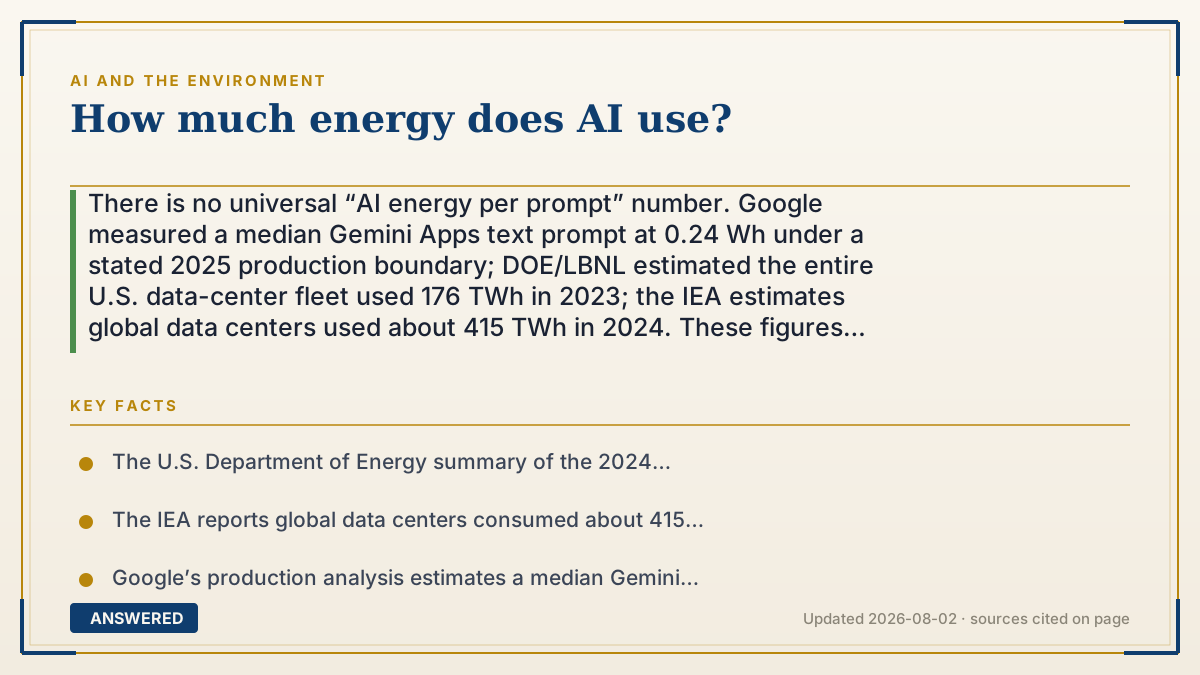
There is no universal “AI energy per prompt” number. Google measured a median Gemini Apps text prompt at 0.24 Wh under a stated 2025 production boundary; DOE/LBNL estimated the entire U.S. data-center fleet used 176 TWh in 2023; the IEA estimates global data centers used about 415 TWh in 2024. These figures answer different questions. For a real decision, measure workload, model, retries, location and the baseline it replaces.
Why — the first-principles explanation
“How much energy does AI use?” mixes at least four measurements: one inference, a training run, a provider's serving fleet and all data centers. AI is not separately metered in most public electricity statistics; data centers also run storage, websites, databases and other workloads. A national total therefore cannot be divided by the number of prompts and called an AI rate.
Even a per-request figure has a boundary. It may include the accelerator, host CPU and RAM, idle capacity, networking, power conversion, cooling and other data-center overhead—or only the chip. It also changes with model size, prompt and output length, reasoning or tool calls, modality, batching, retries, utilization and the local grid. A median text prompt is not a promise about an image, video, long-document or agent workflow.
The useful accounting identity is: workload energy = requests × energy per accepted result, plus training, storage, idle capacity and shared infrastructure allocated under a stated method. The “accepted result” matters because a cheap first draft that needs three retries and ten minutes of review may use more total resources than a larger model that succeeds once. For emissions, add the time and location of electricity; for water, distinguish on-site cooling from upstream power use.
That is why Google’s production measurement, DOE/LBNL’s U.S. fleet estimate and the IEA’s global outlook can all be accurate without being interchangeable. Use public figures to frame the question, then measure the workload you actually plan to run and compare it with the human or software baseline it replaces.
An example that makes it click
A support team is choosing between a small model that drafts policy replies quickly and a larger model that handles exceptions. The team records requests, output length, retries, tool calls, review time and accepted-answer rate for each. It then asks the provider what its published energy boundary covers and documents region, retention and workload location. If the small model produces many failed drafts, its per-request advantage may disappear; if the larger model handles exceptions once, the total cost per approved answer may be lower. The right comparison is the service outcome, not a universal watt-hour slogan.
How to do it
- Name the unit: one inference, a training run, a daily workload, a facility or a national/global fleet. Record the year, geography and whether the figure is measured or projected.
- Write the boundary: accelerator only, full serving stack, cooling, power overhead, idle reserve, storage, networking and training. Do not compare numbers with different boundaries as if they were one benchmark.
- Classify the workload: text, image, audio, video, long context, reasoning, retrieval or agent actions. Log model, input/output size, tool calls, retries and batch utilization.
- Use provider-specific measurements cautiously. A vendor median can be useful for that product and date; it is not a transferable rate for another provider, model or modality.
- Measure the accepted result, not only the first request. Track failed generations, retries, review time and the amount of work the AI actually replaces or adds.
- For a team, request provider methodology and regional energy/emissions information, then estimate workload energy with a sensitivity range instead of a single precise value.
- Compare alternatives: smaller model, caching, batching, retrieval before generation, shorter outputs, human-only baseline and a workflow that avoids redundant calls. Keep quality, privacy and latency in the same decision record.
- Recheck after model, traffic, hardware, region or cooling changes. Efficiency gains can lower energy per request while total demand still rises as usage grows.
Key facts
- The U.S. Department of Energy summary of the 2024 Lawrence Berkeley National Laboratory report estimates all U.S. data centers used 176 TWh in 2023, about 4.4% of U.S. electricity, and projects 325–580 TWh in 2028, about 6.7–12%; the scope is the data-center fleet, not AI alone.
- The IEA reports global data centers consumed about 415 TWh in 2024, roughly 1.5% of global electricity, and its outlook projects around 945 TWh in 2030 with substantial uncertainty; this is a global data-center outlook, not an AI-only meter.
- Google’s production analysis estimates a median Gemini Apps text prompt used 0.24 Wh under its comprehensive serving methodology and says the estimate is based on a specific period and workload; it is not a universal rate for every AI service.
- Google’s technical methodology accounts for active accelerator power, host-system energy, idle machine capacity and data-center overhead; a narrower chip-only boundary would not be the same measurement.
- Google reports a large year-over-year reduction in the median Gemini text prompt’s energy and carbon footprint, showing that software, hardware and serving efficiency can change the number quickly.
- Text, image, video, long-context, reasoning and tool-using requests can have different resource profiles; a median text prompt should not be used to price every modality.
- Training, inference, storage, networking and idle capacity are different accounting objects. A provider or national report must state which are included before comparisons are meaningful.
- Lower energy per request does not guarantee lower total demand: traffic, larger outputs, new modalities and additional AI workloads can grow faster than efficiency improves.
Measure the workload before you subscribe
Separate prompt snapshots from fleet totals, then compare energy, quality, privacy, price and the work your AI workflow actually replaces.
▶ The 60-second explainer (script)
How much energy does AI use? There is no single honest number. Google measured a median Gemini Apps text prompt at 0.24 watt-hours under a stated production boundary. DOE and Lawrence Berkeley National Laboratory estimated the entire U.S. data-center fleet used 176 terawatt-hours in 2023. The IEA estimates global data centers used about 415 terawatt-hours in 2024. Those are different scopes, not numbers you can divide into one universal prompt rate. For a real workflow, log model, modality, prompt and output size, retries, tool calls and accepted results; ask what the provider's boundary includes; then compare the result with the human or software baseline it replaces. Efficiency matters, but total demand can still grow as usage expands.
What authoritative sources say
People also ask
How much energy does one ChatGPT query use?
OpenAI has not published a comparable peer-reviewed per-query figure that can be treated as universal. Google’s 0.24 Wh median Gemini text estimate is a provider- and workload-specific measurement; do not transfer it to ChatGPT, another model or another modality without a method.
Is 0.24 Wh the energy use of every AI prompt?
No. It is a median Gemini Apps text prompt under Google’s stated production boundary and period. Model, output length, reasoning, tools, modality, utilization and accounting boundary can all change the result.
Does AI use more energy than a Google search?
There is no fair universal ratio without matching the same date, workload, infrastructure boundary, response length and source method. Treat simple search-versus-AI comparisons as estimates unless both sides publish comparable measurements.
What uses more energy: training or inference?
It depends on the model, training run and lifetime traffic. Training is a large one-time or repeated workload; inference accumulates across every request and can dominate over a product’s lifetime. Keep the two accounts separate.
Do images and video use more energy than text?
They can, because generation may involve more computation, larger outputs and more retries, but there is no single multiplier that applies to every model. Ask for modality-specific evidence or measure your own accepted-result workload.
How can a company reduce AI energy use?
Use the smallest model that meets the acceptance test, shorten unnecessary context and outputs, cache or batch repeat work, route only hard cases to a larger model, reduce retries and log accepted results. Also check privacy, latency and quality so the optimisation does not create hidden rework.
Should energy be a factor when choosing an AI tool?
Yes, but alongside accuracy, review time, data controls, latency, price, location and the baseline the tool replaces. A precise-looking watt-hour number is not useful if the workflow produces more failed drafts or adds redundant work.
Does better efficiency mean AI demand is falling?
Not necessarily. Energy per request can fall while total use rises if more people send requests, outputs get longer, new modalities launch or providers add idle capacity. Report both intensity and total workload.
The same question, asked other ways
- How much power does AI use?
- How much electricity does AI use?
- Does AI use a lot of energy?
- How much electricity do AI data centers use?
- How much energy do AI data centers use?