Is AI bad for the environment?
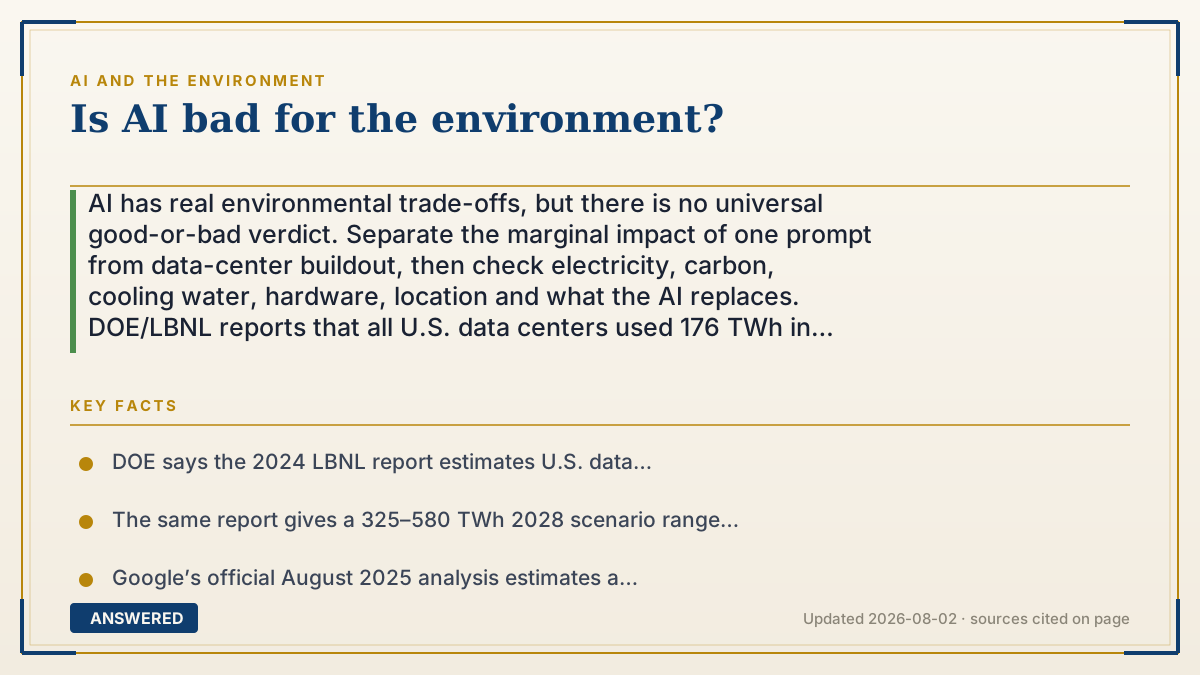
AI has real environmental trade-offs, but there is no universal good-or-bad verdict. Separate the marginal impact of one prompt from data-center buildout, then check electricity, carbon, cooling water, hardware, location and what the AI replaces. DOE/LBNL reports that all U.S. data centers used 176 TWh in 2023 and models 325–580 TWh in 2028; those are fleet-wide scenarios, not AI-only figures. Google’s 0.24 Wh and 0.26 mL Gemini measurement is a dated vendor snapshot, not a universal rate.
Why — the first-principles explanation
The question contains two different scales. A person asking for one summary is asking about marginal use; a company adding millions of requests is asking about an industrial workload. A low average per request can exist at the same time as a large and growing system footprint.
The footprint also has multiple layers. Electricity creates different emissions on different grids and at different times. Cooling can consume water, and power generation can add upstream water use. Servers, accelerators, buildings and network equipment carry material and embodied impacts before a prompt is served. A per-inference number rarely covers every layer.
DOE’s summary of the 2024 Lawrence Berkeley National Laboratory report estimates that U.S. data centers used 176 TWh in 2023, about 4.4% of national electricity, with a 325–580 TWh range for 2028, or about 6.7–12%. The scope is the U.S. data-center fleet and its scenarios, not an AI-only meter. Treat the range as a forecast with assumptions, not as a present-tense measurement.
Google’s production measurement is useful for showing why boundaries matter: it estimates a median Gemini Apps text prompt from May 2025 at 0.24 Wh, 0.03 gCO2e and 0.26 mL of water under its comprehensive serving boundary. Google says the estimate is point-in-time, changes with model, architecture and user behavior, and was not independently verified. It should not be copied to another provider, model or year without evidence.
Location can dominate the practical decision. The same workload can have different carbon and water consequences under different grids, climates, cooling systems and hardware lifecycles. A national percentage can look modest while a new campus creates a concentrated local burden on a grid or watershed.
AI may reduce another impact in a defined use case, such as travel, rework or energy waste, but that is not an automatic net benefit. Compare the baseline, measure avoided impacts and include added demand and rebound effects. The defensible conclusion is conditional: AI is a growing industrial load with measurable costs and possible benefits, and its environmental value depends on the full boundary and what it replaces.
An example that makes it click
Suppose a support team is deciding whether to add an AI drafting tool. Compare the actual alternative: human drafting time, rework, review, travel or another software workflow. Then add the AI provider’s energy and water evidence, model choice, data-center location, retention and expected request volume. If the team uses a large model for every trivial task and cannot show an avoided baseline, the tool may add demand; if a smaller model removes measured rework, the result may be different. The comparison is more useful than calling AI categorically green or harmful.
How to do it
- Name the scale: one prompt, model training, a provider’s data center or industry buildout.
- Set the boundary and resource: electricity, carbon, cooling water, upstream power-plant water, hardware, construction or network effects.
- Record source, date, workload, geography and uncertainty. Keep measured values separate from modeled scenarios.
- For procurement, ask where the workload runs, what powers it, how cooling is handled and whether hardware lifecycle impacts are included.
- Define the baseline and what AI replaces. Count avoided travel or rework only when it is measured, and account for new demand or rebound.
- Reduce avoidable demand: reuse good outputs, avoid redundant generations, choose a model sized for the task and batch work when practical.
- Request dated methodology rather than a single sustainability label; compare energy, water and carbon boundaries across vendors.
- Publish the boundary, date, assumptions and uncertainty beside every public number, and review the claim as models, grids and workloads change.
Key facts
- DOE says the 2024 LBNL report estimates U.S. data centers used 176 TWh in 2023, about 4.4% of U.S. electricity.
- The same report gives a 325–580 TWh 2028 scenario range, about 6.7–12% of U.S. electricity; it is a forecast range for all data centers, not an AI-only reading.
- Google’s official August 2025 analysis estimates a median Gemini Apps text prompt at 0.24 Wh, 0.03 gCO2e and 0.26 mL of water using May 2025 data and a comprehensive serving boundary.
- Google says the prompt estimate is point-in-time, model- and workload-dependent, and not independently verified by a third party.
- Electricity, carbon, cooling water and hardware impacts vary with location, grid mix, climate, utilization, cooling design and lifecycle.
- A potential AI benefit is not a measured net benefit: a credible claim needs a baseline, avoided-impact evidence and an accounting of added demand or rebound.
- NIST’s AI Risk Management Framework is voluntary and can help organizations document risks, assumptions and controls; it is not an environmental certification.
Compare impact before you subscribe
Match the tool and model to the task, then review dated energy, water, privacy, limits and what the workflow replaces.
▶ The 60-second explainer (script)
Is AI bad for the environment? Start by separating two scales. Google measured a median Gemini Apps text prompt at 0.24 watt-hours and 0.26 milliliters of water using May 2025 data and a Google-specific serving boundary. That is not a universal rate for every chatbot. At system scale, DOE and Lawrence Berkeley National Laboratory estimate all U.S. data centers used 176 terawatt-hours in 2023, about 4.4 percent of national electricity, with a 2028 scenario range of 325 to 580 terawatt-hours. Those totals include workloads beyond AI. The practical answer also depends on carbon, cooling water, hardware, location and what the AI replaces. AI is neither automatically a climate catastrophe nor an environmental free pass: compare the full boundary, dated evidence and baseline before claiming harm or benefit.
What authoritative sources say
People also ask
Is AI bad for the environment?
AI has real electricity, carbon, water, hardware and construction impacts, but the answer depends on scale, location and what the system replaces. A single vendor prompt estimate cannot settle the industry-wide question.
Should I stop using AI to help the environment?
Not as a blanket rule. Avoid redundant generations and use a model sized for the task, while judging larger decisions by the full workflow, provider evidence and measured baseline.
Does AI use more electricity than the whole country?
No. DOE’s 2024 LBNL summary puts all U.S. data centers at about 4.4% of U.S. electricity in 2023, with a 2028 scenario range of 6.7–12%. That is significant but not the whole grid, and it is not AI-only.
How much water does AI use?
There is no universal per-prompt number. Water depends on the provider’s accounting boundary, cooling design, power supply, location, model and workload. Google’s 0.26 mL figure is a dated, provider-specific estimate, not a rate for every AI service.
Can AI help the environment?
Potentially, in forecasting, optimization or scientific work, but a potential use is not a measured net benefit. Compare the baseline, count avoided impacts and include added infrastructure and rebound demand.
Why do AI environmental estimates change so quickly?
Models, chips, utilization, cooling, grid mix and user behavior change. Keep the date, boundary and workload attached to every number, and do not compare a vendor snapshot with a fleet forecast as if they were the same metric.
What should a company ask an AI provider?
Ask for dated energy, carbon and water methodology; workload and geography; cooling and grid assumptions; hardware lifecycle coverage; uncertainty; and whether the figures are independently verified.
What is the most responsible way to use AI?
Use it for a defined task, avoid redundant work, choose an appropriately sized model, verify outputs and measure what the workflow replaces. For organizations, document assumptions and review them as the system changes.
The same question, asked other ways
- Why is AI bad for the environment?
- How is AI bad for the environment?
- How does AI affect the environment?
- How bad is AI for the environment?
- How does AI hurt the environment?
- Does AI harm the environment?
- Is AI really bad for the environment?
- How does AI harm the environment?
- How is AI affecting the environment?
- What does AI do to the environment?
- What is AI doing to the environment?
- Why AI is bad for the environment?
- How does AI impact the environment?
- Is AI actually bad for the environment?
- How is AI harmful to the environment?
- Is AI killing the environment?
- Does AI hurt the environment?
- How is AI bad for the environment? I hear it takes water?