How much water does AI use?
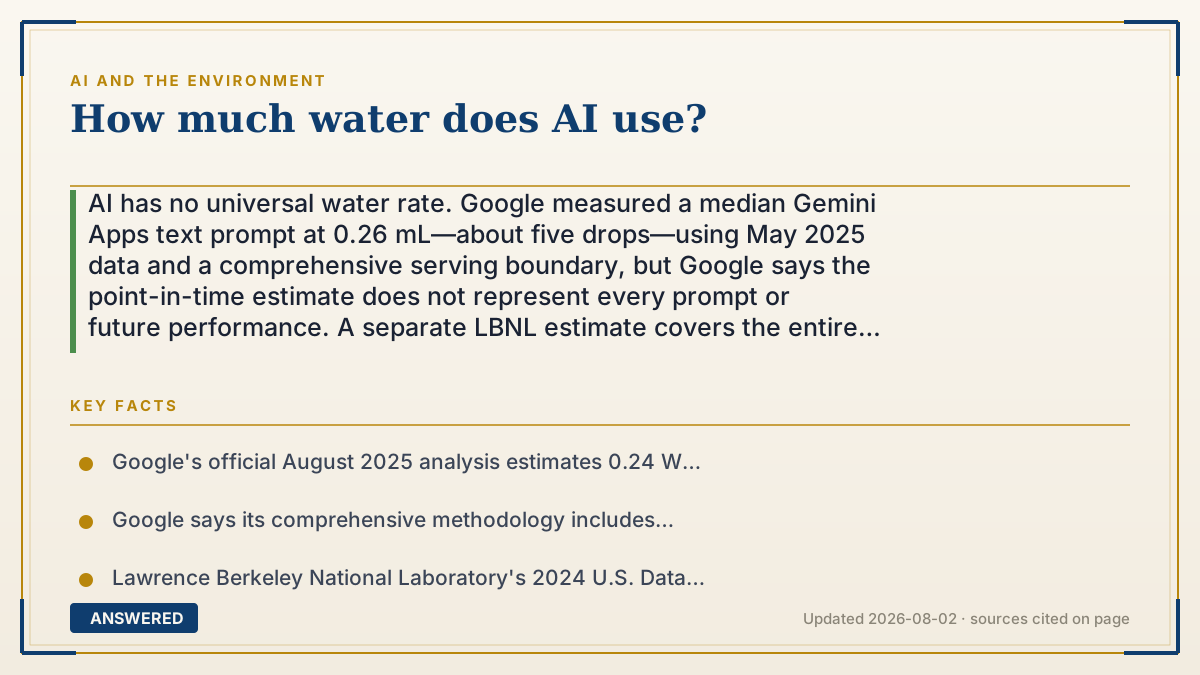
AI has no universal water rate. Google measured a median Gemini Apps text prompt at 0.26 mL—about five drops—using May 2025 data and a comprehensive serving boundary, but Google says the point-in-time estimate does not represent every prompt or future performance. A separate LBNL estimate covers the entire U.S. data-center fleet, not AI alone. The gap is explained by scope, location, year, cooling, electricity and the difference between withdrawal and consumption.
Why — the first-principles explanation
AI can be associated with water in several places. A data center may consume water for cooling; the electricity that powers it can also have an upstream water footprint at a power plant. A source may count withdrawal—the water taken from a source—or consumption—the portion not returned to the local system during the accounting period. It may cover a prompt, a training run, one facility, all U.S. data centers or a global scenario. Those are different measurements and must not be averaged into one universal number.
Google's August 2025 production analysis is useful because it states its boundary. For a median Gemini Apps text-generation prompt, using May 2025 data, Google estimates 0.24 watt-hours and 0.26 milliliters of water under its comprehensive serving methodology. That methodology includes active and idle serving capacity, CPU and RAM, data-center overhead and cooling-water consumption. Google also shows a narrower chip-only estimate of 0.12 mL and says neither figure represents every prompt or future performance. It is a vendor-specific operational snapshot, not an AI prompt tax.
The LBNL 2024 U.S. Data Center Energy Usage Report answers a different question. It estimates the resource use of the whole U.S. data-center fleet, including workloads that are not generative AI, and provides historical data through 2023 plus future scenarios. Its widely cited water figures are about 66 billion liters consumed on site and nearly 800 billion liters indirectly through electricity in 2023. Those are national fleet estimates, not a meter reading for one model or a number that can be divided by the count of prompts.
Academic work such as Ren and colleagues' water-footprint methodology models training and inference across time and location. Its scenarios demonstrate why a model's water intensity can vary with the power mix, cooling system, weather, server efficiency, utilization and workload. A modeled estimate can be valuable for planning without being a direct measurement of today's consumer chatbot. Keep the assumptions and uncertainty attached to every number.
Location changes the practical impact. A few milliliters averaged across a global fleet can still matter if demand grows quickly or if a data center concentrates withdrawals in a water-stressed watershed. Conversely, a facility with low on-site water use may shift impacts to electricity, emissions, hardware or upstream supply chains. Cooling design is a trade-off among water, energy and carbon; “water-free” at the server does not mean impact-free at the system boundary.
For everyday use, avoid redundant generations, reuse a good answer, choose a model sized for the task and prefer batching or caching when a product offers it. These are efficiency habits, not a promise of a fixed water saving for an individual prompt. The largest levers usually sit with model efficiency, utilization, cooling design, power procurement and data-center siting, not with a consumer trying to calculate a precise drop count.
For a sustainability or procurement claim, request the measurement boundary, metric, workload, geography, date, uncertainty, cooling design and independent verification. Ask whether the number is water withdrawal or consumption, whether electricity is included and whether it covers training, inference or both. If a provider gives only a global average with no method, label it as unknown rather than turning it into a marketing headline. A defensible conclusion is conditional: state the number, boundary, comparison and what the source cannot establish.
An example that makes it click
Imagine measuring transportation. One electric-car trip tells you something about that trip; a city's annual fuel and electricity report tells you something about the whole system. You cannot divide the city total by one trip and call the result universal because vehicles, routes and power sources differ. AI water figures work the same way: Google's five-drop Gemini estimate is a specific operational snapshot, while LBNL's national estimate is a fleet-level system measure.
How to do it
- Write down the metric before the number: water withdrawal or consumption, on-site cooling or upstream electricity, training or inference, and the geography and year.
- Prefer a dated operational measurement when one exists. Read the method, boundary and uncertainty; do not generalize one vendor's prompt to every model or provider.
- Keep national data-center totals separate from AI-only or per-prompt estimates. LBNL's U.S. fleet report includes workloads beyond generative AI.
- Treat academic projections and modeled scenarios as estimates, not direct meter readings. Report the assumptions, range and publication status alongside the number.
- Check local context. Water stress, cooling design, power mix, weather and watershed location can matter more than a global average.
- For everyday use, remove redundant generations, reuse useful outputs and select an appropriately sized model. Describe this as efficiency practice, not a guaranteed water reduction.
- When comparing vendors or making a sustainability claim, ask for workload, boundary, date, metric, geography, uncertainty, cooling and verification fields. If they are missing, do not publish a precise claim.
- For procurement, record the source and version of every environmental number, set a review date and re-check it after a model, data center, cooling or workload change.
Key facts
- Google's official August 2025 analysis estimates 0.24 Wh of energy and 0.26 mL of water for a median Gemini Apps text prompt, using May 2025 data and a comprehensive serving boundary; its narrower chip-only estimate is 0.12 mL.
- Google says its comprehensive methodology includes active and idle serving capacity, CPU/RAM, data-center overhead and cooling-water consumption, and warns the point-in-time estimate does not represent every prompt or future performance.
- Lawrence Berkeley National Laboratory's 2024 U.S. Data Center Energy Usage Report estimates the entire U.S. data-center fleet consumed about 66 billion liters of water on site in 2023 and nearly 800 billion liters indirectly through power plants; these totals are not AI-only.
- The LBNL report is a national fleet estimate with historical data and future scenarios, so it should not be divided by the number of AI prompts or presented as a direct measurement of one model.
- Ren and colleagues' methodology models AI water withdrawal and consumption across training and inference and shows why location, time, power mix, cooling and workload change the result; its scenarios are not a meter reading for today's consumer chatbot.
- Water consumption is not the same as withdrawal: evaporative cooling can remove water from a local watershed even when the water later returns to the broader atmosphere, while some withdrawals are returned.
- A small per-prompt estimate and a large aggregate or local impact can both be true. Scale, siting and watershed stress determine practical significance.
- No public calculator can honestly promise a fixed water amount for an arbitrary prompt without the provider's boundary, workload, date and operational data.
Choose your next step
Compare current options, limits and terms before you decide.
▶ The 60-second explainer (script)
How much water does AI use? There is no universal rate. Google measured a median Gemini Apps text prompt at 0.26 milliliters—about five drops—using May 2025 data and a comprehensive serving boundary, while noting that it does not represent every prompt or future performance. LBNL's estimate covers the entire U.S. data-center fleet, not AI alone, and includes on-site and indirect water. Academic models show that cooling, power mix, location, workload and the definition of withdrawal versus consumption change the answer. State the boundary before the number, and do not turn a vendor snapshot into a universal claim.
What authoritative sources say
People also ask
Does one ChatGPT question use a bottle of water?
Not as a universal fact. That claim comes from an older modeled scenario with different assumptions. Google's measured median Gemini Apps text prompt was 0.26 mL under its stated May 2025, comprehensive boundary. Do not transfer either number to another provider without its method.
Why do AI water estimates disagree so much?
They may count different things: withdrawal versus consumption, data-center cooling versus power generation, training versus inference, one vendor versus all data centers, or different years and locations. Boundary differences can dominate the result.
Is AI's water use a problem if one prompt is only drops?
Both statements can be true: one measured prompt can be small while large, concentrated data-center growth affects a local watershed. The relevant questions are where the facility is, how it is cooled, what powers it and how demand scales.
Does the water used by a data center disappear forever?
Consumed water may evaporate and later return through the water cycle, but it leaves the local watershed at the time and place of use. Withdrawals may be mostly returned. Always check which metric a source reports.
Can data centers use no water?
Some cooling designs reduce or avoid on-site water, but the trade-off can be more electricity, different emissions or upstream water use. There is no universal zero-impact design; compare the full system boundary.
Does training AI use more water than answering a prompt?
Training and inference have different workloads, hardware, duration and allocation methods. A training estimate cannot be compared with a prompt estimate until the boundary, functional unit and accounting period are aligned.
How can I reduce the water footprint of my AI use?
Avoid redundant generations, reuse useful outputs, choose a model sized for the task and ask providers for dated, boundary-specific environmental data. These steps improve efficiency, but no public calculator can promise a fixed water saving for an individual prompt.
What should a company ask an AI provider about water use?
Ask for withdrawal and consumption separately, on-site and upstream boundaries, workload and geography, measurement date, cooling design, uncertainty, verification and how updates will be reported. Treat a single global average without method as insufficient evidence.