How to avoid ChatGPT AI detection?
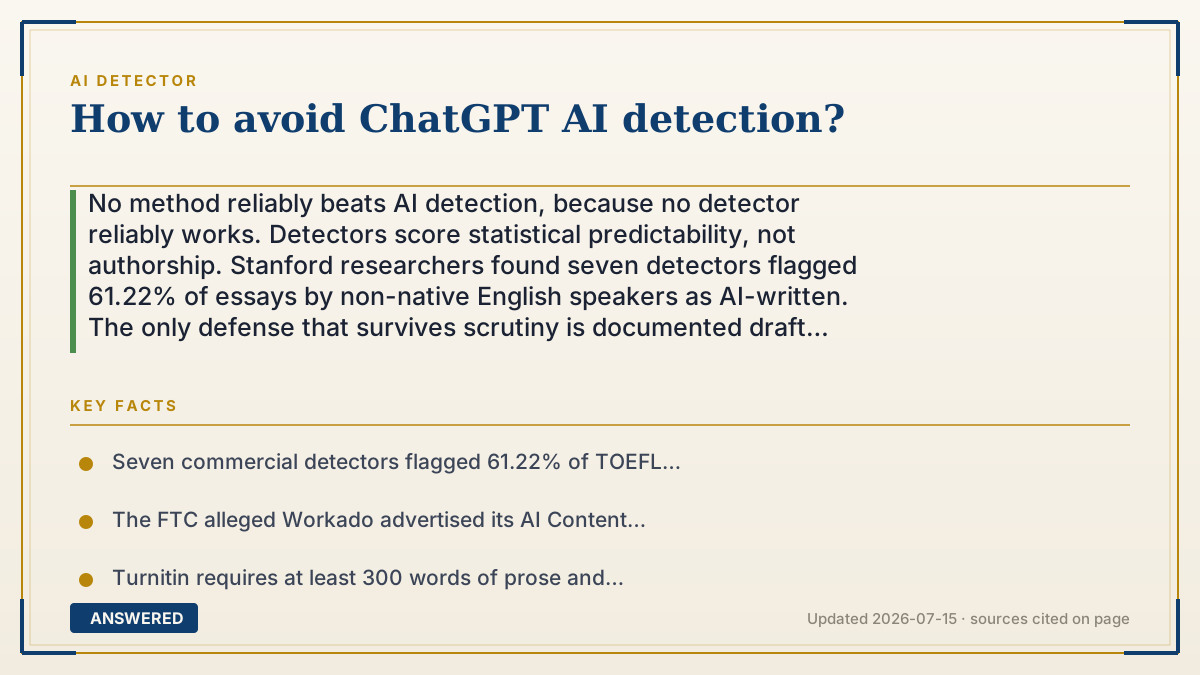
No method reliably beats AI detection, because no detector reliably works. Detectors score statistical predictability, not authorship. Stanford researchers found seven detectors flagged 61.22% of essays by non-native English speakers as AI-written. The only defense that survives scrutiny is documented draft history, not clever rewording.
Why — the first-principles explanation
A language model writes by repeatedly picking a likely next word. Detectors try to run that backward: they measure perplexity (how surprising each word is, given the words before it) and burstiness (how much sentence length and complexity vary). Text where every word is the expected one, in sentences of similar rhythm, scores as machine-made. That is the entire mechanism. It never sees who typed the words — it only sees how predictable the finished text is.
This is why evasion advice and false accusations are the same problem wearing two hats. Anything that flattens your writing — a plain book report, a lab procedure, a five-paragraph essay template, or simply writing in your second language — pushes perplexity down and the AI score up. Stanford's team found detectors performed near-perfectly on essays by U.S.-born eighth graders while flagging most TOEFL essays as AI. The detector was not fooled by cheaters; it was fooled by ordinary careful writing.
The reverse also holds, which is why "humanizers" exist at all. Injecting odd word choices and uneven sentences raises perplexity and lowers the score. The same Stanford paper showed that simply asking the model to rewrite text "employing literary language" was enough to slip past the detectors they tested. Vendors then retrain on the humanizer output, the humanizers adjust, and the cycle repeats. Nobody wins permanently, because the signal being measured was always a proxy.
So the durable answer is to stop competing on style and compete on provenance. A stylometric score is a guess about text. A timestamped revision history is a record of a process. If your document shows 90 minutes of typing, deletions, and reordering, that is evidence. If it shows one paste of 900 finished words at 11:52 p.m., no amount of rewording fixes what that looks like.
An example that makes it click
You know the game where someone says half a phrase and you shout the rest? "Peanut butter and ___." AI text is an entire essay of "jelly" — the expected word, every single time, for 800 words straight. An AI detector is just a machine playing that game against your paper and counting how often it guessed right.
Now picture a student who learned English three years ago writing a careful, plain summary of a novel. She also picks the safe, expected word almost every time — because that is what careful writers in a second language do. The machine guesses right on her paper too, and yells "AI." It never saw her typing. It only ever heard "jelly."
How to do it
- Write somewhere that records history: Google Docs, Word on the web, or Grammarly Authorship. Turn it on before the first sentence, not after you get flagged.
- Compose in the document itself. Even for your own words, pasting 800 finished characters in one action looks identical to AI in draft-tracking tools like NoRedInk's Originality Insights.
- Keep the outline, notes, and source links in the same file's history so the trail starts before the prose does.
- If you use AI for brainstorming, outlining, or grammar, check the course policy in writing and disclose it the way the policy says. Permitted-and-cited beats undetected.
- If you are flagged, ask for three things: the exact percentage, the document word count, and the highlighted passages. Turnitin marks any score from 0 to 20% with an asterisk because false positives are more common there, and it needs 300+ words to report at all.
- Bring your revision history to the meeting. Turnitin's own guidance says its score must not be the sole basis for action against a student.
Key facts
- Seven commercial detectors flagged 61.22% of TOEFL essays by non-native English speakers as AI-generated; 19% were flagged by all seven, while essays by U.S.-born eighth graders were classified near-perfectly (Liang et al., Patterns, 2023).
- The FTC alleged Workado advertised its AI Content Detector as 98% accurate when independent testing showed roughly 53% accuracy on general-purpose content; complaint filed April 2025, final order approved August 2025.
- Turnitin requires at least 300 words of prose and displays an asterisk on any AI score between 0 and 20% because that range has more false positives.
- Vanderbilt University disabled Turnitin's AI detector on August 16, 2023, calculating that a 1% false positive rate against its 75,000 papers submitted in 2022 would mean roughly 750 wrongly flagged papers.
- The Stanford study found that prompting a model to rewrite text with more literary language was enough to evade the detectors tested — the same edit a nervous human might make by hand.
▶ The 60-second explainer (script)
There is no reliable way to beat AI detection, and here is the uncomfortable reason: there is no reliable AI detector to beat. Detectors don't know who wrote your paper. They measure one thing — how predictable your word choices are. AI picks the expected word every time. So the machine flags predictable text. The problem is that careful, plain, human writing is also predictable. Stanford researchers tested seven detectors and found they flagged sixty-one percent of essays by non-native English speakers as AI-written, while scoring American eighth graders near-perfectly. Nineteen percent got flagged by all seven at once. The FTC went after one detector company that advertised ninety-eight percent accuracy when real-world testing showed about fifty-three. Vanderbilt just switched theirs off — at a one percent error rate, their annual paper volume meant seven hundred and fifty innocent students. So stop optimizing your sentences. Optimize your evidence. Write in Google Docs or Word online with version history running. Don't paste finished text, even your own. Keep your outline in the same file. If you get flagged, ask for the score, the word count, and the highlights — Turnitin itself puts an asterisk on anything under twenty percent and says the number can't be the only basis for punishing you. A score is a guess. A revision history is a record. Bring the record.
What authoritative sources say
People also ask
Do AI humanizer tools actually work?
Sometimes, temporarily. They raise perplexity by swapping in less predictable words and uneven sentences, which is the exact signal detectors measure. Vendors retrain against popular humanizers, so any given tool's success rate drifts, and heavily reworded text often reads worse to a human grader than the original did.
Does running ChatGPT text through a paraphraser make it undetectable?
No, and it can make things worse. Turnitin reports AI-generated text that was later AI-paraphrased as its own separate category, highlighted in a different color from plain AI text. Paraphrasing changes what the report says about you, not whether it says something.
I wrote it myself and got flagged. What do I do?
Ask for the score, word count, and highlighted passages, then show your revision history from Google Docs or Word. Turnitin's own documentation says the score can't be the only basis for action, and Vanderbilt disabled the tool entirely over false positives.
Why do non-native English speakers get flagged so much more?
Detectors score writing sophistication as a proxy for humanness. Second-language writers naturally use narrower vocabulary and simpler syntax, which reads as low perplexity — the same signature AI produces. Stanford measured this at 61.22% of TOEFL essays versus near-zero for U.S.-born eighth graders.
Can a teacher tell I used AI without a detector?
Often, yes — through things a detector can't see: work that doesn't match your prior writing, invented citations, or the inability to explain your own argument in person. That's also why draft history helps you more than rewording does.