How does Turnitin detect AI?
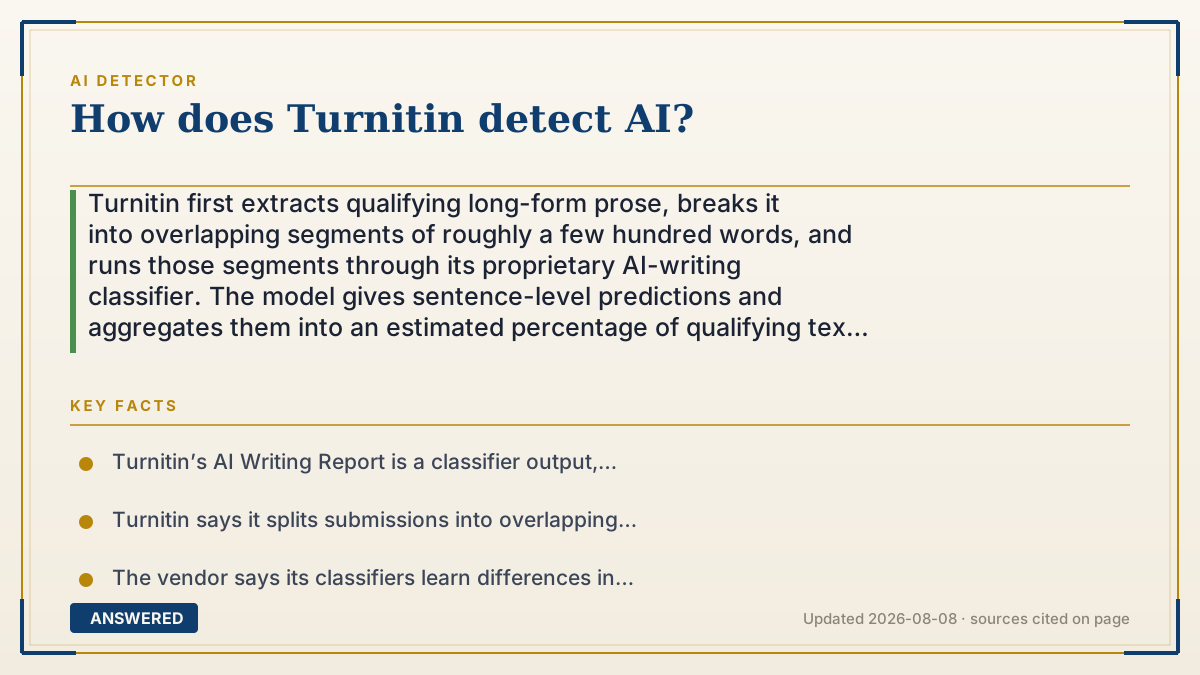
Turnitin first extracts qualifying long-form prose, breaks it into overlapping segments of roughly a few hundred words, and runs those segments through its proprietary AI-writing classifier. The model gives sentence-level predictions and aggregates them into an estimated percentage of qualifying text that may be AI-generated or AI-altered. This is independent of the Similarity score: it does not find a source match. Scores can be wrong and Turnitin says they must not be the sole basis for action against a student.
Why — the first-principles explanation
Turnitin runs two different kinds of analysis that people often confuse. The Similarity score compares text with Turnitin’s content collection and reports matching text. The AI writing percentage is a classifier prediction about writing patterns. Turnitin says the two scores are completely independent, so an AI highlight does not come with a source page and a low similarity score does not prove the writing is human.
The AI pipeline begins with eligibility. Turnitin processes qualifying prose in a long-form format rather than every character in the file. Current requirements include supported file types and languages, a file below the stated size limit, and 300 to 30,000 words of prose. Poetry, scripts, code, bullet lists, tables and annotated bibliographies are examples Turnitin says its model does not reliably detect. The displayed percentage is therefore a percentage of qualifying text, not necessarily the whole submission.
For a qualifying paper, Turnitin says it breaks the text into overlapping segments of roughly a few hundred words—about five to ten sentences—so each sentence appears with context. The segments go through its AI-detection model. Turnitin describes sentence scores on a continuum from human-like to AI-like, then says it averages segment-level results to estimate how much qualifying text may have been generated by AI.
What signal is the model looking for? Turnitin’s public FAQ says its classifiers are trained to distinguish word-probability sequences typical of AI-generated text from the more inconsistent and idiosyncratic sequences in human writing. That is more precise than saying it “just checks perplexity,” but it is not a complete public specification of every feature, threshold or training detail. The detector is a learned classifier, not a transparent formula that an outsider can reproduce from the report.
Turnitin says the detector is based on an open-source foundation model available from Hugging Face, then retrained, evaluated and fine-tuned with its own curated data. Its training description includes both AI-generated and authentic academic writing across geographies, subjects and underrepresented groups. The model and the AI systems it targets change over time, so the same document can receive a different result if it is resubmitted after an update; an old report is not silently recalculated.
The report applies presentation safeguards after classification. When the predicted AI amount is above the reporting threshold, instructors can see a percentage and highlighted qualifying text. For results above 0% but below 20%, Turnitin shows an asterisk rather than an exact percentage or highlights because it says false positives are more likely in that range. A gray or error state can mean the file was ineligible, unsupported, old or failed to process—not that the paper was proven human-written.
For English submissions, current Turnitin documentation also describes detection of likely AI-generated text that may have been altered by paraphrasers or bypasser tools. These are still probabilistic classifications. Product updates can change model coverage and how categories or highlight colors appear, so interpret the current report and release notes rather than assuming an old screenshot maps to the latest model.
The final step is human, not algorithmic. Turnitin explicitly says the model can misidentify human, AI-generated and AI-altered text and should not be the sole basis for adverse action. A fair review looks at the highlighted passage, assignment instructions, drafts, notes, version history, citations, the student’s explanation and institutional policy. The score can open a conversation; it cannot establish intent, authorship or misconduct by itself.
An example that makes it click
Suppose a 1,000-word file contains 800 words of long-form prose and 200 words of tables, bullets and references. Turnitin may analyze only the 800 qualifying words. If its model predicts that 240 of those qualifying words are likely AI-generated, the report could show 30%—not 24% of the entire file. This is a simplified illustration of the denominator, not a way to reproduce Turnitin’s proprietary scoring.
How to do it
- Check whether the institution licenses and enables AI writing detection. A Similarity Report can exist without an AI Writing Report.
- Validate the file: current Turnitin guidance requires an accepted type, less than 100 MB, 300–30,000 words of long-form prose and a supported language.
- Turnitin identifies qualifying prose and excludes or treats as unreliable non-prose formats such as code, poetry, scripts, bullets, tables and annotated bibliographies.
- The service divides qualifying text into overlapping segments of roughly a few hundred words, about five to ten sentences, so sentences are evaluated with surrounding context.
- Its trained classifier scores sentences or segment content along a human-to-AI likelihood continuum using learned word-probability patterns and other proprietary model behavior.
- Turnitin aggregates the segment predictions into an estimated percentage of qualifying text likely generated by AI or, where supported, likely altered by AI paraphrasing or bypasser tools.
- The report applies display rules: an exact score and highlights for reportable results, an asterisk for results above 0% but below 20%, and gray/error states for ineligible or failed processing.
- Keep the AI percentage separate from the Similarity score. Similarity reports matching text; AI detection predicts a writing category and does not produce a source match.
- Review the highlighted context with drafts, notes, version history, citations, assignment rules and the student’s account. Do not infer intent or misconduct from the percentage alone.
- Record the report date and model context. If a document is resubmitted after Turnitin updates its detector, the score may change; previous reports are not automatically rescored.
Key facts
- Turnitin’s AI Writing Report is a classifier output, while its Similarity score is a matching-text comparison; Turnitin says the two are independent.
- Turnitin says it splits submissions into overlapping segments of roughly a few hundred words, or about five to ten sentences, before generating sentence and document-level predictions.
- The vendor says its classifiers learn differences in word-probability sequences between AI-generated and human academic writing; it does not publish a fully reproducible scoring formula.
- Turnitin says its detector is based on an open-source foundation model from Hugging Face and is retrained and fine-tuned with proprietary, curated academic-writing data.
- The AI percentage uses qualifying long-form prose as its denominator, so it may not equal the fraction of the entire uploaded file that is highlighted or considered.
- Current file guidance requires less than 100 MB, 300–30,000 words of prose, a supported language and an accepted file type such as DOCX, PDF, TXT or RTF.
- Turnitin says its detector does not reliably process non-prose formats such as poetry, scripts, code, bullet points, tables and annotated bibliographies.
- Results above 0% but below 20% are displayed as *% without an exact percentage or highlights because Turnitin says that range has a higher incidence of false positives.
- Turnitin’s stated false-positive target is a vendor-reported metric for defined document conditions; it is not a guarantee that a particular highlighted passage or student was correctly classified.
- The detector and target-model coverage are updated over time. A stored report changes only if the document is resubmitted and processed again.
- English detection can include likely AI-generated text modified by paraphrasing or bypasser tools; language and feature coverage differ and can change.
- Turnitin says its AI result should not be the sole basis for adverse action and that the instructor or institution—not the model—decides whether misconduct occurred.
Interpret the pipeline before you act on the score
The AI percentage is a model prediction about qualifying prose, not a database match or a misconduct verdict. Check eligibility, version, highlighted context, drafts and institutional policy before making a consequential decision.
▶ The 60-second explainer (script)
How does Turnitin detect AI? It does not search a database for a matching ChatGPT answer. First it checks whether the file contains enough supported long-form prose. Then it breaks that prose into overlapping segments of a few hundred words—about five to ten sentences—so each sentence has context. Turnitin says its trained classifier looks for differences in word-probability sequences between AI-generated and human academic writing, gives sentence-level predictions and aggregates them into the percentage of qualifying text likely generated or altered by AI. That percentage is independent of the Similarity score and may not use the entire file as its denominator. Results above zero but below twenty percent appear as an asterisk without an exact score or highlights because false positives are more common there. Models and report presentation change, and resubmitting after an update can change a score. Most important: Turnitin says the result can be wrong and must not be the sole basis for action. Review drafts, version history, sources, context and policy with the student.
What authoritative sources say
People also ask
Does Turnitin compare AI writing with a database?
No. Database matching produces the separate Similarity score. AI writing detection runs a classifier over qualifying prose and predicts which text may be AI-generated or AI-altered.
Does Turnitin just measure perplexity?
Turnitin publicly says its classifiers learn differences in word-probability sequences, but it does not describe the current product as one transparent perplexity formula. The model, thresholds and proprietary training are more complex than that shortcut.
What does the Turnitin AI percentage mean?
It is the estimated share of qualifying long-form prose the model predicts may be AI-generated or, where supported, AI-altered. It is not necessarily a percentage of every word in the uploaded file.
Why does Turnitin show *% instead of a number?
For results above 0% but below 20%, Turnitin suppresses the exact percentage and highlights because it says false positives are more likely in that range. The asterisk is not a misconduct finding.
Can Turnitin detect AI in a short response?
Its current AI Writing Report requires at least 300 words of qualifying long-form prose. Bullets, tables, code, poetry, scripts and other non-prose formats are not reliably handled.
Can Turnitin detect paraphrased or humanized AI text?
Turnitin documents paraphraser and bypasser detection for supported English submissions, but these remain probabilistic predictions and do not prove which tool or workflow a writer used.
Which languages can Turnitin check for AI writing?
Turnitin currently documents long-form English, Spanish and Japanese support. Paraphrasing and bypasser capabilities are described as English-only, and current coverage should be rechecked before relying on it.
Can the same paper get a different AI score later?
Yes, if it is resubmitted after the detector changes. Turnitin says existing reports are not retroactively recalculated, but a new processing run can produce a different score.
Does a Turnitin AI score prove cheating?
No. Turnitin says the result can misidentify text and must not be the sole basis for adverse action. Intent and policy compliance require contextual human review.
What evidence should be reviewed with a Turnitin score?
Review the highlighted passages, prompt, drafts, notes, version history, source trail, citation quality, prior work, the student’s explanation and the institution’s published AI policy.
The same question, asked other ways
- How does Turnitin detect AI writing?