Is ChatGPT safe for students?
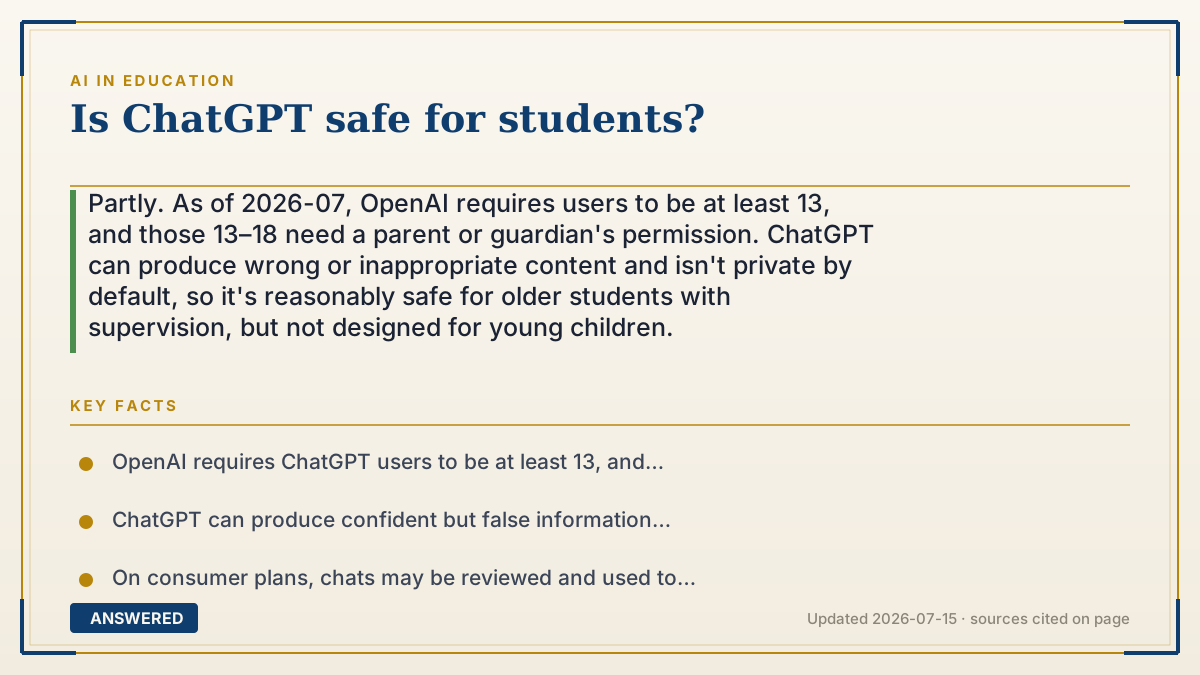
Partly. As of 2026-07, OpenAI requires users to be at least 13, and those 13–18 need a parent or guardian's permission. ChatGPT can produce wrong or inappropriate content and isn't private by default, so it's reasonably safe for older students with supervision, but not designed for young children.
Why — the first-principles explanation
"Safe" for students has three separate meanings: age-appropriate, accurate, and private. ChatGPT is built for adults and teens, not kids. OpenAI's terms require users to be at least 13, and users under 18 must have a parent or guardian's permission. That rule exists because a general-purpose model can surface mature or unsettling content, and because child-privacy laws (like COPPA in the U.S.) restrict data collection from young children.
On accuracy, ChatGPT is not a fact machine. It generates text by predicting likely words, so it can produce confident, wrong answers (hallucinations). A student who can't yet judge a subject may absorb errors, which is why it should be treated as a study partner to double-check, not an authority. OpenAI has added teen safety settings and parental controls, but no filter is perfect.
On privacy, the default is not private. On consumer plans, conversations can be reviewed and, unless you opt out, used to improve models, so students shouldn't paste full names, addresses, ID numbers, or other personal details. Schools that want stronger protection use accounts built for education, where by default the data isn't used to train models. Bottom line: with the right account, an age-appropriate student, adult supervision, and good habits about facts and personal info, it's reasonably safe; used unsupervised by a young child, it isn't.
An example that makes it click
Think of ChatGPT like the public library's help desk staffed by a very well-read stranger. For a 16-year-old, that's useful: you can ask questions and get pointed in a direction, as long as you double-check the big claims and don't hand over your home address. But you wouldn't drop off a 7-year-old alone at that desk for the afternoon, because the stranger doesn't know which questions or answers are appropriate for a small child.
That's why there's an age gate at 13, a permission rule under 18, and a simple habit for everyone: verify important facts and keep your personal details to yourself.
How to do it
- Confirm age eligibility: users must be 13+, and 13–18 need a parent or guardian's permission.
- For younger students, use only under direct adult supervision or with school-approved, education-specific accounts.
- Turn on available teen safety settings and parental controls.
- Teach the fact-check habit: verify important answers against a trusted source, since AI can be confidently wrong.
- Protect privacy: never paste full names, addresses, ID numbers, or passwords.
- Prefer education or teacher accounts where data isn't used to train models by default.
Key facts
- OpenAI requires ChatGPT users to be at least 13, and users under 18 must have parental or guardian permission (as of 2026-07).
- ChatGPT can produce confident but false information (hallucinations), so answers need verification.
- On consumer plans, chats may be reviewed and used to improve models unless the user opts out.
- OpenAI has added teen safety settings and parental controls, but no content filter is perfect.
- Education-focused accounts do not use shared data to train models by default.
Choosing an AI tool for study?
The answer above explains the concept; this next step helps you choose by job, limits and current terms.
▶ The 60-second explainer (script)
Is ChatGPT safe for students? Partly, and it depends on age and habits. First, the age rule. OpenAI requires users to be at least 13, and anyone under 18 needs a parent or guardian's permission. It's built for teens and adults, not young kids. Second, accuracy. ChatGPT generates text by predicting likely words, so it can be confidently wrong. Students should treat it as a study partner to double-check, never as the final authority. Third, privacy. On regular plans, chats can be reviewed and used to improve the model unless you opt out, so never paste your full name, address, ID numbers, or passwords. OpenAI has added teen safety settings and parental controls, and schools can use education accounts where your data isn't used for training by default. Bottom line: with an age-appropriate student, some supervision, fact-checking, and privacy sense, it's reasonably safe. Left unsupervised with a young child, it isn't.
What authoritative sources say
People also ask
How old do you have to be to use ChatGPT?
At least 13, and users under 18 must have a parent or guardian's permission, per OpenAI's terms as of 2026-07.
Can young kids use ChatGPT safely?
It's not designed for children under 13. Younger use should only happen with adult supervision or via school-approved tools.
Is my data private on ChatGPT?
Not by default on consumer plans. Chats can be reviewed and used for training unless you opt out; education accounts don't train on your data by default.
Can ChatGPT give students wrong answers?
Yes. It predicts likely words and can be confidently wrong, so important answers should be verified.
The same question, asked other ways
- Can AI chatbots be harmful to students?